
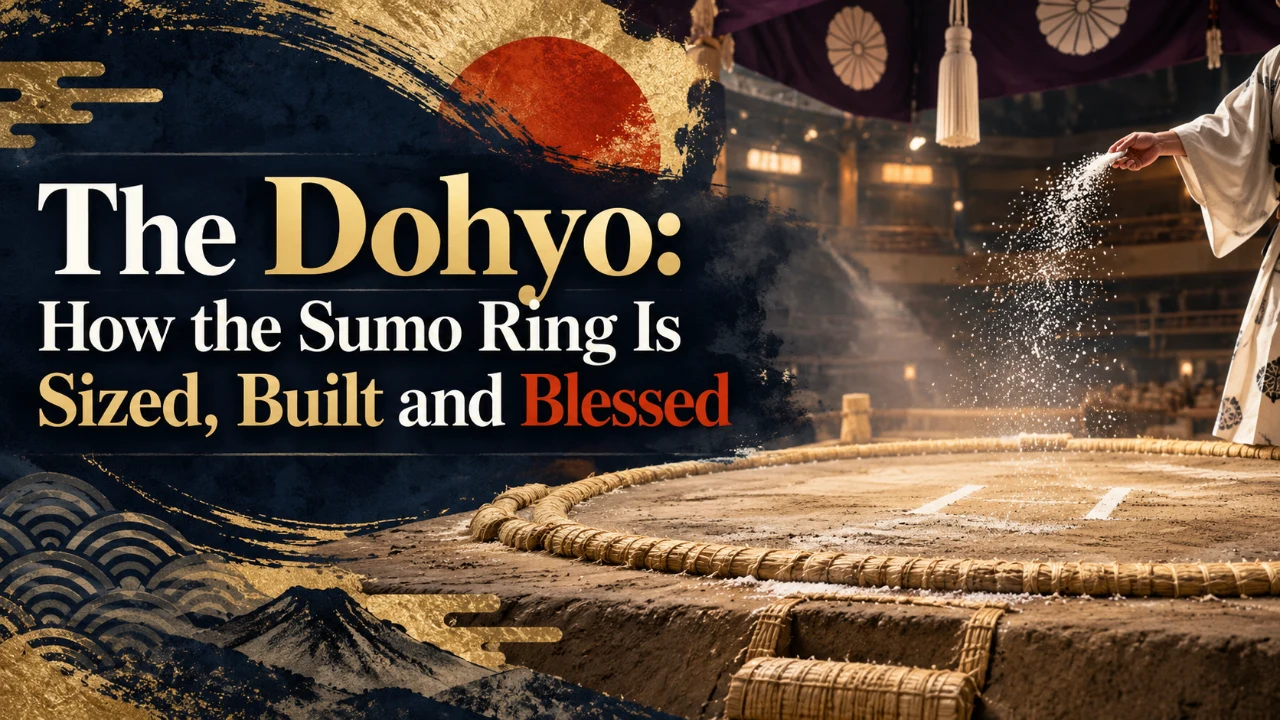
The dohyo ring is the raised square of packed clay that the ring sumo wrestlers fight in, with a circle of straw bales set into its top. The word is written with two characters, do for earth and hyo for straw bale, and that is exactly what it is made of. It is also easy to overlook, because the eye follows the wrestlers, not the floor. Yet the floor has a written specification, a fixed number of bales, a supply of clay from one particular city, a crew that rebuilds it by hand before every tournament and a Shinto ceremony that buries offerings in its centre. This guide covers all of it: the size and why it is 4.55 metres, the 66 bales and what each one is for, the clay, the people who build it, what is buried inside, and the roof and tassels above it.
📖 What you’ll learn
- The exact size of a sumo ring, and the 1931 change that fixed the circle at 4.55 metres
- Why a ring uses 66 straw bales when only 20 of them form the circle
- How much the ring weighs, where the clay comes from, and how Tokyo and the regional tournaments rebuild it differently
- What the Dohyo Matsuri buries in the centre of the ring, and when visitors can watch it for free
What Is a Dohyo? The Sumo Ring at a Glance
A dohyo is a flat-topped mound of clay, 6.70 metres square, with a circle of bales 4.55 metres across set into its surface. Every professional bout is fought inside that circle, from the six annual tournaments to the regional tours.
The dohyo is not a mat and not a stage. It is built from clay, pounded hard by hand before every tournament. The wrestlers fight barefoot on it. The circle is compact: two heavyweights meeting in the middle have little more than two metres of clay behind each of them.
If you are new to the sport as a whole, start with our guide to what sumo is. The table below gives the numbers for the ring itself, taken from the Japan Sumo Association’s explanations of its own regulations.
| Part | Figure | Note |
|---|---|---|
| Height of the mound | 34–60 cm | Tournament rings only; practice rings are flat |
| Side of the square | 6.70 m | Each side of the square mound |
| Diameter of the circle | 4.55 m (15 shaku) | Fixed in April 1931 |
| Bales in the circle | 20 | 66 bales in the whole ring |
| Starting lines | 6 cm wide, 90 cm long, 70 cm apart | White enamel paint |
| Total weight | About 45 tonnes | Figure given by the Japan Sumo Association |
Q. How big is a sumo ring?
A. The circle is 4.55 metres across, about 14 ft 11 in. It sits on a clay mound 6.70 metres square (about 22 ft) and 34 to 60 centimetres high (about 13 to 24 in). Those are the Japan Sumo Association’s figures for a tournament ring.
Dohyo Size: The Rule Behind 4.55 Meters
The size is written into the first article of the dohyo regulations, part of sumo’s rulebook, and has been fixed at 4.55 metres since 1931. The regulations run to 11 articles in total. Article one is the one that defines the ring.
According to the Japan Sumo Association, that article sets out two kinds of ring. A ring for public bouts is a flat-topped mound with sloping sides (a truncated pyramid), between 34 and 60 centimetres high and 6.70 metres along each side. A circle 4.55 metres across is laid inside it with small straw bales. A ring used for practice is simpler: the bales are buried flat in level ground, in a circle of the same 4.55 metres. That is why the rings in the stables look like a circle set into the floor rather than a platform.
The circle was not always this size. The Association’s history records that in April 1931 the diameter was widened from 13 shaku, about 3.94 metres, to 15 shaku, the present 4.55 metres. The same reform ended the double ring. Until then the ring had been marked by two concentric circles of bales; from 1931 there has been only one.
Sixty centimetres of extra width sounds small. On a ring this size it is not: it adds about 30 centimetres of clay behind each wrestler at the start of a bout.
One detail about the circle matters for anyone watching closely. The boundary is the outer line of the bales, not the inner one. A heel standing on top of a bale is still in. How that plays out in a close finish, and what the judges do about it, is covered in our guide to sumo rules.
Q. Is a practice ring the same size as a tournament ring?
A. The circle is the same, 4.55 metres across, but there is no mound. Article one of the dohyo regulations requires the raised mound only for public bouts. In a stable, the bales are buried flat in level ground, so visitors to a morning practice see the circle at floor height.
The 66 Straw Bales and What Each One Does
A tournament ring uses 66 small straw bales, but only 20 of them form the fighting circle; the rest frame the square and hold water. Each bale is a straw tube packed with clay and set into the surface of the mound.
The Japan Sumo Association lists the full set by name. The table below follows its count.
| Bale | Number | Where it sits | What it does |
|---|---|---|---|
| Shobu-dawara | 16 | The fighting circle | Marks the edge of the bout area |
| Tokudawara | 4 | In the circle, midway along each side | Set slightly outward, leaving a little extra room |
| Kaku-dawara | 28 | The straight sides of the square | Frames the top of the mound |
| Age-dawara | 4 | The four corners, laid diagonally | Closes each corner of the square |
| Fumi-dawara | 10 | Set into the sloping sides | Steps for climbing onto the ring |
| Mizuoke-dawara | 4 | Beside the ring | Stands for the water buckets |
| Total | 66 | Every bale is packed with clay, not sand or straw | |
The circle is built as four identical quarters. Each quarter holds four ordinary bales, and a single tokudawara sits between one quarter and the next. That gives the Association’s figure of 20: four tokudawara and four bales in each gap between them.
The tokudawara are the odd ones. They are not in line with the rest of the circle. Each is shifted outward by roughly the width of one bale, which gives a wrestler pushed back at one of those four points a few extra centimetres. The Association says the gap is thought to have begun as drainage: when sumo was held outdoors, part of the ring was opened so that rainwater could run off. The gap outlived the rain. It remains in every indoor ring today.
At the corners of the square, one age-dawara is laid across each angle on the diagonal. The straight runs between them are kaku-dawara. Neither has anything to do with the result of a bout; they give the mound its clean edge.
In the middle of the circle are the two white starting lines, the shikiri-sen. The Association gives them as 6 centimetres wide and 90 centimetres long, painted in white enamel, with 70 centimetres between them. A wrestler may not set his fists down in front of his own line at the start.
Q. Is a wrestler standing on the straw bale in or out?
A. In. The Japan Sumo Association defines the boundary as the outer line of the circle bales, so a foot on top of a bale has not left the ring. It is out only once it touches the clay beyond them. Our guide to sumo rules covers how close finishes are judged.
What the Dohyo Is Made Of: Clay from Kawagoe
The ring is built from arakida-tsuchi, a sticky clay-rich soil now dug in Kawagoe, Saitama, and a finished tournament ring weighs about 45 tonnes. The name records where the soil first came from. A document from the Kanto regional bureau of Japan’s Ministry of Land, Infrastructure, Transport and Tourism explains that sumo once used earth from Arakidahara, in what is now Arakawa ward in Tokyo. When that source could no longer be dug, the supply moved. The document states that rings are now built with arakida-tsuchi taken from Kawagoe in Saitama prefecture.
How much of that 45 tonnes is replaced each time depends on where the tournament is held. The Japan Sumo Association sets out three different cases.
| Where | What happens to the old ring | New clay |
|---|---|---|
| Tokyo (January, May, September) | The base from the last Tokyo tournament is kept. About 20 cm is shaved off the surface, then rebuilt on top | About 8 tonnes |
| Regional tournaments (Osaka, Nagoya, Fukuoka) | Removed completely after every tournament, so each one starts from the base up | The whole ring |
| Regional tours (jungyo) | A simple base is prepared at each venue | About 8 tonnes |
In Tokyo the ring stays in the Ryogoku Kokugikan between tournaments. At the other three venues, the next ring begins from nothing. If you plan to see the ring in person, our guide to the Ryogoku Kokugikan covers the building and how to get there.
Q. What is a sumo ring made of?
A. Pounded clay. The soil is arakida-tsuchi, now taken from Kawagoe in Saitama, and even the straw bales are filled with earth rather than sand or straw. A finished tournament ring weighs about 45 tonnes, roughly 50 US tons; a Tokyo rebuild replaces only about 8 tonnes of it.
Who Builds the Sumo Wrestler’s Ring
The sumo wrestler’s ring is built by the yobidashi, sumo’s ring attendants, about 45 of them working by hand for roughly three days. No machinery is used. The job is called dohyo-tsuki, and it happens before every one of the six annual tournaments.
A profile published by the Japanese craft company Nakagawa Masashichi describes the work. Around 45 yobidashi take part, and the build takes about three days. The clay is beaten down with a large wooden tamper, and the bales are filled, laid and pounded into place.
The tools are simple, and some are not what you would expect. Beer bottles are among them. The circle is drawn with a large nail tied to a length of rope, used as a compass from the centre point.
The same people build far more than six rings a year. In an interview with Bunshun Online, the yobidashi Katsuyuki explained that the training rings of all 45 sumo stables are also built by yobidashi, and they are finished before the day each new ranking list is released. Tours add more. A separate team goes ahead of the wrestlers to build a ring at each stop.
That is one reason the yobidashi matter more than their place on the broadcast suggests. They sing out the wrestlers’ names, sweep the clay and carry the prize banners, and our guide to the officials of sumo covers that side of the job. The ring itself, though, is their work before anyone else’s. For what a stable ring looks like in daily use, see our guide to sumo stables.
Q. How long does it take to build a sumo ring?
A. About three days for a tournament ring, built by around 45 yobidashi without machines. Regional tours work on a different clock: a separate team of yobidashi travels ahead of the wrestlers and has a ring ready at each stop before they arrive.
What Is Buried in the Ring: Dohyo Matsuri and Kami-okuri
Offerings are buried in a small hole at the centre of the ring at the Dohyo Matsuri, held the day before each tournament. The offerings stay in the clay for the whole tournament.
The Japan Sumo Association describes what goes into the hole. A pit about 15 centimetres square is dug in the middle of the ring. Six items are placed inside: dried chestnuts, washed rice, kelp, dried squid, salt and the nuts of the kaya tree. They sit in small unglazed earthenware dishes, wrapped in thick hosho paper, and sacred sake is poured over them before the hole is closed. The items are ones associated with good fortune. The whole package is called the shizume-mono, roughly “the offerings that settle the ground”.
The ceremony is led by one of the two tate-gyoji, the most senior referees, who acts as the officiating priest. It takes place in the morning, and the Association has announced it as open to the public.
The Association’s notice for the September 2026 tournament shows what attending looked like in practice. The ceremony was held at the Ryogoku Kokugikan on Saturday 12 September 2026, the day before opening day. Entry ran from 9:20 to 9:50 in the morning, admission was free, and seats were first come, first served. That notice also stated that no wrestlers would attend. Attendance by wrestlers has varied: an earlier English-language notice from the Association listed wrestlers ranked sanyaku and above among those present. Check the notice for the tournament you plan to visit, and see our sumo schedule for the dates.
The ring is released again at the end. On the final day, after the last bout, a short rite called kami-okuri, “sending off the gods”, closes the tournament. A gyoji holding a sacred wand is tossed into the air. The Association’s official account notes that once the kami-okuri is over, the offerings buried at the Dohyo Matsuri are dug back up.
Q. Can visitors watch the Dohyo Matsuri?
A. Yes, when the Association opens it to the public. It is held on the morning before each tournament opens and has been free to enter on a first-come basis. For the September 2026 tournament, entry at the Kokugikan ran from 9:20 to 9:50 on 12 September. Conditions are set for each tournament, so check the Association’s notice first.
The Hanging Roof, the Four Tassels and Who May Step Up
The roof above a tournament ring has hung from the ceiling since September 1952, when the four pillars that held it were removed. Four large tassels hang from its corners instead.
Before 1952 the roof stood on four posts, one at each corner of the mound. The Association’s history records the change in a single line: the four pillars were abolished, a suspended roof took their place, and tassels in four colours were hung from it. The Kotobank reference dictionary describes the four colours as standing for the four seasons, spring, summer, autumn and winter.
The roof and tassels frame the ring for the yokozuna’s ring-entering ceremony, which is the one moment in a tournament day when the whole structure is the focus.
Who may climb onto the ring has also been a matter of public statement. The Japan Sumo Association does not allow women onto the dohyo. On 28 April 2018 its chairman issued a statement on the question. The statement said emergencies and urgent situations are an exception. It set out three reasons that past chairmen had given for the tradition. First, sumo has its origins in Shinto ritual. Second, the Association sees itself as preserving a traditional culture. Third, the ring is a sacred place for fighting and for training. The statement also addressed a widely repeated explanation, that women are kept off because they are regarded as impure, and called that interpretation a misunderstanding.
Q. Are women allowed on the sumo ring?
A. Not under the Japan Sumo Association’s tradition. Its chairman’s statement of 28 April 2018 said emergencies are an exception, cited the ring’s Shinto origins, traditional culture and its status as a sacred place of competition, and called the idea that women are excluded as impure a misunderstanding.
Summary
A dohyo is a hand-built clay ring with a written size, a fixed set of bales and a ceremony at each end of its life. The points to take away:
- The size is in the rulebook. Article one of the dohyo regulations sets a flat-topped mound 34 to 60 cm high and 6.70 m square, with a circle 4.55 m across. The circle has been that size since April 1931.
- 66 bales, 20 in the circle. Four tokudawara are set outward, a gap said to have started as drainage for rain. The boundary is the outer line of the bales.
- About 45 tonnes of Kawagoe clay. Tokyo keeps its base and shaves about 20 cm off the surface; the regional tournaments remove the ring completely each time.
- Built by hand. About 45 yobidashi take roughly three days, without machines, and they also build the practice rings of every stable.
- Blessed and released. Offerings go into a 15 cm hole at the Dohyo Matsuri the day before opening, and come out again after the kami-okuri on the final day.
- A roof without pillars. The posts went in 1952; the four tassels stand for the four seasons.
Related guides: What is sumo? · Sumo rules · How to buy sumo tickets · The mawashi, explained · The officials of sumo
Sources
- Japan Sumo Association explanatory pages — the dohyo regulations and ring size, the 20 bales of the circle, the 66 bales, the tokudawara, the age-dawara, the starting lines, the ring’s weight and rebuilding and the offerings, read September 25, 2026
- Japan Sumo Association — history of the Association (1931 and 1952 changes)
- Japan Sumo Association — Dohyo Matsuri notice for the September 2026 tournament and earlier English-language Dohyo Matsuri notice
- Japan Sumo Association — chairman’s statement of April 28, 2018
- Japan Sumo Association official X account — post on the kami-okuri
- Ministry of Land, Infrastructure, Transport and Tourism, Kanto Regional Development Bureau — document on arakida-tsuchi
- Kotobank — dohyo
- Nakagawa Masashichi — profile of dohyo-tsuki; Bunshun Online — interview with the yobidashi Katsuyuki