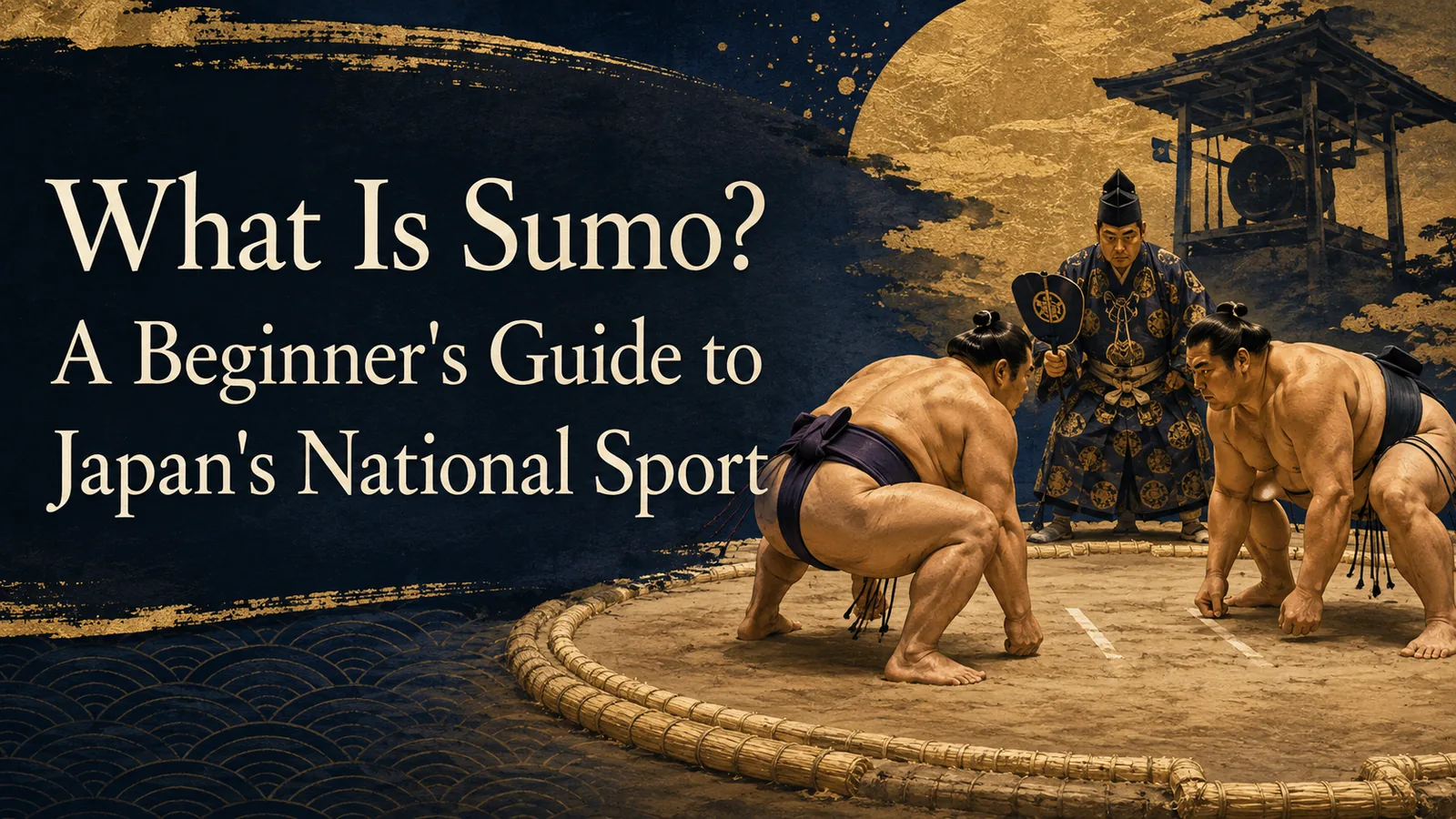
Sumo is Japan’s professional wrestling tradition, and the rule that decides it is simpler than it looks. Two athletes meet inside a clay ring. The first one to step outside the ring, or to touch the clay with anything other than the soles of his feet, loses. Most bouts are over in seconds. Almost everything else you see — the ranking sheet, the salt, the long stare-down — exists to organize those seconds. This guide explains what sumo is, how a bout is decided, how the ranking works, and when you can watch it.
📖 What you’ll learn
- The two ways a sumo bout is won, and the fouls that end one early
- Why the wrestlers stand up and crouch again before they charge
- How the ranking sheet works, and why yokozuna is not a championship belt
- The 2026 and 2027 tournament calendar, from the Japan Sumo Association
What Is Sumo?
Sumo is Japan’s professional form of wrestling, run by the Japan Sumo Association. Two rikishi (wrestlers) face each other on a raised clay ring and try to force the opponent out of it, or down onto it. Six tournaments are held each year, each lasting 15 days, and every wrestler’s rank rises or falls on the results.
The sport began as religion rather than entertainment. The first matches were performed as ritual offerings, with prayers for a good harvest, inside shrine grounds and alongside sacred dance. During the Nara period in the 8th century, sumo entered the ceremonies of the Imperial Court. According to the Japan Sumo Association, the sport dates back some 1,500 years.
Professional sumo as a paying spectacle is much younger. It grew during the Edo period, when sumo became a mass attraction in the way kabuki did. That is when much of what you see today took its present shape: the tournaments, the ranked hierarchy, the referee in court dress, and the topknot.
The formalities that survived are not decoration added for visitors. Each one has a job inside the contest. Once you know what each one is for, the waiting stops feeling like a delay.
How a Sumo Match Is Won — and Lost
There are two ways to lose. A wrestler loses if any part of his body other than the soles of his feet touches the clay — a knee, a fingertip, even the topknot. He also loses if he leaves the ring, and a single toe or heel over the straw bales is enough.
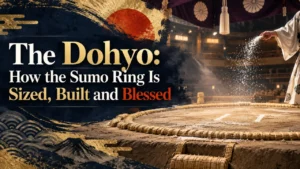
The ring is called the dohyo, and it takes its name from the straw rice bales that mark it out. It is 6.7 m (22 ft) square and 60 cm (24 in) high, built from a hard clay and dusted with a thin layer of sand. Bouts are confined to an inner circle a little over 4.55 m (14 ft 11 in) across. A roof shaped like a Shinto shrine hangs above it on cables, with a giant tassel at each corner for the four seasons.
A few things are forbidden. Striking with a closed fist, pulling hair, gouging eyes, choking, and kicking at the stomach or chest all end the bout at once. So does grabbing the part of the belt that covers the groin. Open-handed strikes to the face and shoulders are legal, which surprises most first-time viewers.
There are no weight classes. A wrestler can face an opponent twice his size on any given day, so leverage, timing and grip matter as much as mass. The Association recognizes 82 winning techniques, or kimarite, and many of them are throws or lifts set up by a grip on the belt.
Q. Are there weight classes in sumo?
A. No. Professional sumo has no weight limits and no divisions by size, unlike boxing or Olympic wrestling. A rikishi can be matched against an opponent twice his weight, and that gap is part of the sport rather than an accident of scheduling. It is also why the Association recognizes 82 separate winning techniques.
Q. What happens when the referee’s call looks wrong?
A. Five judges, the shimpan, sit around the ring for every bout, whatever the rank of the wrestlers. All of them are former rikishi. If the decision is in doubt they climb onto the dohyo and settle it among themselves. They can overrule the referee, or order the bout to be fought again.
Why the Wrestlers Keep Standing Up: the Shikiri
The stare-down is not stalling, and it is not the bout. It is the shikiri, the sequence that gets both wrestlers ready to start at the same instant. There is no starting whistle in sumo. The charge begins when the two of them agree, without a word, that it should.
Watch the fists rather than the faces. The wrestlers squat, lean forward and put their fists on the clay, then rise, return to their corners and take more salt. When both sets of knuckles settle on the ground together, the bout is about to start. Once you are watching the hands, the waiting becomes the most readable part of the match.
Each step in that sequence has a purpose. Salt is thrown to purify the ring, and it also dries the hands and disinfects small grazes; it is scooped from bamboo baskets at the east and west sides. Throwing it is a privilege of the top two divisions, and on some occasions the division below. The water taken before a bout, chikara-mizu, is handed over by the winner of the previous bout or by the next competitor on the same side, and the wrestler rinses his mouth with it.
The officials are readable too. The referee, or gyoji, wears a court costume modelled on samurai dress of about 800 years ago, and the colour of the tassel on his fan states his rank: purple, or purple and white, for the two most senior; vermilion for the next grade; red and white for the top division; blue and white for the second. Only the two most senior referees carry a short sword, and only the highest of them officiates the last bout of the day.
Q. Why do sumo wrestlers throw salt?
A. The salt purifies the ring, a gesture carried over from the sport’s origins in Shinto ritual. It has a practical side as well: it dries the hands and disinfects scrapes. Only wrestlers in the top two divisions, and sometimes the division below, are allowed to throw it, so the ritual also marks rank.
The Banzuke: How Sumo Ranking Works
Everything in professional sumo is decided by the banzuke, the official ranking sheet issued before each tournament in a dense, stylized calligraphy. It is redrawn after every tournament, and a wrestler moves up or down on the strength of his 15 days. Wrestlers are listed on an east side and a west side, but they do not compete as teams.
| Division or rank | What it means |
|---|---|
| Yokozuna | The top rank. Never demoted; a yokozuna who declines is expected to retire. |
| Ozeki | Once the highest rank, now second to yokozuna. |
| Sekiwake and komusubi | The two ranks below ozeki. With ozeki they form the sanyaku. |
| Maegashira | The rest of the top division, makuuchi. |
| Juryo | The second division. With makuuchi, these wrestlers are the salaried ranks. |
| Makushita and below | The unsalaried divisions. They fight on 7 days of a tournament, not 15. |
Yokozuna is the one rank that is never taken away. A wrestler who slips at the top is not demoted; he is expected to retire instead. To be considered for promotion at all, a rikishi must win two tournaments in a row as an ozeki, or produce results the Association judges equivalent, and he must be held to be a man of the character the rank demands. Only 75 men have reached it. The two current yokozuna are Hoshoryu, promoted as the 74th in January 2025, and Onosato, promoted as the 75th in May 2025.
Wrestlers live and train in a heya, a stable run by a stablemaster, and there are 45 of them. By long-standing practice a wrestler is not matched against someone from his own stable during a tournament; the exception is a championship playoff. It is a rule of the draw, and it follows from the fact that the two men train together every morning.
Q. Is yokozuna a championship title?
A. No. Yokozuna is a rank on the banzuke, held until retirement, and more than one wrestler can hold it at the same time. The tournament winner takes the Emperor’s Cup, which is a separate thing. A wrestler can win a tournament without being a yokozuna, and a yokozuna can go a full year without winning one.
Six Tournaments a Year: The Sumo Calendar
Professional sumo runs on six 15-day tournaments, or basho, spread through the year. Three are held in Tokyo, and one each in Osaka, Nagoya and Fukuoka. Wrestlers in the top two divisions fight once a day against a different opponent each time; the lower divisions fight on seven of the 15 days.
| Tournament | Venue | 2026 | 2027 |
|---|---|---|---|
| January | Kokugikan, Tokyo | Jan 11 – Jan 25 | Jan 10 – Jan 24 |
| March | EDION Arena Osaka | Mar 8 – Mar 22 | Mar 14 – Mar 28 |
| May | Kokugikan, Tokyo | May 10 – May 24 | May 9 – May 23 |
| July | IG Arena, Nagoya | Jul 12 – Jul 26 | Jul 11 – Jul 25 |
| September | Kokugikan, Tokyo | Sep 13 – Sep 27 | Sep 12 – Sep 26 |
| November | Fukuoka Kokusai Center | Nov 8 – Nov 22 | Nov 14 – Nov 28 |
Two dates matter if you are planning a trip. Advance tickets go on sale roughly two months before the first day — August 8, 2026 for the September tournament, for example. The banzuke for that tournament is published on August 31, 2026, thirteen days before it starts. In other words, the card is announced after most of the seats have already been sold. You are buying a tournament, not a matchup.
Tokyo tournaments are held at the Ryogoku Kokugikan, and the July tournament moved to the new IG Arena in Nagoya in 2026. Popular tournaments sell out, and the Association’s English site says so plainly on the ticket page. On a sold-out day the wrestlers, staff and press are handed decorated envelopes known as oiribukuro — a full-house bonus still paid out in paper.
Q. How do I follow sumo from outside Japan?
A. The Japan Sumo Association runs an English site with the banzuke, the daily matchups, results, withdrawals and the tournament calendar, all updated during a tournament. Start there for anything factual. A tournament day runs from morning through to the top-division bouts in the late afternoon, so the final hour is the part most highlight coverage uses.
Five Things People Get Wrong About Sumo
“It is just big men pushing each other.” Size is one variable, and it is not the decisive one. With no weight classes, a lighter wrestler survives on angle, timing and grip, which is why the Association counts 82 distinct winning techniques rather than a handful.
The belt is not a diaper. It is a mawashi, made of heavy silk, folded lengthwise and wrapped around the waist four to seven times. There is no standard size: each belt is woven to order for one wrestler, and the lengths recorded run from about 5.4 m to about 14 m. It is also the main handle in the sport: much of a bout is a fight for a grip on it. Grabbing the front fold is a foul.
Yokozuna is a rank, not a person. English-speaking fans often meet the word first as the ring name of an American professional wrestler of the 1990s. In sumo it is the top rank on the banzuke, open to any rikishi who earns it, whatever his nationality.
Winning a tournament does not make you a yokozuna. Promotion asks for two consecutive championships as an ozeki, or results the Association judges equivalent, plus a judgment about conduct. That is why a wrestler can take the Emperor’s Cup and stay exactly where he was.
Same-stable wrestlers are not avoiding each other. They are not scheduled against each other, by long-standing practice, because they share a stable and train together daily. It is a rule of the draw, not an arranged result.
Summary
- A bout is lost by touching the clay with anything but the soles of the feet, or by leaving the ring.
- The dohyo is 6.7 m square and 60 cm high, with an inner circle of about 4.55 m.
- There are no weight classes, and 82 winning techniques are officially recognized.
- The shikiri is the start procedure, not a delay. Watch the fists, not the faces.
- The banzuke is redrawn after every tournament, and yokozuna is a rank that is never demoted.
- Six 15-day tournaments a year: three in Tokyo, one each in Osaka, Nagoya and Fukuoka.
Six seconds is a short time to watch. Most of what decides those seconds happened earlier — on the ranking sheet, in the stable, in the mornings that determine who moves first. Even the ring is temporary: fifteen centimetres of clay is taken off the top before every tournament, new clay is laid down, and the surface is levelled again. Once you know what to look for, the bout is the last part of a much longer story.