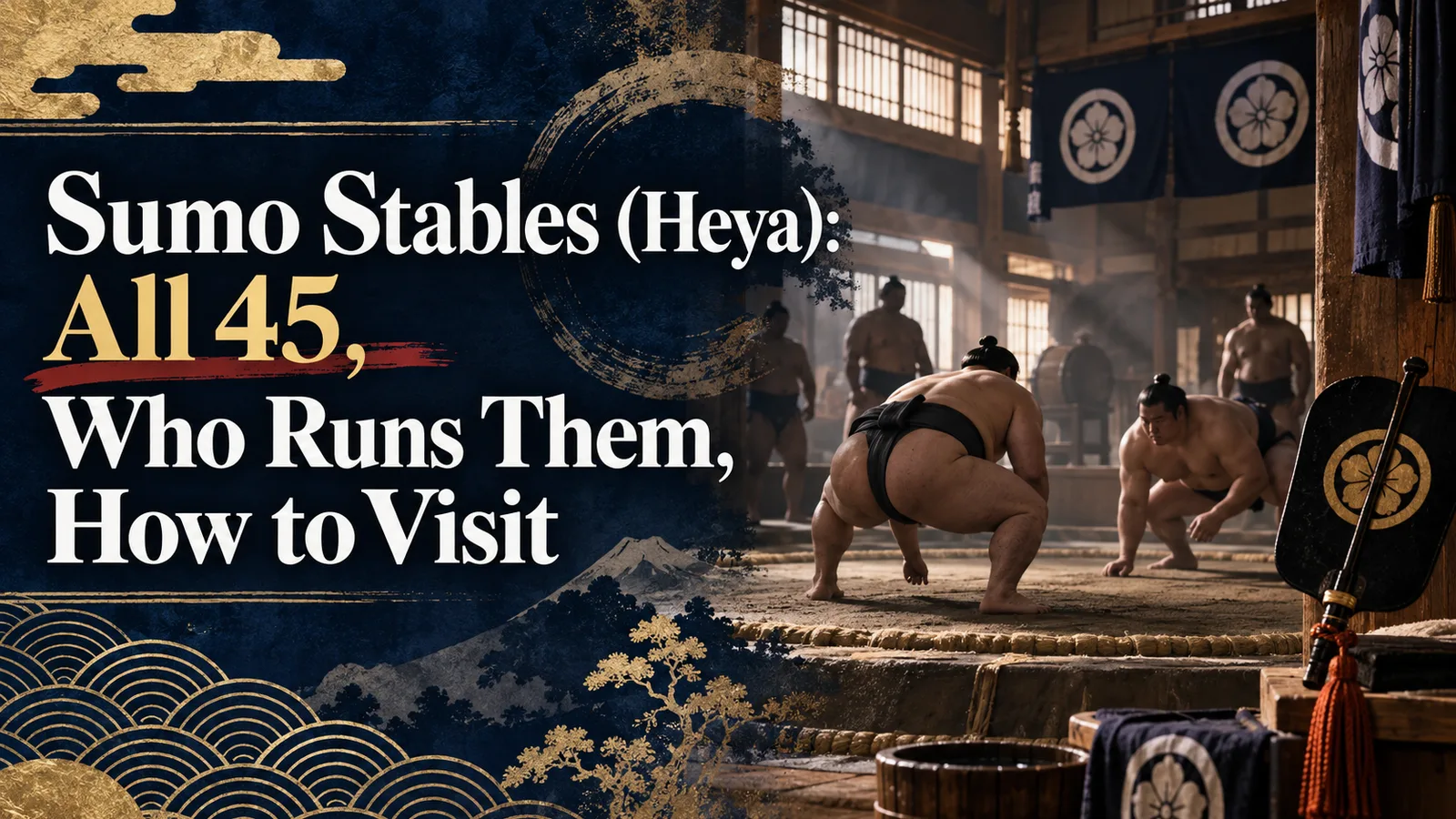
A sumo stable — heya in Japanese — is the house a professional wrestler lives in, trains in and belongs to for his whole career. It is also the only way into the sport: there is no application form at the Japan Sumo Association, and no trial you can turn up to. In law a stable is not a team and not a club. The Association’s articles of incorporation give stables a chapter of their own, headed “outsourcing of talent development to sumo stables”, and the Association pays each stable master a fee to carry that work out. There are 45 stables on the September 2026 ranking list, holding 593 ranked wrestlers between them. This guide sets out what they are, who runs them, how big they actually are, and whether you can watch one train — using the Association’s own filings and its own ranking data.
📖 What you’ll learn
- What a stable is in law — and why “team”, “gym” and “club” are all wrong
- All 45 stables, counted: how many wrestlers each one has, and which have none in the top divisions
- What an oyakata is, and why 12 of the 45 never reached sumo’s named ranks
- Whether you can watch morning practice, and exactly what the one stable that publishes viewing hours says in its own words
- What happened to Miyagino stable, and why the answer is visible in the Association’s own directory
What Is a Sumo Stable?
A sumo stable is a training house, run by a retired wrestler, where serving wrestlers live and practise, and it is the unit through which the Japan Sumo Association develops every professional in the sport.
That sounds like a description. It is closer to a legal definition, because the Association’s articles of incorporation say almost exactly this. Chapter 8 of those articles is titled “outsourcing of talent development at sumo stables”, and Article 46 reads: “In order to transmit the way of sumo from master to pupil, this foundation outsources the work of developing personnel to those who operate sumo stables and to others whom this foundation recognises.” The second clause is the part English writing never reaches: “This foundation shall pay, in respect of the outsourced work, the costs stipulated in its regulations.”
So a stable is a contractor. The Association does not employ coaches and post them to training centres; it hands the entire job of producing wrestlers to 45 separate houses and pays each of them to do it. The relationship is a contract, renewed and terminated by resolution of the board — the 2025 annual report lists “conclusion of talent-development outsourcing contracts with elders reaching retirement age” as ordinary board business, in the same list as budget approvals.
Everything else about a stable follows from that arrangement. A wrestler is registered through a stable, not signed by one, and there is no transfer market, free agency or loan system to move him afterwards. When wrestlers do change stables it is because a stable has closed or been merged, as Miyagino’s were in 2026, and the move goes through the Association. The house a wrestler joins at fifteen is normally the house he retires from.
Q. How many sumo stables are there?
A. 45. That is the number listed in the Association’s own stable directory, and it matches the number of distinct stables on the September 2026 ranking list exactly. Between them they hold 593 ranked wrestlers, an average of 13 each.
All 45 Stables, Measured
The September 2026 ranking list contains 45 stables and 593 ranked wrestlers, and the median stable has twelve of them — counted here by taking the list in full, division by division, and totalling wrestlers by the stable each is registered to.
English-language writing about sumo names a handful of stables — the ones that produce champions — and leaves the rest as background. The table below is every one of them. The master, his highest rank as a wrestler and the stable’s address come from the Association’s own directory pages; the wrestler counts are our own tally from the banzuke.
| Stable | Master (highest rank reached, ring name) | Rikishi | Makuuchi | Juryo | Where |
|---|---|---|---|---|---|
| Isegahama (伊勢ヶ濱) | Yokozuna, Terunofuji | 32 | 6 | 3 | Sumida, Tokyo |
| Sakaigawa (境川) | Komusubi, Ryogoku | 25 | 1 | 1 | Adachi, Tokyo |
| Tamanoi (玉ノ井) | Ozeki, Tochiazuma | 24 | 0 | 2 | Adachi, Tokyo |
| Takasago (高砂) | Sekiwake, Asasekiryu | 23 | 4 | 0 | Sumida, Tokyo |
| Nishonoseki (二所ノ関) | Yokozuna, Kisenosato | 23 | 1 | 1 | Ami, Ibaraki |
| Kokonoe (九重) | Ozeki, Chiyotaikai | 20 | 1 | 0 | Katsushika, Tokyo |
| Oitekaze (追手風) | Maegashira 2, Daishoyama | 19 | 2 | 1 | Soka, Saitama |
| Kise (木瀬) | Maegashira 1, Higonoumi | 18 | 3 | 1 | Sumida, Tokyo |
| Takadagawa (高田川) | Sekiwake, Akinoshima | 18 | 1 | 2 | Koto, Tokyo |
| Futagoyama (二子山) | Ozeki, Miyabiyama | 18 | 1 | 1 | Katsushika, Tokyo |
| Dewanoumi (出羽海) | Maegashira 2, Oginohana | 16 | 0 | 2 | Sumida, Tokyo |
| Tokitsukaze (時津風) | Maegashira 1, Tosayutaka | 16 | 2 | 1 | Sumida, Tokyo |
| Arashio (荒汐) | Maegashira 2, Sokokurai | 15 | 2 | 2 | Chuo, Tokyo |
| Kasugano (春日野) | Sekiwake, Tochinowaka | 15 | 0 | 1 | Sumida, Tokyo |
| Sadogatake (佐渡ヶ嶽) | Sekiwake, Kotonowaka | 15 | 3 | 0 | Matsudo, Chiba |
| Tagonoura (田子ノ浦) | Maegashira 8, Takanotsuru | 15 | 1 | 0 | Edogawa, Tokyo |
| Tatsunami (立浪) | Komusubi, Kyokutoyo | 14 | 1 | 1 | Taito, Tokyo |
| Naruto (鳴戸) | Ozeki, Kotooshu | 13 | 1 | 0 | Sumida, Tokyo |
| Yamahibiki (山響) | Maegashira 1, Iwao | 13 | 0 | 0 | Koto, Tokyo |
| Isenoumi (伊勢ノ海) | Maegashira 3, Hokutoriki | 12 | 1 | 1 | Bunkyo, Tokyo |
| Onomatsu (阿武松) | Maegashira 8, Daido | 12 | 0 | 1 | Narashino, Chiba |
| Oshiogawa (押尾川) | Sekiwake, Takekaze | 12 | 0 | 1 | Sumida, Tokyo |
| Onoe (尾上) | Komusubi, Hamanoshima | 12 | 0 | 0 | Ota, Tokyo |
| Shikoroyama (錣山) | Komusubi, Homasho | 12 | 1 | 0 | Koto, Tokyo |
| Fujishima (藤島) | Ozeki, Musoyama | 12 | 2 | 0 | Arakawa, Tokyo |
| Musashigawa (武蔵川) | Yokozuna, Musashimaru | 12 | 0 | 0 | Edogawa, Tokyo |
| Asakayama (浅香山) | Ozeki, Kaio | 11 | 0 | 0 | Sumida, Tokyo |
| Otowayama (音羽山) | Yokozuna, Kakuryu | 11 | 1 | 0 | Sumida, Tokyo |
| Takekuma (武隈) | Ozeki, Goeido | 11 | 1 | 0 | Ota, Tokyo |
| Hakkaku (八角) | Yokozuna, Hokutoumi | 11 | 0 | 1 | Sumida, Tokyo |
| Hanaregoma (放駒) | Sekiwake, Tamanoshima | 11 | 1 | 0 | Adachi, Tokyo |
| Ikazuchi (雷) | Komusubi, Kakizoe | 10 | 1 | 0 | Sumida, Tokyo |
| Oshima (大島) | Sekiwake, Kyokutenho | 10 | 0 | 1 | Katsushika, Tokyo |
| Ajigawa (安治川) | Sekiwake, Aminishiki | 9 | 1 | 0 | Koto, Tokyo |
| Shikihide (式秀) | Maegashira 9, Kitazakura | 9 | 0 | 0 | Ryugasaki, Ibaraki |
| Nakamura (中村) | Sekiwake, Yoshikaze | 9 | 0 | 2 | Sumida, Tokyo |
| Minato (湊) | Maegashira 2, Minatofuji | 9 | 0 | 0 | Kawaguchi, Saitama |
| Minatogawa (湊川) | Ozeki, Takakeisho | 9 | 2 | 0 | Itabashi, Tokyo |
| Otake (大嶽) | Maegashira 9, Tamaasuka | 8 | 1 | 0 | Koto, Tokyo |
| Hidenoyama (秀ノ山) | Ozeki, Kotoshogiku | 8 | 0 | 0 | Sumida, Tokyo |
| Nishiiwa (西岩) | Sekiwake, Wakanosato | 7 | 0 | 0 | Taito, Tokyo |
| Asahiyama (朝日山) | Sekiwake, Kotonishiki | 6 | 0 | 0 | Kamagaya, Chiba |
| Shibatayama (芝田山) | Yokozuna, Onokuni | 4 | 0 | 0 | Suginami, Tokyo |
| Kataonami (片男波) | Sekiwake, Tamakasuga | 3 | 0 | 2 | Sumida, Tokyo |
| Nishikido (錦戸) | Sekiwake, Mitoizumi | 1 | 0 | 0 | Sumida, Tokyo |
| 45 stables | — | 593 | 42 | 28 | 38 in Tokyo |
Read down that table and the shape of the sport changes. The largest stable, Isegahama, has 32 wrestlers. The smallest, Nishikido, has one. The median is twelve. Eleven stables — nearly a quarter of them — have no sekitori at all, meaning not a single wrestler in the two salaried divisions, and only 25 have anyone in the top division. A stable is not a squad of contenders. Most of them are small houses in outer Tokyo with a dozen young men in them, and the Association’s development budget flows to those houses on exactly the same terms as it flows to Isegahama.
The geography is just as concentrated. Thirty-eight of the 45 are in Tokyo, and sixteen of those are in Sumida City alone — the ward that contains the Kokugikan, the Sumo Museum and the Association’s head office. Two of them, Hakkaku and Nishikido, are on the same block. The seven outside Tokyo sit in the commuter belt: three in Chiba, two in Saitama, two in Ibaraki, the furthest being Nishonoseki in the town of Ami, about 60km from the arena. Stables cluster where the tournaments and the training school are, because wrestlers of every rank travel to other stables to spar and because half the tournament days each year are held at the Kokugikan.
Q. Where are sumo stables located?
A. Almost all in Tokyo, and mostly in one ward. 38 of the 45 are in Tokyo and 16 of those are in Sumida City, the ward around the Ryogoku Kokugikan. The other seven are in Chiba, Saitama and Ibaraki, within commuting distance of the arena.
A Day in the Heya: Keiko, Rank Order and the Okami-san
Practice — keiko — happens in the morning, and in every published account of stable life, from the Association’s own recruiting materials to wrestlers’ memoirs, it runs in reverse rank order. The lowest-ranked wrestlers are up first, sometimes before six, sweeping the practice ring and starting to train while the sekitori are still asleep. The senior men come down later, and the session builds towards them. By the time the highest-ranked wrestler in the house steps onto the clay, the junior wrestlers have already been training for two or three hours and will now spend the rest of the morning as his practice partners and attendants.
Rank governs everything else in the building too: who bathes first, who eats first, who is served and who serves. A junior wrestler cooks the chanko, waits on the senior men at the table, and eats what is left afterwards. A sekitori has attendants, a private room and a salary. The wrestler two ranks below him has none of those things and sleeps in a shared room. The stable is where sumo’s hierarchy is actually enforced, far more directly than in the arena.
This is also where a durable English assumption about sumo — that wrestlers are simply fed without limit — meets the routine. What stables and wrestlers themselves describe is training hard on an empty stomach, then one large meal, then rest. The shape of the day, set by the stable, is what they credit for the physique, not the quantity of food.
Running the household is a separate job from running the training, and it usually belongs to the master’s wife, the okami-san. She manages the money, the meals, the schedule, the parents of teenage recruits and the supporters’ association. English coverage rarely has a word for the role and tends to translate it as “the coach’s wife”, which understates it: in a house of twenty young men who arrived at fifteen, she is the administration.
How seriously the Association takes the mechanics of practice can be measured. Its 2025 accounts carry a line item for practice belts — keiko-mawashi — of ¥5,576,155, listed separately from every other cost of running the sport. The cloth that lower-division wrestlers train in has its own entry in the audited accounts of a ¥15.6 billion foundation.
Q. What time does sumo morning practice start?
A. Early, and it depends on rank. The lowest-ranked wrestlers often begin before 6am; the session is normally well under way by 7:30 and finishes mid-morning. Arashio stable, which publishes its own public viewing hours, gives them as 7:30 to 9:00.
Can You Watch? What Arashio Actually Says
You can watch practice at Arashio stable from the street, with no reservation and no charge; at any other stable, public access cannot be assumed and has to be arranged. Travel guides describe morning practice as the thing to do when tournament tickets sell out and imply that turning up is enough. The four routes below are genuinely different from each other, and mixing them up is what leaves people standing outside a locked door.
| Route | What it actually is | Booking |
|---|---|---|
| The Arashio window | One stable, in Nihonbashi-Hamacho, with street-level windows onto the practice room. You stand on the pavement outside and watch through the glass. You do not go in. | None needed. Free. |
| An open practice day | A stable opening its doors as a one-off event, sometimes with a chanko meal attached and a fixed number of tickets. | Announced by the stable, usually in Japanese, usually at short notice. |
| A paid tour | An operator with a standing arrangement takes a group inside. Which stable is often not named until you have booked. | Weeks ahead. Paid. |
| Turning up alone | Approaching a stable directly as a visitor with no introduction. | Not a route. Expect to be turned away. |
Arashio is worth quoting rather than paraphrasing, because it publishes its own terms in English and they are stricter than the guides suggest. Practice runs 7:30 to 9:00. Reservations are not required. It is free of charge. Visitors are asked to keep quiet, not to use flash, to refrain from eating and drinking, and not to sit on the neighbouring stairs. And the stable states plainly that the schedule is not guaranteed and that there may be sudden breaks — it also travels for weeks at a time, training away from Tokyo before regional tournaments. Checking the stable’s own calendar the night before is not caution, it is the instruction.
What the guides get wrong is the generalisation. Arashio is the one stable we found that publishes a standing, no-reservation arrangement for the public; the others are private houses where a dozen or twenty people live, and the reason a polite email goes unanswered is not rudeness. The Association’s 2025 annual report records that it prohibits personal social-media posting by its members and permits stable accounts only for the purpose of recruiting new wrestlers, under a policy written and run by its public relations department. The policy describes those accounts as a recruiting channel. It does not make them a visitor-booking channel, and nothing in the Association’s material suggests they are meant to be one.
Q. Can tourists watch sumo practice?
A. At Arashio, yes, freely: from the pavement, through its windows, 7:30 to 9:00, no reservation, no charge, subject to a schedule it does not guarantee. Elsewhere, count on needing either a paid tour booked in advance or an announced open practice day; turning up at a stable uninvited is not a route you can rely on.
You Cannot Join the Association — Only a Stable
There is no route into professional sumo that goes around a stable. The Association’s own instructions for aspiring wrestlers are explicit: you submit your entry papers to the Association through the elder who will be your master at the stable you want to join. The stable comes first, the paperwork second. A boy who wants to be a wrestler and has no stable willing to take him has nowhere to send an application.
The published entry standards, current as of 26 September 2024, are these. You must have completed compulsory education and be a healthy male. You must be at least 167cm and 67kg — 165cm and 65kg for March-tournament candidates still finishing junior high school. The general age limit is under 23; it rises to under 25 for those with results in designated adult or university competitions, those who have competed at a national high-school-level tournament, or those who pass a separate athletic-ability test. Candidates who fall short on height or weight may sit that athletic test and qualify that way.
Once registered, a new recruit spends six months at the Association’s Sumo Training School while living and training at the stable he was assigned to. In 2025, 65 wrestlers were newly registered and 59 retired — a sport that turns over roughly a tenth of its ranked population every year, and does the whole of that recruiting through 45 private households.
Q. Can a foreigner join a sumo stable?
A. Yes — the current ranks include wrestlers from Mongolia, Ukraine, Brazil, Georgia and elsewhere, and several stable masters are themselves former foreign-born wrestlers. The published entry standards set no nationality condition. A limit of one foreign-born wrestler per stable is widely reported, but the Association does not publish that rule in the material it makes available, so treat the number as reported rather than confirmed.
The Oyakata: A Contractor on Paper, a Master in the Room
An oyakata is an elder of the Association — a retired wrestler holding one of its elder names — and a stable master is the elder who has contracted with the Association to run a stable and develop its wrestlers.
English writing translates the word as “coach” more often than anything else, occasionally as “stablemaster”, almost never as “owner”. None of those is quite it, and the gap matters.
He is not an owner: as the next section sets out, he does not own the name he holds. On paper he is the counterparty to a contract with the Association, paid to develop wrestlers. In the practice room he is something the word “coach” does not carry — the man responsible for a teenager who has left home, for what that teenager eats, how he behaves, whether he is fit to fight and what becomes of him when he stops. Article 46 uses the phrase shishi-soden: transmission from master to pupil. The contract is with a person, not a post, which is why a stable can cease to exist when its master does.
There are 105 elders in the Association, spread across the 45 stables: a master for each house, plus assistant elders attached to it. And the distribution of who gets to run a house is not what an outsider would guess. By our count from the Association’s directory, of the 45 current masters, six were yokozuna, nine were ozeki, thirteen sekiwake and five komusubi — but twelve never reached sumo’s named ranks at all, retiring as rank-and-file maegashira. Dewanoumi and Tokitsukaze, two of the oldest and most storied houses in the sport, are both run by men whose careers peaked in the middle of the top division.
Nor does the master’s record predict the stable’s. On the September 2026 banzuke, Shibatayama — run by the 62nd yokozuna, Onokuni — has four wrestlers and no sekitori, while Oitekaze, run by a former maegashira 2, has nineteen wrestlers, three of them in the salaried divisions. Being great at sumo and being good at raising wrestlers are different jobs, and the ranking list says so every two months.
What the Association pays for that work is published to the yen.
| 2025 accounts | Amount | What it covers |
|---|---|---|
| Wrestler development costs | ¥1,388,165,855 | Stable maintenance and practice-room costs paid to each master, plus training allowances for wrestlers below the salaried divisions |
| Same line, 2024 | ¥1,329,529,949 | Year-on-year increase of ¥58,635,906 |
| Practice-belt costs | ¥5,576,155 | A separate line item, for the belts worn in training |
| Our division, not theirs | ≈¥2.34m per wrestler ≈¥30.8m per stable | The development line divided by 593 wrestlers and by 45 stables. The Association does not publish a per-stable breakdown. |
One detail in the 2025 report is worth keeping. Faced with rising prices, the Association paid stable masters an additional lump sum at the end of the year, topping up the maintenance and training allowances in proportion to how many wrestlers each house had. A subsidy scaled by headcount, granted because inflation was making it hard to run a stable, is not how a sports league treats its clubs. It is how a principal treats its contractors.
Q. Is an oyakata the same thing as a coach?
A. Not really. Legally he is a contractor: the Association outsources the development of wrestlers to him and pays him for it. In practice he is a master in an apprenticeship, responsible for the whole of a young wrestler’s life and not only his training. “Stablemaster” is the closest English word; “owner” is wrong, because he does not own anything — including his own elder name.
Who Owns a Stable Name? Nobody Does Now
Under Article 47 of the Association’s articles of incorporation, elder names are managed by the Association itself; nobody owns one, and paying for one is prohibited.
Follow English-language sumo discussion for a month, though, and you will read that someone’s kabu was on loan from someone else, or that a share has come free and a faction will fight over it. The vocabulary of ownership and lending is everywhere. It comes from somewhere real, and it is now out of date.
An elder name — toshiyori myoseki, colloquially kabu, “share” — is one of a fixed roster of names. Holding one is what makes a retired wrestler an elder, and only an elder can run a stable. For most of the twentieth century these names functioned as private property: they were bought, sold, inherited and lent, and reported prices ran into the hundreds of millions of yen. That is the world the English word “share” was borrowed from, and it genuinely existed.
It was closed on 30 January 2014, when the Association became a public-interest foundation. The articles adopted then, and in force today, say four things in one short chapter. Article 47: “Elder names shall be managed by this foundation.” A retiring elder may recommend a successor, but only within five years of leaving. Succession is examined by the Elder Qualification Screening Committee and then decided by resolution of the board. And the fourth clause is unambiguous: “No person shall give or receive money or other consideration in connection with succession to an elder name or the recommendation of a person to succeed to one.” Breach is to be punished severely.
So the honest answer to “who owns that name” is: nobody does. The foundation holds them, the board grants them, and paying for one is a disciplinary offence. Borrowed shares — the arrangement in which a wrestler held a name belonging to someone else — were reported at the time as prohibited in principle from the same transition, with a limited grace period for those already in place; that detail sits in the regulations the Association does not publish, so it is reported rather than quoted here.
Two honest limits on that. The first is that the articles are a rule, not a description of behaviour; what the rule replaced was a long and well-documented market, and a rule does not erase the habits of everyone who grew up in it. The second is that the Association publishes its articles but does not publish the elder-name regulations the board makes under them. That is also true of the conditions for opening a new stable or inheriting an existing one: minimum numbers of tournaments spent in the top divisions are widely reported, and are not in any document the Association makes public. Where this article states a rule, it is quoting the articles of incorporation. Where a number is only reported, it says so.
Q. Do stable masters own their elder name (kabu)?
A. No. Since the 2014 reform the articles of incorporation state that elder names are managed by the Association, that succession is decided by the board on the recommendation of a screening committee, and that no money may change hands over a name or a recommendation. The English habit of describing a kabu as bought or on loan describes the system as it worked before 2014.
Stables Open and Close: What Happened to Miyagino
Because a stable is a contract with a person, the roster of 45 is not permanent. Houses are founded when an elder qualifies and is approved to open one, and they end when a master retires without a successor, or when the Association decides they should. The 2025 board minutes carry both kinds of entry — “succession to an elder name and succession to a sumo stable” appears twice in the year’s business.
The case English-language fans ask about most is Miyagino, the stable run by Hakuho, the most successful wrestler in the sport’s history. It was suspended in 2024 after a violence case involving one of its wrestlers, and its wrestlers were placed in the custody of Isegahama stable. The Association’s 2025 annual report lists “the matter of Miyagino stable, currently under the custody of its ichimon” as board business on 2 June 2025. Its former master left the Association in June 2025. The custody arrangement was reported as lifted on 28 May 2026, with the wrestlers becoming full members of Isegahama.
You do not need the news reports to establish where this ended, because the Association’s own pages answer it. Miyagino is not among the 45 stables in the official directory. The elder name Miyagino is still held — it appears in the register of elders, carried by the 63rd yokozuna, Asahifuji — and his listed stable is Isegahama. A name that survives, attached to a house that does not.
The consequence is visible in the ranking list. Isegahama now has 32 ranked wrestlers, 28% more than the second-largest stable, and holds six of the 42 places in the top division. It is the largest house in sumo by a distance, and it is that size because another house was folded into it. Miyagino also shows how wrestlers come to change stables at all: not by transfer, but because a stable stops operating and its people are reassigned.
Q. Does Miyagino stable still exist?
A. No. It is not in the Association’s directory of 45 stables, and its former wrestlers are registered to Isegahama. The elder name Miyagino still exists and is held by the former yokozuna Asahifuji, whose own listed stable is Isegahama — which is why the name keeps appearing and the stable does not.
One more grouping sits above the stables and is easy to misread. The 45 houses are grouped into five ichimon — Dewanoumi, Nishonoseki, Tokitsukaze, Takasago and Isegahama — lineages generally described as sharing training and backing each other in Association elections. The one function documented in the Association’s own records is custody: the 2025 board minutes describe Miyagino as “under the custody of its ichimon”. The word does not appear anywhere in the articles of incorporation, the Association does not publish which stable belongs to which grouping, and membership was reported as made compulsory in 2018. It is real, it matters, and it is not a formal part of the constitution.
Summary
- A stable is a contractor, not a club. Chapter 8 of the Association’s articles outsources the development of wrestlers to the people who run stables, and pays them to do it.
- 45 stables, 593 ranked wrestlers. The median stable has twelve. Eleven have no wrestler in the salaried divisions at all, and 38 of the 45 are in Tokyo — sixteen in Sumida City alone.
- The master’s record does not predict the house. Twelve of the 45 masters never reached sumo’s named ranks; a former yokozuna runs a stable of four.
- Nobody owns an elder name. Since 2014 the Association manages them, the board grants them, and money may not change hands — which is what the English phrase “kabu on loan” is out of step with.
- One stable can be watched freely. Arashio, through its street windows, 7:30 to 9:00, no booking, no charge, on a schedule it does not guarantee. The other 44 need a tour, an announced open day, or nothing at all.
If you want to watch practice: check Arashio’s own calendar the night before and again in the morning, arrive by 7:30, and expect to stand outside. For any other stable, go only through an open practice day the stable has announced or a tour operator with a confirmed arrangement — and ask which stable before you pay. If you want the institution: the 45-stable table above is the map; our guides to the Japan Sumo Association and the banzuke explain who the stables answer to and how their wrestlers are ranked.
Related guides: What is sumo? · What a wrestler’s life is like · The Japan Sumo Association · Sumo rankings and the banzuke · Yokozuna, explained · The mawashi · Ryogoku Kokugikan
The Association publishes the name and address of all 45 stables, the master of each, every wrestler registered to them, and the exact sum it pays them to raise those wrestlers. All of it is on its own website, and all of it is in Japanese. The number that best explains what a stable is sits in a line of an audited Japanese-language account: ¥1,388,165,855, paid out to 45 private houses to bring up 593 young men, in a sport with no transfers, no contracts and no way in except through a front door in Sumida.