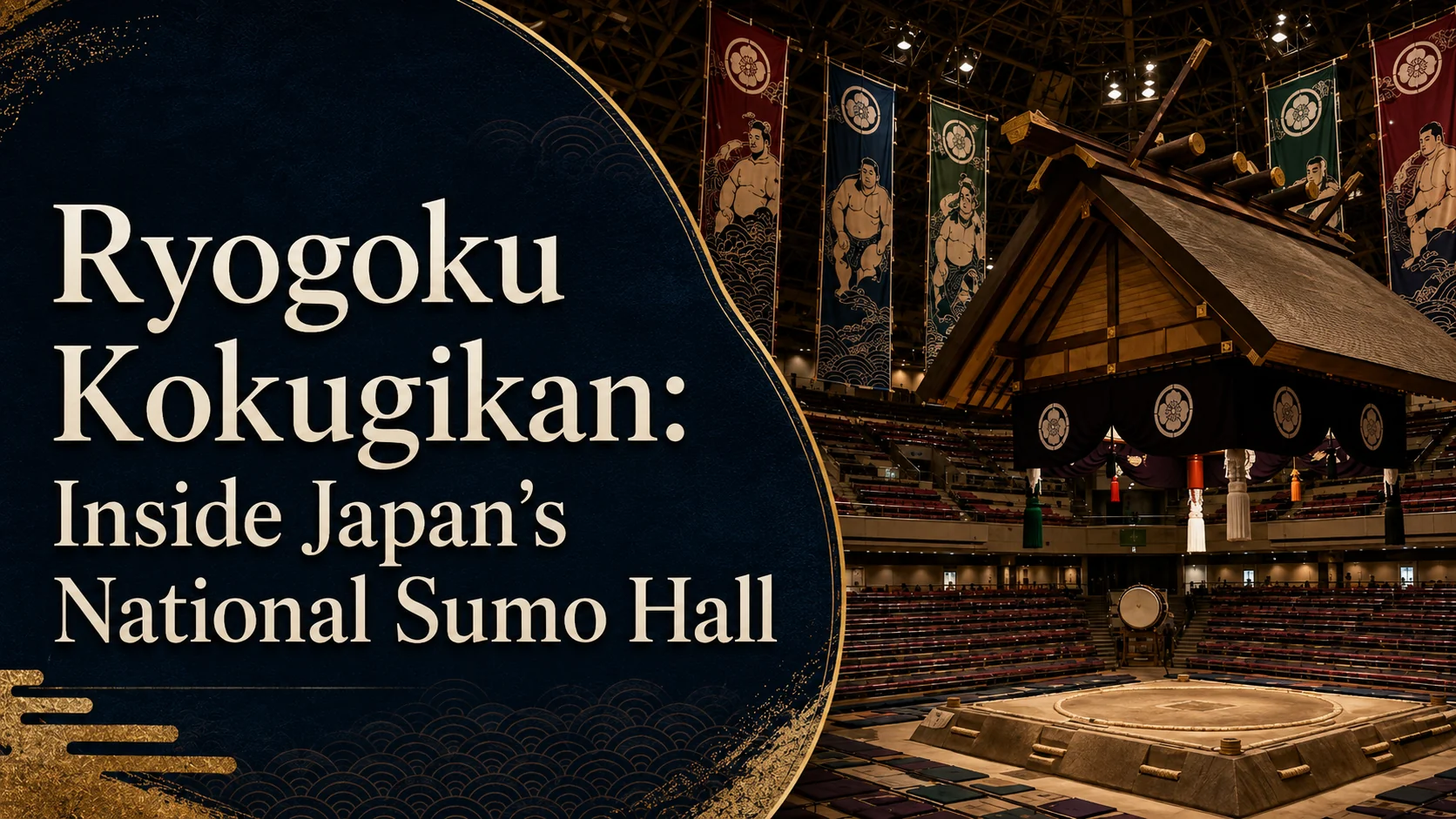
Ryogoku Kokugikan is the building where professional sumo lives. Three of the six annual tournaments are held here, in a hall of 11,098 seats in the Yokoami district of Tokyo, two minutes on foot from Ryogoku Station. It also holds a museum you can walk into free on an ordinary weekday, a basement that grills 45,000 skewers of chicken a day, and a roof that collects its own water supply. This guide covers what is inside, how a tournament day runs, and what the Japan Sumo Association actually asks of visitors.
📖 What you’ll learn
- What Ryogoku Kokugikan is, how big it is, and which tournaments it hosts
- How the four levels work, and the free official tool that shows you the view from your seat before you buy
- Exact door-opening times for the September 2026 tournament, and the house rules that catch visitors out
- What to eat inside, including the ¥500 chanko and the yakitori grilled under the arena floor
- How to get there by train, subway or river boat, and what to do with your suitcase when you arrive
- Why you can visit the building on a day with no sumo at all
What Is Ryogoku Kokugikan? Japan’s Home of Professional Sumo
Ryogoku Kokugikan is the national sumo arena in Sumida, Tokyo, owned and run by the Japan Sumo Association. It seats 11,098 people and hosts three of the six annual Grand Sumo Tournaments, or basho — the 15-day tournaments that decide the sport’s champions — in January, May and September. The current building opened in January 1985.
The name explains why searches for this place get tangled. Kokugikan means “hall of the national sport,” and it names an institution rather than one building: there have been three of them. Ryogoku is the surrounding neighbourhood, an old riverside quarter that has been sumo’s home district for most of the sport’s professional history. The hall’s actual address is in Yokoami, one block over.
| Item | Detail |
|---|---|
| Address | 1-3-28 Yokoami, Sumida-ku, Tokyo 130-0015 |
| Capacity | 11,098 |
| Opened | January 1985; first tournament day January 13, 1985 |
| Tournaments held here | January, May and September, 15 days each |
| Structure | Three floors above ground, two below, 35,700 m² of floor area |
| Nearest station | Ryogoku (JR Sobu Line), west exit, 2 minutes on foot |
| Also inside | The Sumo Museum, a year-round souvenir shop, a shrine counter |
Q. Is all sumo held at Ryogoku Kokugikan?
A. No. Three of the six tournaments are held here. The other three move to Osaka in March, Nagoya in July and Fukuoka in November, in ordinary multi-purpose arenas fitted out with a clay ring for the fortnight. Ryogoku is the only venue the Association owns, and the only one that is a sumo building all year round.
Arena Layout and Seating: From Ringside to the Suspended Roof
The building is arranged as four usable levels around a sunken floor, with the ring at the bottom of it. Look up from the clay and you see the tsuriyane, a roof in the style of a Shinto shrine hanging in mid-air above the ring with no pillars under it. It is not scenery brought in for the tournament. It is permanently installed on two wires, and when the hall is used for anything else it is winched up into the ceiling and out of the way.
Two details there matter more than they look. The first is that the box seats are removable. The arena floor measures 20 m by 20 m in its normal state, and lifting the boxes out opens it to 40 m by 40 m, or 1,600 m². That is how the same hall holds a boxing tournament one month and a concert the next.
The second is that the first floor is not chairs. It is masu-seki, square boxes marked out on the floor, sold as a whole box and used with your shoes off. There is no back rest. Visitors who cannot sit on the floor for several hours should book a chair on the second floor rather than a box below.
Before you commit, use the Association’s own preview. It publishes Google Street View walkthroughs of the entrance, the first floor and the second floor, so you can stand where your seat would be and look at the ring before you pay. Almost no English guide to the building mentions it.
Q. Which seat should I book at Ryogoku Kokugikan?
A. For a first visit, a second-floor chair. You see the whole ring, you keep your back and knees, and the cheapest ones cost a fraction of a box. Take a first-floor box if you are a group of four and want the traditional experience, and treat ringside as a specialist choice: no food, no drink, no photography and no phone use are permitted there. Prices for every seat type are in our guide to buying sumo tickets.
Matchday Guide: Entry Times, Re-entry and House Rules
Doors do not open at the same hour every day. For the September 2026 tournament the Association opens the building at 8:45 a.m. from day 1 through day 12, at 10:30 a.m. on days 13 and 14, and at 10:00 a.m. on the final day. The lower divisions wrestle in the morning to a half-empty hall; the top division fills it in the late afternoon, and the last bout comes at around 6 p.m.
| Days of the tournament | Doors open | What is on when you arrive |
|---|---|---|
| Days 1 to 12 | 8:45 a.m. | Lowest divisions, quiet hall, easy to move around |
| Days 13 and 14 | 10:30 a.m. | A shorter day, and the hall fills earlier |
| Day 15, the final day | 10:00 a.m. | The championship is decided; shops and events close earliest |
The rules inside are short, and several of them surprise people who have only watched sumo on television.
- Everyone aged four and over needs a ticket, including a child on a parent’s lap.
- You may leave and come back once per day. Keep your ticket stub; staff check it on the way back in.
- QR tickets must be distributed to each person’s own phone before you arrive. Screenshots and printouts are refused at the gate.
- Do not bring your own food and drink. The Association asks visitors to buy inside.
- You may eat at your seat anywhere except ringside. The ringside section allows no food, no drink, and no cushions or backrest chairs carried in from outside.
- Do not throw your cushion. Older television footage shows the crowd hurling seat cushions after an upset; it is now prohibited, because people get hurt.
- Do not touch the wrestlers or the judges, and do not wait outside the building to watch wrestlers arrive or leave. The Association asks visitors not to, out of consideration for the neighbourhood.
Q. What time should I actually arrive?
A. If you want a full day, arrive at opening and watch the lower divisions in a near-empty hall. It is the only time you can sit close to the ring without a ringside ticket, because the seats around you are unoccupied. If you want the part everyone comes for, arrive in the early afternoon: the top-division wrestlers enter the ring in ceremony in the late afternoon, and the day ends at around 6 p.m.
Kokugikan Food and Drink: Underground Yakitori and Matchday Chanko
The building feeds itself from its own basement. Below the arena floor is a kitchen that grills an average of 45,000 skewers of chicken a day during a tournament, and the boxes of yakitori sold upstairs — five skewers, three of chicken and two of tsukune meatballs, at ¥850 (approx. US$6) — are cooked down there that morning. They are made to a recipe designed to taste right cold, which is why people carry them home rather than eat them at the seat.
The dish became the hall’s signature back at the Kuramae Kokugikan, about sixty years ago, and the reason is a pun rather than a recipe. A wrestler who puts a hand down on the clay has lost. A chicken stands on two legs and never does. Chicken is therefore lucky food at a sumo tournament.
| What | Price | Where | Notes |
|---|---|---|---|
| Kokugikan yakitori, 5 skewers | ¥850 | Cafe (2F west), food counters (1F east and west, 2F east) | Grilled in the basement; built to be eaten cold |
| Special chanko | ¥500 | Great hall (B1), 11:00 a.m. to 4:30 p.m. | Over 2,000 bowls a day; a different stable cooks it each tournament |
| Wrestler bento boxes | ¥1,350 | Cafe and food counters | Built around one wrestler’s favourite food or home region; limited numbers |
| Souvenir shop | — | Ground floor | Also open on ordinary weekdays outside tournaments, 10 a.m. to 3 p.m. |
The chanko is the other thing worth queuing for. Chanko is the stew sumo stables cook for their wrestlers, and one stable is chosen to make it for the public each tournament, in a dedicated space in the basement great hall. It sells over 2,000 bowls a day at ¥500 (approx. US$3.30), and the recipe changes halfway through: a soy-sauce base for the first eight days, a salt base from day nine to the final day.
Q. Can I bring my own food and drink into the Kokugikan?
A. The Association asks you not to. Food and drink bought at the counters may be taken to your seat anywhere except the ringside section, where nothing may be eaten or drunk at all. Alcohol is sold inside, and drinking at your seat during the bouts is normal in the box and chair sections.
Getting There: Train, Subway and River Boat
Ryogoku Kokugikan is one of the easiest large venues in Tokyo to reach, and one of very few you can arrive at by boat.
The JR Sobu Line route is the one to use. Ryogoku Station is about ten minutes from Tokyo Station and from Ueno, and seventeen from Shinjuku, and the hall is two minutes from the west exit. The Toei Oedo Line subway stops at a separate Ryogoku Station, five minutes away through exit A3. The third option is the Tokyo Mizube Line, a river boat service on the Sumida, which lands at a pier three minutes from the door.
There is no visitor parking, and none nearby. If you arrive with luggage, the building can take it: a cloakroom on the ground floor, run by the courier company Yamato Transport, is open 10 a.m. to 6 p.m. at ¥800 (approx. US$5) per item, and there are coin lockers in the outdoor passages on the east and west sides. The same counter will ship a suitcase or a pile of souvenirs onward within Japan.
Families are handled in the basement great hall, which opens with the doors and runs to 5:30 p.m.: a women-only nursing space with feeding cushions, a nappy-changing station, and a small area with two child-sized chairs for feeding. There is no hot water and no microwave. Pushchairs cannot go into the seating areas, but five marked parking spots are set aside for them, three on the ground floor and two upstairs.
Q. Is there parking at Ryogoku Kokugikan?
A. Not for visitors. The venue keeps around fifty spaces for staff and officials, and asks everyone else to come by public transport, noting that there is no large parking anywhere close by. With three rail and river routes landing within five minutes of the entrance, driving is the worst of the options.
The Sumo Museum and Year-Round Visits
You do not need a tournament, or a ticket, to get inside the building. On ordinary weekdays the Sumo Museum on the ground floor opens from 10 a.m. to 4:30 p.m., last entry 4 p.m., and admission is free. The souvenir shop keeps its own hours, 10 a.m. to 3 p.m. on weekdays. Both close at weekends and on public holidays outside tournaments, and the arena itself stays shut.
During a Tokyo tournament the museum opens every day but changes shape: 12:30 p.m. to 4 p.m., and you need a sumo ticket to reach it.
The museum is small on purpose, and worth knowing about before you go. It has a single exhibition room of 150 m², so there is no permanent display. Instead it mounts three themed exhibitions a year from its own collection of woodblock prints, old ranking sheets and ceremonial aprons. It is also older than the building around it: it opened in September 1954 at the Kuramae Kokugikan and moved here in January 1985, when this hall opened.
Inside the exhibition room is a counter for Nomi no Sukune Shrine, dedicated to the figure traditionally regarded as sumo’s founding wrestler. It issues amulets, and a limited number of stamped shrine seals to ticket holders during tournaments.
Q. Can you visit Ryogoku Kokugikan when there is no tournament?
A. Yes, on a weekday. The Sumo Museum and the souvenir shop are both open to anyone, free of charge, with no ticket. What you cannot do is go into the arena: the hall itself is closed except during tournaments and rental events, and there is no public tour of the ring.
Architecture and History: From Ekoin to a Rainwater-Powered Arena
This is the third Kokugikan. The first opened in 1909 in the grounds of Ekoin temple, a few hundred metres from where the current hall stands. The second stood at Kuramae, across the river, from 1954 to 1984. The Association then bought the present site, a disused railway freight yard beside Ryogoku Station, and put the sport back in its old neighbourhood.
Work started on April 27, 1983. The building was finished in January 1985 and the first tournament opened on January 13. It reportedly cost around fifteen billion yen, paid out of the Association’s own funds rather than public money.
The engineering is more interesting than the dates. The roof is a 94-metre steel truss span, hoisted into place in single lifts by a winching method borrowed from bridge building, rather than the forest of temporary columns the job would normally need. That roof does a second job. Its 8,360 m² of surface drains into a 1,000 m³ tank under the building, and the collected rainwater supplies roughly 70 per cent of the hall’s non-drinking water, meaning the toilets and the cooling towers. It was the first system of its scale in Japan, built at the request of Sumida ward, and it started a local habit: the ward has since put rainwater tanks under the Tokyo Skytree and its own city hall.
The hall does not sit idle between tournaments either. It staged the boxing events of the Tokyo 2020 Olympic Games from July 24 to August 8, 2021, at a reduced capacity of 7,300, and it takes concerts, esports tournaments, exhibitions and television broadcasts through the rest of the year. Every one of them happens under a hanging shrine roof that has simply been wound up out of sight.
Summary
- Ryogoku Kokugikan seats 11,098 and hosts the January, May and September tournaments. The other three move to Osaka, Nagoya and Fukuoka.
- Doors open at 8:45 a.m. on most days of the September 2026 tournament and later on the last three. A ticket is needed from age four, and you may re-enter once.
- The first floor means floor boxes with your shoes off; the second floor means chairs. Check the view first through the Association’s official Street View walkthrough.
- Eat the basement yakitori and the ¥500 chanko, and do not carry your own food in.
- Two minutes from JR Ryogoku Station, five from the Oedo Line, three from the river pier, and no parking at all.
- On an ordinary weekday the museum and the shop are open, free, and need no ticket.
Read next: what sumo is and how it works, how to buy sumo tickets, what a rikishi’s life is really like, and the rank of yokozuna.
A hall that collects its own rainwater, ships your suitcase onward and grills 45,000 skewers a day is, for two weeks at a time, mostly quiet. The morning bouts play to rows of empty boxes, and the wrestlers who fight them will never see the place full. The building was made for the last hour of the day. It spends most of its time on everything that leads up to it.