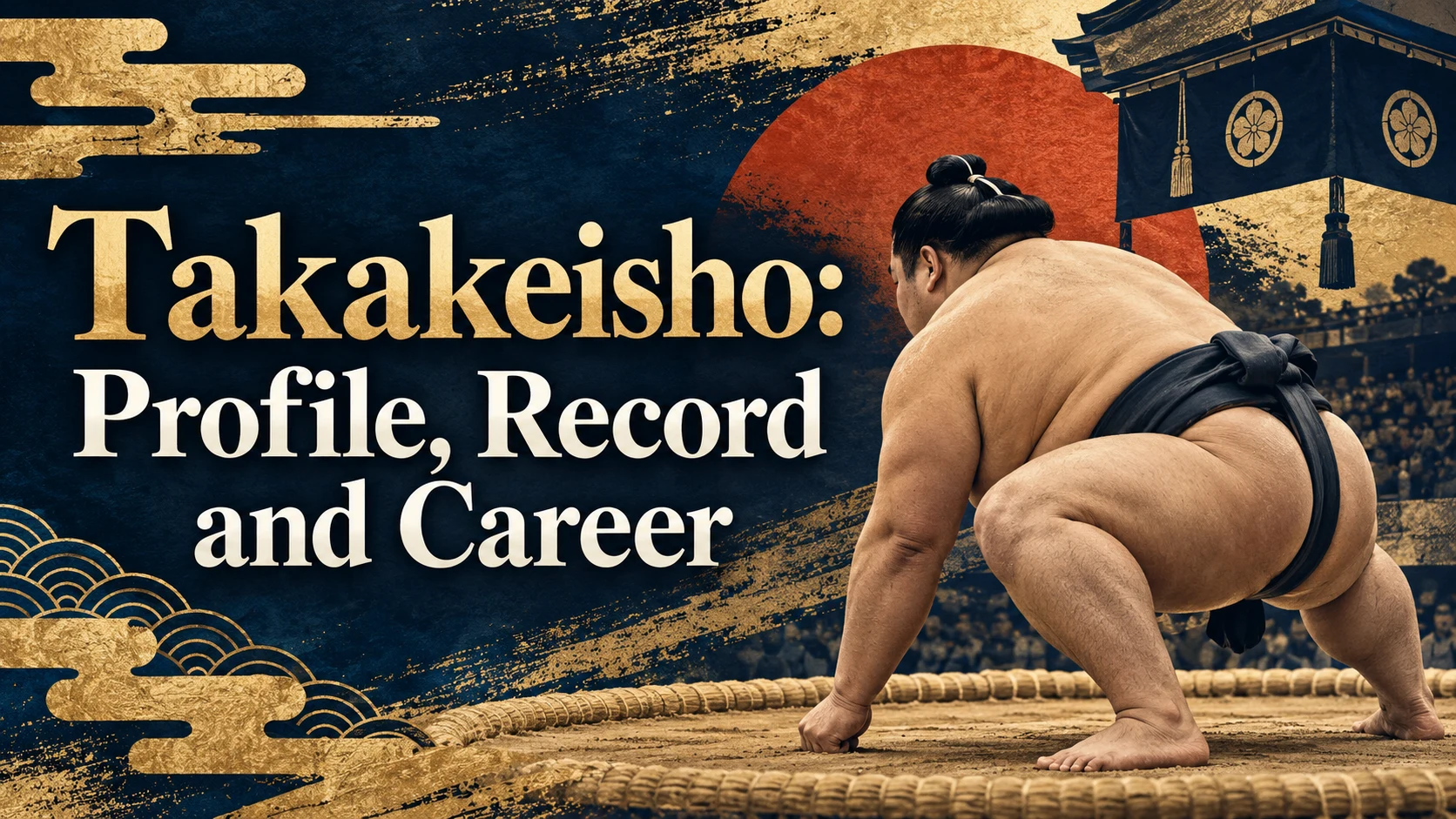
Takakeisho retired in September 2024 as a former ozeki, the second-highest rank in professional sumo, and today runs a stable of his own. He held that rank across two separate spells, won four top-division championships, and left the ring at 28 with a career record of 441 wins, 254 losses and 116 absences. This guide covers what the Japan Sumo Association’s own records say about his career, how he actually won his bouts, why he never rose further, and what he does now as the master of Minatogawa stable.
📖 What you’ll learn
- What the Japan Sumo Association’s records say about his profile and career
- How he reached ozeki in under five years, and why he never went further
- The techniques behind his thrusting sumo, and how the Association classifies them
- Where he is today: Minatogawa stable, its address, and the wrestlers in it
Who Is Takakeisho?
Takakeisho is a retired Japanese sumo wrestler who reached ozeki, the second-highest rank, and now coaches under the elder name Minatogawa.
He was born Takanobu Sato on August 5, 1996, in Ashiya, Hyogo Prefecture. He entered professional sumo in September 2014, fought first under the ring name Sato, and later took the name Takakeisho. The Japan Sumo Association lists his highest rank as ozeki and records his retirement in September 2024.
The Association’s board approved two things on the same day, September 20, 2024: his retirement, and his succession to the toshiyori name Minatogawa, one of the Association’s limited set of elder stock names. A retiring wrestler who acquires one of those names stays inside the Association as a coach. Takakeisho did, and two years later he was running a stable.
So there are two careers to separate here. The first ran ten years and ended at 28, which is young for a wrestler who reached the second-highest rank. The second began immediately and is still running. This page covers both, using the Association’s own records throughout.
For what daily life looks like for a rikishi, the formal word for a professional sumo wrestler, see our guide to what a rikishi actually is.
Q. Is Takakeisho still wrestling?
A. No. The Japan Sumo Association’s board approved his retirement on September 20, 2024, and his profile page now carries the tag “Retired.” He remains inside the Association as a coach under the elder name Minatogawa, and since January 2026 he has run his own stable. He does not compete.
Takakeisho’s Profile: Real Name, Height and Stable
Takakeisho’s registered name is Takanobu Sato, and the Association lists him at 175 cm (5 ft 9 in) and 165 kg (364 lb).
Two of those figures are worth pausing on. At 175 cm he was short for the top division, and at 165 kg he was heavy for his height. That combination is not incidental to how he fought, and it explains the style described further down this page.
The table below reproduces the fields the Association publishes on its English profile page, as recorded on September 20, 2026. His birthplace is given there as Hyogo; the Association’s separate list of former ozeki narrows it to the city of Ashiya.
| Item | Official record |
|---|---|
| Ring name | Sato → Takakeisho |
| Real name | Takanobu Sato |
| Born | August 5, 1996 |
| Birthplace | Ashiya, Hyogo Prefecture |
| Height | 175.0 cm (5 ft 9 in) |
| Weight | 165.0 kg (364 lb) |
| Highest rank | Ozeki |
| Signature maneuvers | tsuki, oshi (thrusting and pushing) |
| Stable as a wrestler | Tokiwayama |
| Career record | 441-254-116 |
| Top-division record | 353-219-116 |
| Retired | September 2024 |
One line in that table carries most of the story. All 116 of his career absences fall inside his top-division record, which means every day he missed as a professional, he missed after reaching the top. Nothing was lost on the way up.
One other field is worth holding onto. His stable is listed as Tokiwayama, and it is the only stable he belonged to as a wrestler. The same stable, under a different name, is the one he runs today.
Q. What is Takakeisho’s real name?
A. Takanobu Sato. The Japan Sumo Association lists it on his profile as his given name, with Sato and then Takakeisho as the sequence of ring names he used. He now goes by the elder name Minatogawa inside the Association, while his registered name remains Takanobu Sato.
From His 2014 Debut to Ozeki in Five Years
Takakeisho made his professional debut in September 2014, and the Association promoted him to ozeki in May 2019, less than five years later.
Sumo has six divisions, and Takakeisho entered at the bottom one in 2014. Only the top two divisions are salaried. The Association’s record of his promotions shows how quickly he crossed that distance.
He also won championships on the way up, and that record is unusual. The Association credits him with one championship each in jonokuchi and jonidan, the two lowest divisions, one in makushita, the unsalaried division directly below the salaried ranks, and one in juryo, the second division. Added to his four top-division titles, that is a championship in five of sumo’s six divisions.
The single gap is sandanme, the third division from the bottom, where the Association records none. A wrestler who fights his way out of a division in a single tournament never gets a second chance at its championship, and the record reads that way here.
How the six divisions fit together, and what a promotion actually requires, is set out in our guide to the sumo rankings and the banzuke.
Q. How long did it take Takakeisho to reach ozeki?
A. Four years and eight months. He debuted in September 2014 and was promoted to ozeki in May 2019, at 22. He had reached the salaried ranks in May 2016, the top division in January 2017, and his first titled rank in January 2018, according to the Japan Sumo Association. That first promotion did not hold: the Association’s list of former ozeki records a second spell starting in November 2019.
Takakeisho’s Record: 441-254-116 and Four Championships
Takakeisho finished his career with 441 wins, 254 losses and 116 absences, including four top-division championships and seven special prizes.
Read alongside his top-division figures of 353-219-116, the numbers describe a wrestler who spent almost his whole career at the top and won more than he lost while he was there. They also describe someone who was absent a great deal.
| Award | Count | What it is |
|---|---|---|
| Top-division championships | 4 | Best record of the tournament in makuuchi |
| Juryo championships | 1 | Second division |
| Makushita championships | 1 | Third division, unsalaried |
| Sandanme championships | 0 | Fourth division |
| Jonidan championships | 1 | Fifth division |
| Jonokuchi championships | 1 | Bottom division |
| Outstanding Performance Award | 3 | Special prize, top division |
| Fighting Spirit Prize | 2 | Special prize, top division |
| Technique Prize | 2 | Special prize, top division |
| Kinboshi | 3 | Recorded for beating a yokozuna as a rank-and-file wrestler |
The division spread is the line to read. Takakeisho won a championship in five of the six divisions, missing only sandanme. He won outright at every level he passed through, not only after he arrived at the top.
His three kinboshi belong to the same pattern. A kinboshi is recorded when a wrestler in the rank and file defeats a yokozuna, sumo’s highest rank, and it can only be earned before promotion into the titled ranks. He collected three in roughly the year between his top-division debut and his first titled rank.
The completed bouts say the same thing another way. Set the absences aside and his top-division record stands at 353 wins from 572 bouts, a rate just under 62 percent. Across a 15-bout tournament that pace produces about nine wins, past the eight that make a winning record.
The Association’s profile records the number of top-division championships but not the tournaments they came in. This page follows the Association. Where its records stop, so does this article.
Q. How many championships did Takakeisho win?
A. Four in the top division, according to the Japan Sumo Association. He also won one championship each in juryo, makushita, jonidan and jonokuchi, giving him titles in five of sumo’s six divisions. The only division he did not win was sandanme, where the Association records none. The Association schedules seven bouts in the lower four divisions and fifteen in the top two, so these titles are not equivalent.
The Tsuki-Oshi Style: How He Actually Won
Takakeisho won by thrusting and pushing rather than by grappling, and the Association lists his signature maneuvers as tsuki and oshi.
Those two words describe the two halves of one approach. Tsuki is thrusting at the opponent’s chest and throat with open palms. Oshi is pushing him backward with the hands set and the legs driving. Neither involves taking a grip on the opponent’s belt, which is the other main way to fight in sumo.
The Association’s profile page publishes a breakdown of his most-used winning techniques over a set of bouts it counts: 24 wins from 53 bouts. The page does not state which period those bouts cover, so this article does not date them. The percentages below are shares of those 24 wins.
Set the two official sources side by side and something useful appears. The Association sorts all 82 kimarite, its named winning techniques, into categories, and his top three fall into three different ones. Oshidashi is a basic technique, tsukiotoshi a twisting technique, and hatakikomi a special technique. His sumo was built on pushing, but it did not finish on pushing alone.
His build belongs in the same picture. The Association records him at 175 cm and 165 kg, which made him shorter than most of the top division and heavy for that height. He fought his whole career without a belt grip as his main route to a win.
That matters for reading his bouts. In the Association’s sample he took one win in four with a twisting technique or a pull-down, so an opponent bracing against the push was not safe either. The full set of techniques and how bouts are decided is covered in our guide to the rules of sumo.
Q. What is tsuki-oshi sumo?
A. It is sumo fought at arm’s length. Tsuki is thrusting at the opponent’s chest and throat with open palms, and oshi is pushing him backward with the hands set and the legs driving. The aim is to win without ever taking a grip on the opponent’s belt, which is the other main way to fight. The Association lists tsuki and oshi as signature maneuvers on a wrestler’s profile, separately from the technique it records for each individual bout.
Why Takakeisho Never Became Yokozuna
Takakeisho never rose to yokozuna, and the Association gives no reason, though its records hold two relevant facts about his time at ozeki.
Start with the tenure. The Association’s list of former ozeki records his time at the rank in two separate spells: May 2019 to July 2019, and November 2019 to July 2024. A gap like that means the rank was lost and then regained. Ozeki is the rank a wrestler can lose on record alone, and a demoted ozeki is given one immediate chance to win it back. He took his.
Then the absences. All 116 of them sit inside his top-division career, and they are what a body under repair looks like on a ranking sheet. Nippon.com reported in January 2023 that Takakeisho was carrying a chronic neck injury alongside other complaints, and that a retirement announcement would not have been a surprise. He went on to fight for another 20 months.
Promotion to yokozuna is not automatic, and no published formula produces it. What the record shows is four championships on one side and 116 absent days on the other. Whether the second weighed against the first is not something the Association has stated. What the rank above ozeki requires is set out in our guide to the rank of yokozuna.
There is one more detail most summaries miss. His profile’s record of his final year shows him ranked ozeki through five tournaments and then sekiwake in September 2024, the rank directly below. He did not retire as an ozeki. He retired one rank lower, in a tournament he did not finish.
Q. Why did Takakeisho retire at 28?
A. The Japan Sumo Association’s board approved his retirement on September 20, 2024, and published no reason. What its records do show is 116 absences across his top-division career, and a fall from ozeki to sekiwake in his final tournament. Nippon.com had reported a chronic neck injury in January 2023.
Takakeisho Today: Master of Minatogawa Stable
Takakeisho now coaches as Minatogawa, and on January 26, 2026 he took over Tokiwayama stable and renamed it after himself.
The Association announced the succession on November 27, 2025, with effect from January 26, 2026. Eight wrestlers transferred with the stable on that date, so the heya, the training stable where wrestlers live and practise together, carried on without a break under a new name and a new oyakata, the Japanese word for a stablemaster.
Minatogawa stable is at 6-32-3 Maenocho, Itabashi-ku, Tokyo. The Association’s English stable page lists Minatogawa Takanobu as its master and Tokiwayama Taichi as a coach. Tokiwayama is the former komusubi Takamisugi, born March 1, 1961 in Kanagawa, with a career record of 720-753-46. The man who ran the stable before him is still listed on its page.
| Division | Rank | Wrestler |
|---|---|---|
| Makuuchi | East Maegashira #4 | Takanosho Nobuaki |
| Makuuchi | East Maegashira #16 | Wakanosho Eido |
| Makushita | East Makushita #20 | Takakento |
| Makushita | West Makushita #42 | Aratakayama |
| Sandanme | West Sandanme #36 | Yurikisho |
| Sandanme | East Sandanme #42 | Takashoki |
| Jonidan | East Jonidan #48 | Takatairiku |
| Jonidan | West Jonidan #51 | Takataisho |
| Jonokuchi | West Jonokuchi #17 | Joshoyu |
Nine wrestlers across five divisions, on the September 2026 ranking sheet. The highest of them, Takanosho, was ranked komusubi at the time of Takakeisho’s retirement and stands at East Maegashira #4 now. The two were stablemates as wrestlers. One of them is now the other’s coach.
That is the part of the story the record sheets carry and the biographies leave out. A stable is a going concern with an address, a payroll and a place on the ranking sheet, and Takakeisho took one over at 29. How stables work, who lives in them and whether outsiders can watch practice is covered in our guide to the sumo stable system.
Q. Can you visit Minatogawa stable?
A. The stable is at 6-32-3 Maenocho, Itabashi-ku, Tokyo, and the Japan Sumo Association publishes that address. Whether a stable admits visitors to morning practice is decided by that stable, not by the Association, and the rules differ from one to the next. Our guide to sumo stables explains how stable visits are arranged.
Summary
Takakeisho was an ozeki who won four top-division championships and retired in September 2024, ranked one place below that rank.
The Association’s records make the shape of it clear. He rose to the second-highest rank in four years and eight months, winning titles in five of sumo’s six divisions along the way. He fought at arm’s length, finishing more bouts with a frontal push out than with anything else, but taking a quarter of his counted wins with a twisting technique or a pull-down, so opponents could not simply brace. And he lost 116 days to absence, all of them after reaching the top division, which is the reason the rank above him stayed out of reach.
Then he started again on the other side of the ring. Since January 2026 he has run Minatogawa stable in Itabashi, Tokyo, with nine wrestlers on the September 2026 sheet and his former stablemate Takanosho at the head of them.
For other wrestlers covered the same way, see our full directory of sumo wrestlers, the guide to what a rikishi is, and the explanation of how the rankings are built.
A ten-year career in sumo leaves behind a set of numbers, and his are unusually legible: 441 wins, four championships, 116 absences, one rank short. What those numbers do not record is that the man who compiled them is now responsible for nine others trying to do the same thing, in a building that carries his name. He has carried the elder name Minatogawa for two years now, against the ten he spent as a wrestler.