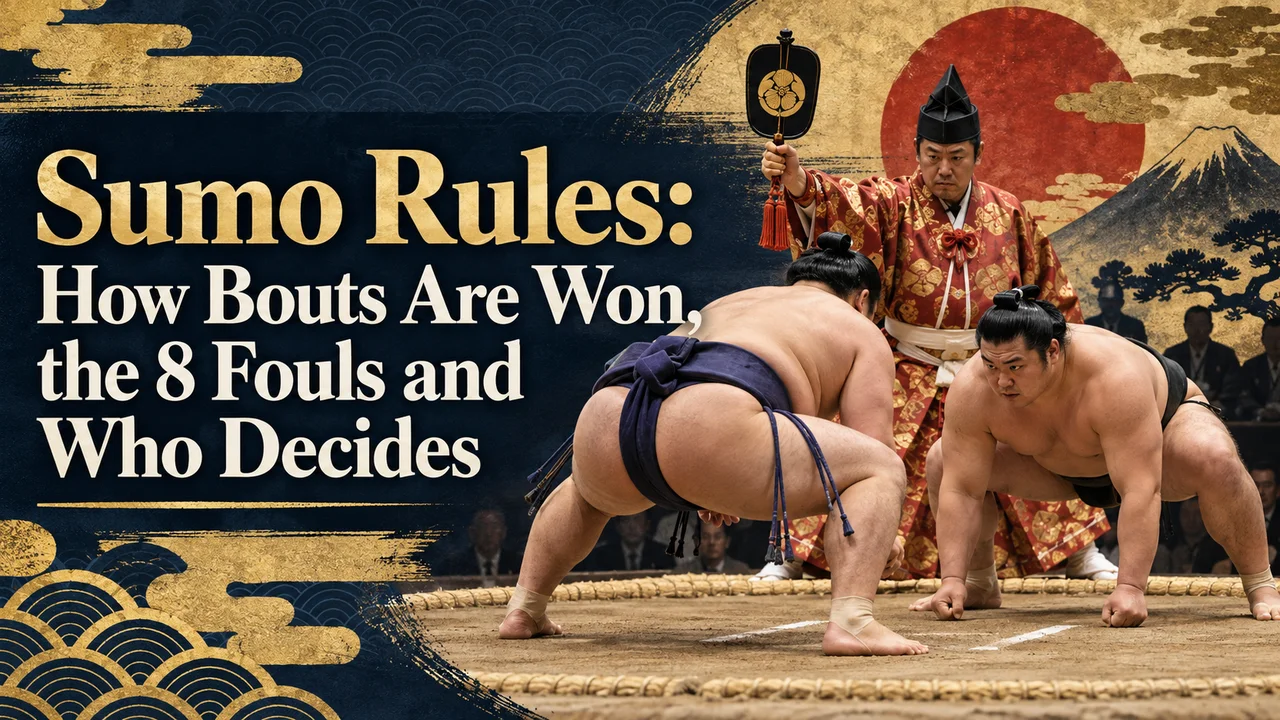
Sumo rules fit in a single sentence. A wrestler loses the moment any part of his body other than the soles of his feet touches the clay, or the moment he touches the ground outside the ring. There are no rounds, no points and no weight classes. Around that sentence sits a short rulebook: 82 official winning techniques, eight forbidden moves, a referee who must call every bout, and five judges who can overrule him. This guide sets it out from the Japan Sumo Association’s own rules and records.
📖 What you’ll learn
- The two ways to lose a sumo bout, and why nothing else counts
- Where the edge of the ring really is: on the bales or beyond them
- The pre-bout time limits, and what makes a false start
- The 82 kimarite, and the two techniques that decide half of all bouts
- The eight forbidden moves, and what happens when one is used
- How the referee, five judges and the mono-ii settle a close call
What Are the Rules of Sumo? The Two Ways to Lose
A sumo wrestler loses when anything but the soles of his feet touches the clay, or when he touches the ground outside the ring.
That is the whole scoring system. The Japan Sumo Association’s English guide spells out how literal it is: a knee, a fingertip or even the topknot brushing the surface is enough, and so is a toe or a heel over the line.
There are no rounds and no points, so nobody can build a lead. Nor is size any protection. Professional sumo has no weight classes, and the Association notes that a wrestler can be matched against an opponent twice his weight.
These are the rules of professional sumo in Japan; amateur sumo has its own rulebook. For the sport’s history and ranks, start with our guide to what sumo is.
Q. Are there weight classes in sumo?
A. Not in professional sumo. The Japan Sumo Association runs a single open competition in which rank, not body weight, decides who meets whom. Its English guide notes that a wrestler can face an opponent twice his weight. A small wrestler gets no allowance: the same two losing conditions apply to everyone, whatever the gap in size.
The Dohyo: Where the Edge of the Ring Actually Is
The edge of the sumo ring is the outside line of its straw bales, so a wrestler standing on the bales is still in.
The Association’s own explanation is plain: while a wrestler stays on top of the bales, he is still alive, or nokotta in the referee’s call. The moment his heel touches the sand beyond them, he has lost.
The dohyo (the raised clay ring in which bouts are fought) is a platform of packed clay 6.7 m (22 ft) square and 60 cm (2 ft) high, dusted with sand. The circle set into it is 4.55 m (14 ft 11 in) across, a size fixed in April 1931, when the Association widened it from 13 to 15 shaku, the traditional Japanese foot. The platform is rebuilt for every tournament.
The circle is made of 20 small straw bales. Sixteen, the shobu-dawara, mark the boundary. The other four, the tokudawara, sit at the four compass points, set outward by about one bale’s width. The Association traces the gap to outdoor sumo, when it let rainwater drain off the ring. Today it gives a wrestler backed onto those points a little extra room.
Q. Is a sumo wrestler out if he steps on the bales?
A. No. The boundary is the outside line of the bales, so a wrestler standing on them is still in play. He loses only when a foot, a heel or any other part of his body touches the ground beyond that line. Inside the ring the same logic holds: standing is fine, but a knee or a hand on the clay ends the bout.
Before the Bout: Shikiri, Time Limits and the Tachi-ai
Before each bout, wrestlers get a fixed preparation period, the shikiri: four minutes in the top division, three in the second and two below.
The clock starts when the yobidashi (the ring announcer) finishes calling the two names. The wrestlers crouch, face each other and return to their side of the ring, repeating the routine until the limit is reached; the next charge is then the real one. The limit can also be shortened on the day so that the final bout ends at 6 p.m.
| Division | Pre-bout time limit | Bouts per tournament |
|---|---|---|
| Makuuchi (top division) | 4 minutes | 15, one a day |
| Juryo (second division) | 3 minutes | 15, one a day |
| Makushita and below | 2 minutes | 7 across the 15 days |
The limits are a modern addition: the Association’s English guide records a 10-minute limit from 1928, later cut to seven, then five, and finally four minutes. For the lower divisions, its Japanese-language site gives two minutes, while the older English guide says those wrestlers begin almost at once.
The bout starts with the tachi-ai, the initial charge, when the two wrestlers synchronise their breathing and rise together. If one goes early, the referee or a judge calls matta, a false start, and they reset. After the January 2026 tournament, the chairman of the Yokozuna Deliberation Council publicly criticised the number of false starts and asked the stablemasters to coach their wrestlers.
One move at the charge is legal but divisive: the henka, a sidestep that leaves the opponent charging into empty space. Nothing in the rules forbids it.
The rituals inside the shikiri are procedure, not scoring, and the Association’s English guide names each one: chikaramizu, “power water”, to rinse the mouth; sonkyo, a crouch on the toes; chirichozu, a clap followed by arms spread wide, palms down; shiko, the high leg stamp traditionally understood as driving evil from the ground; and shiomaki, the salt that by tradition purifies the ring.
Q. Why do sumo wrestlers throw salt before a bout?
A. By tradition, the salt purifies the ring before the wrestlers meet, a practice said to come from sumo’s roots in Shinto ritual. The Association’s English guide lists it as shiomaki, “spreading salt”, one of the set steps of the pre-bout routine. It belongs to the procedure, not the scoring: the bout itself is decided only by the two losing conditions.
How Bouts Are Won: The 82 Kimarite and the Two That Decide Half
The Japan Sumo Association recognises 82 winning techniques, the kimarite, yet two of them, oshidashi and yorikiri, decide about half of all bouts.
Oshidashi is a push-out with no grip on the belt; yorikiri is a force-out while gripping it. The official list sorts the 82 into six groups: 7 basic techniques, 13 throws, 18 trips and leg techniques, 6 backward body drops, 19 twists and 19 special techniques. The Association also counts how often each is used, across 190,450 bouts in all six divisions from January 2013 to July 2026. These are the ten most common.
| # | Kimarite | What happens | Bouts | Share |
|---|---|---|---|---|
| 1 | Oshidashi | Pushes the opponent out without holding the belt | 47,936 | 25.17% |
| 2 | Yorikiri | Forces him out while gripping the belt | 47,473 | 24.93% |
| 3 | Hatakikomi | Slaps him down as he charges forward | 15,677 | 8.23% |
| 4 | Tsukiotoshi | Thrusts him down to the side | 10,348 | 5.43% |
| 5 | Yoritaoshi | Forces him out and down, gripping the belt | 9,163 | 4.81% |
| 6 | Uwatenage | Throws him with an outside belt grip | 8,802 | 4.62% |
| 7 | Hikiotoshi | Pulls him down forward | 6,614 | 3.47% |
| 8 | Oshitaoshi | Pushes him out and down | 6,553 | 3.44% |
| 9 | Okuridashi | Pushes him out from behind | 6,262 | 3.29% |
| 10 | Shitatenage | Throws him with an inside belt grip | 4,323 | 2.27% |
| Top ten combined | 163,151 | 85.66% | ||
The two leaders are separated by just 463 bouts over more than 13 years. That matters because the English Wikipedia article on kimarite says yorikiri accounts for 32.4% of professional bouts. The Association’s own tally puts it at 24.93%, in second place.
At the far end of the same table, five of the 82 techniques were not used once in the whole 13-year count.
Not every loss is a win for technique. The Association files five “non-techniques” for bouts that a wrestler largely loses on his own.
| Non-technique | What happens | Bouts, 2013–2026 |
|---|---|---|
| Isamiashi | The attacker steps out first while driving his opponent to the edge | 374 |
| Tsukihiza | A knee touches the clay with no force from the opponent | 215 |
| Tsukite | A hand touches the clay with no force from the opponent | 90 |
| Koshikudake | He loses his balance and drops onto his hips without being attacked | 51 |
| Fumidashi | He steps out of the ring with no force from the opponent | 42 |
| All five combined | 772 (0.41%) | |
Isamiashi is the cruellest of the five. On March 10, 2026, Day 3 of the March tournament, Asanoyama drove Tobizaru to the bales, but his own right foot had crossed first. The judges reviewed it, and the decision for Tobizaru stood.
Q. What is the most common winning technique in sumo?
A. Oshidashi, the push-out. Across 190,450 bouts in all six divisions from January 2013 to July 2026, the Japan Sumo Association counted 47,936 wins by oshidashi (25.17%), narrowly ahead of yorikiri, the belt force-out, at 47,473 (24.93%). Between them, the two account for just over half of all bouts.
The Eight Forbidden Moves: What Sumo Wrestlers Cannot Do
Sumo bans eight moves, the kinjite, and a wrestler who uses any of them loses the bout on the spot, recorded as hansoku.
The Association’s judging regulations set this out in a single article.
| # | Forbidden move | In practice |
|---|---|---|
| 1 | Striking with a closed fist | No punching. Open-hand slaps and thrusts are legal |
| 2 | Grabbing the hair | No pulling the topknot |
| 3 | Jabbing the eyes, the solar plexus or other vital points | No strikes aimed at weak spots |
| 4 | Slapping both ears at once with open palms | A single slap is legal; the double strike is not |
| 5 | Grabbing the front vertical fold of the mawashi (the silk competition belt) | Also hooking fingers in from the side and pulling |
| 6 | Grabbing the throat | No gripping the windpipe |
| 7 | Kicking the chest or stomach | Trips and leg sweeps are legal |
| 8 | Bending back one or two fingers | No finger locks |
What is left is a great deal. Pushing, open-hand slapping, gripping the belt, tripping and even picking up a leg are all legal: ashitori, the leg pick, is one of the 82 official techniques. Grabbing only the rear vertical fold of the mawashi is not a foul either; the referee simply tells the wrestler to change his grip. More on the belt is in our guide to the mawashi.
Fouls do happen at the top level. Two recent top-division cases were both for pulling the topknot: Ryuden over Asakoryu on January 11, 2026, and Abukatsu over Oshoma on March 13, 2026. Both times the referee had pointed his fan at the man who pulled the hair, and the judges reversed the call.
Whether a hand actually grabbed the hair is a judgment call, and it belongs to the judges on review.
Q. Can you grab your opponent’s legs in sumo?
A. Yes. Grabbing a leg is legal, and the leg pick, ashitori, is one of the Japan Sumo Association’s 82 official winning techniques. Trips and sweeps are legal too, and several appear in the official list of techniques. What is banned is kicking an opponent in the chest or stomach.
Who Decides: The Gyoji, Five Judges and the Mono-ii
Every bout is called by a referee, the gyoji, but five judges seated around the ring can challenge his decision and overturn it.
The gyoji starts the bout, follows it and, at the end, points his war fan, the gunbai, toward the winner’s side. Referees are ranked, and the colour of their tassels shows the grade, from purple for the two senior referees down to blue or black in the lowest divisions. Only those two, who hold the names Kimura Shonosuke and Shikimori Inosuke, may officiate a bout involving a yokozuna (sumo’s highest rank).
According to the Association’s English guide, the five shimpan, judges in black formal kimono, are all former wrestlers serving as elders. For how the Association itself is organised, see our guide to the Japan Sumo Association.
If any judge disagrees with the referee, he raises a hand and a mono-ii, a judges’ conference, follows. The five confer on the dohyo and check the replay with a video room. The head judge then announces one of three outcomes: gunbai-dori, the call stands; sashichigae, the call is reversed; or torinaoshi, a rematch, ordered when the two men fell or stepped out together, which is called dotai, “same body”.
On September 20, 2024, Day 13 of the September tournament, the referee gave the bout between Onosato, then a sekiwake (the third-highest rank), and Kotozakura, an ozeki (the rank above), to Kotozakura. The judges ruled it dotai, and Onosato won the rematch by yorikiri. The record is older: in May 1988, Kirishima and Mitoizumi needed three rematches in a row, four bouts in all.
How often mono-ii happen is not published, and bout records generally log only the deciding bout, so any figure quoted for it is an estimate.
Q. What happens when a sumo bout is too close to call?
A. Any of the five judges can raise a hand to call a mono-ii. The judges meet on the ring, check the video replay, and the head judge announces the outcome: the referee’s call stands, it is reversed, or the bout is fought again from the charge. A rematch, torinaoshi, is ordered when both wrestlers touched down or went out at the same time.
Tournament Rules: 15 Days, Kachikoshi and Playoffs
Wrestlers in the top two divisions fight once a day for 15 days, those below fight seven times, and a winning record decides promotion.
There are six Grand Sumo Tournaments, or basho, a year: January, May and September in Tokyo, March in Osaka, July in Nagoya and November in Fukuoka. The next one opens at Ryogoku Kokugikan on September 13, 2026. Every date is in our sumo tournament schedule.
A winning record, kachikoshi, is eight or more wins out of 15, or four out of seven; a losing one is makekoshi. That line decides whether a wrestler moves up or down the banzuke, the ranking sheet redrawn after every tournament, as our guide to sumo rankings explains. Only a yokozuna cannot be demoted; one who keeps losing is expected to retire instead.
A wrestler who cannot appear loses by default, fusenpai, and his opponent is credited with a win.
Each division crowns the wrestler with the best record, and the top-division champion receives the Emperor’s Cup. Two tied wrestlers meet in a playoff. Three fight a tomoesen: according to the Association, they draw lots marked “East 1”, “West 1” and a circle, the first two meet, the winner faces the third, and the title goes to the first man to win twice in a row.
That is how Aonishiki won in Nagoya on July 26, 2026. He, Kirishima and Atamifuji all finished 12–3; Atamifuji beat Kirishima, then Aonishiki beat Atamifuji and Kirishima in turn.
Three special prizes, for outstanding performance, fighting spirit and technique, go to top-division wrestlers ranked sekiwake or below, and only to those with a winning record.
Q. What happens if sumo wrestlers tie for the championship?
A. They fight a playoff after the final bout of the last day. Two tied wrestlers meet once. Three tied wrestlers fight a tomoesen: they draw lots, the first two meet, and the winner takes on the third, repeating until one wrestler wins twice in a row. At the July 2026 tournament, Aonishiki won a three-way playoff exactly that way.
How to Follow a Bout: What to Watch in the Final Seconds
To follow a sumo bout, watch the feet at the bales: half of all bouts end with one man forced over the edge.
The upper body shows who is attacking; the feet show who is winning. Then look at the gyoji’s fan, which gives the provisional result. If a judge raises a hand, nothing is settled until the head judge speaks. Once it is, the winning technique is announced and entered in the record.
The banners paraded around the ring before some bouts are kensho, sponsors’ prize money. According to the Association, each costs ¥70,000 (approx. US$470), of which the winner takes home ¥30,000 (approx. US$200).
To watch the bouts on TV or online, including start times in your time zone, see our guide to how to watch sumo live.
For seats and prices, see our guide to buying sumo tickets; for the Tokyo venue, see Ryogoku Kokugikan.
Summary
Sumo’s rules are short, and almost everything else in the sport exists to serve them.
A wrestler loses when anything but the soles of his feet touches the clay, or when he touches the ground beyond the bales. Wins are logged against 82 techniques, half of them by oshidashi or yorikiri. Eight moves are forbidden and cost the bout at once, and five judges can overturn the referee through a mono-ii.
Read next: What is sumo? · Sumo rankings explained · Grand sumo tournament schedule · Yokozuna · The mawashi
The rulebook fits on a page, which is why so much of sumo happens before a bout starts. The four minutes of shikiri, the choice of grip, the decision to meet the charge or step aside: none of it is scored. The rules settle only the last second. What decides that second has been under way for much longer.