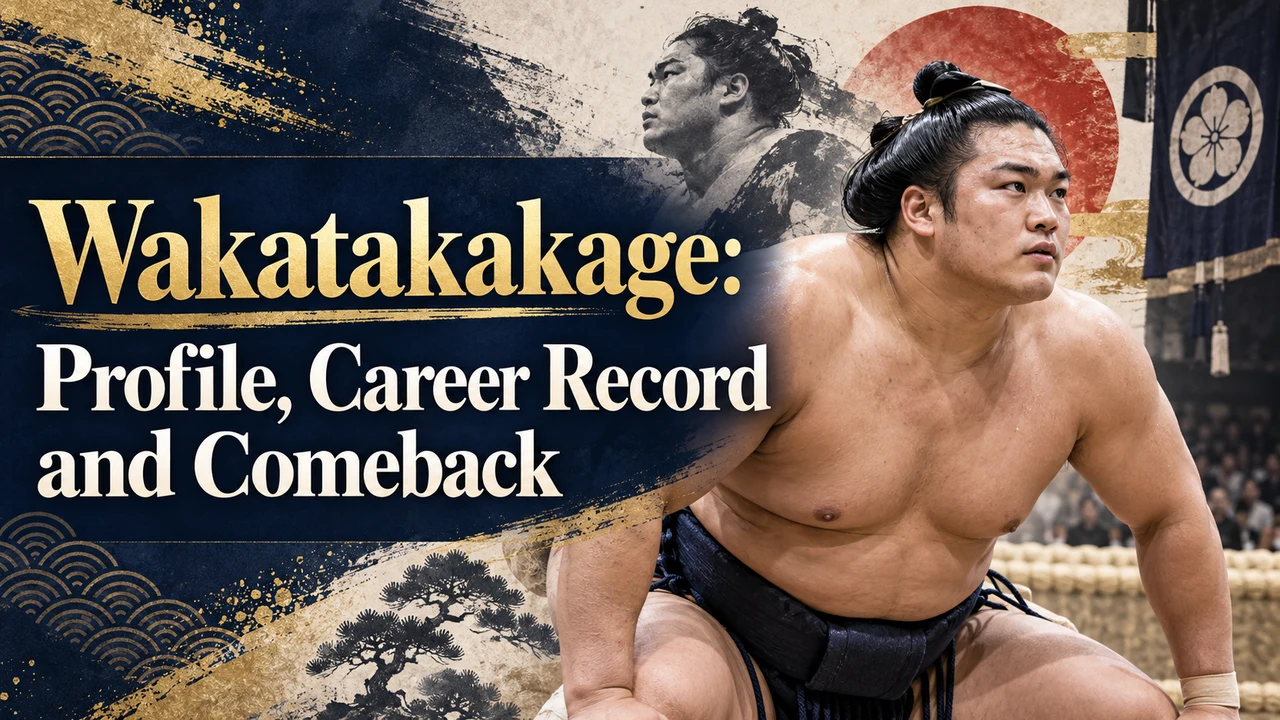
Wakatakakage has won the Emperor’s Cup twice, and both times he did it from a rank below the sport’s second-highest. The Japan Sumo Association credits the Arashio stable wrestler with 420 wins, 261 losses and 95 absences as of Day 8 of the September 2026 tournament, where his name sits at maegashira #12, the rank and file of the top division. Three years earlier a knee injury dropped him out of the salaried divisions altogether. This page sets out his profile, his record as the association publishes it, the fall and the climb back, and how he actually wins.
📖 What you’ll learn
- Who Wakatakakage is, and what the Japan Sumo Association lists as his record
- How he fell from the third-highest rank to the unsalaried divisions and came back
- The one technique he says he is the best in sumo at, and what the numbers say about it
- Where he stands in September 2026, and where you can watch his stable train
Who Is Wakatakakage?
Wakatakakage Atsushi is a Japanese sumo wrestler from Fukushima who fights for the Arashio stable and has won two top-division championships. His highest rank is sekiwake, the second of the three titled ranks below the champion grade, and he has been a professional since March 2017.
He belongs to a category that is rarer than it sounds: a rikishi, a professional sumo wrestler, who arrived through a university sumo club rather than out of junior high school. He graduated from Toyo University in 2017 and entered the ranks part-way up the ladder, which is why his professional career is shorter than his sumo career.
Two things about him are worth fixing in mind before the record. The first is his listed size: the association records him at 183.0 cm (6 ft 0 in) and 138.0 kg (304 lb) in makuuchi, the top division. The second is what he does with it, which is to get both hands inside, take the belt and walk his opponent out rather than push him.
The third thing is the one this page keeps coming back to. In 2023 he was ranked sekiwake and then missed three tournaments in a row with a knee injury, falling to the third of sumo’s six divisions, where wrestlers are unpaid. He climbed back to the top division inside a year, and in May 2026 he won the Emperor’s Cup from komusubi, the lowest titled rank. If the ranking system itself is new to you, our guide to what a rikishi is explains the working life behind those words.
Wakatakakage’s Profile: Rank, Size and Stable
Wakatakakage is listed at east maegashira #12 for September 2026, at 183.0 cm and 138.0 kg, fighting for Arashio stable. Every figure in the table below comes from the Japan Sumo Association’s profile page, which is marked “as of September 2026: Day 8.” That date matters, because the September tournament was still running when the association published these numbers.
| Item | Detail |
|---|---|
| Ring name | Wakatakakage (unchanged since his debut) |
| Real name | Atsushi Onami |
| Born | December 6, 1994 |
| Birthplace | Fukushima City, Fukushima Prefecture |
| Height and weight | 183.0 cm (6 ft 0 in), 138.0 kg (304 lb) |
| Stable | Arashio |
| Rank in September 2026 | East maegashira #12 |
| Highest rank | Sekiwake |
| Career record | 420 wins, 261 losses, 95 absences |
| Top-division record | 259 wins, 164 losses, 80 absences |
| Signature technique | migi-yotsu, yori |
| Professional debut | March 2017 |
Two rows repay a second look. The 95 absences are days and whole tournaments sat out injured, and the association records them in the same ledger as the wins, so they stay visible for the rest of a career. “Migi-yotsu, yori” is the association’s own shorthand for how he fights: migi-yotsu means his right hand goes inside on the belt, and yori means he walks the opponent backwards from there.
The stable line matters too. Arashio heya, the stable a wrestler lives and trains in, is run by a former maegashira #2 who fought as Sokokurai, and stands in the Sumida ward of Tokyo. Our own survey of the stables counted 15 wrestlers there in September 2026. His older brother Wakamotoharu fights out of the same stable, and in September 2026 the two of them were ranked side by side, at east maegashira #11 and #12. When we surveyed the stables for our guide to the stable system, Arashio was the only one we found that lets the public watch a morning practice from the street: the stable’s own site says training is open to view from about 7:30 a.m., asks visitors to come to the east gate, and states that there is no parking.
Q. What rank is Wakatakakage now?
A. He is listed at east maegashira #12 for the September 2026 tournament, which places him in the lower half of the top division. His highest rank was sekiwake, which he last held in July 2026. According to the Japan Sumo Association’s record, he had not fought a bout in the September tournament through Day 8.
From Toyo University to a Sandanme Start
Wakatakakage entered professional sumo at 22, after four years at Toyo University, and he started three divisions above the bottom rung. That is unusual. The ordinary route into the association starts a new wrestler at the foot of the ranking sheet in the lowest division, whatever he has won as an amateur, and the entry he used is the exception to it.
He earned the head start. Toyo University’s alumni magazine records that he studied business law, served as vice-captain of the sumo club in his fourth year, and won the team title and finished runner-up in the individual event at the National University Student Sumo Championship. That result qualified him for sandanme tsukedashi, an entry route that places a decorated student wrestler directly into the third division from the bottom.
The association’s Japanese-language record for Wakatakakage shows what that looked like in practice. At the March 2017 tournament he appeared on the banzuke, the ranking sheet the association redraws before every tournament, as a sandanme #100 tsukedashi entrant, and he went 5-2. He has never changed his ring name since.
Sumo was the family business long before any of that. He is the youngest of three brothers who all turned professional, his father runs a sumo dojo in Fukushima, and in the association’s own questionnaire he gives the age he started as seven and his motto as single-minded devotion. His two older brothers left for the ranks straight from high school; he was the one who went to university first, and the Japan Times counted brother pairs in the salaried ranks at 19 in the sport’s history when the second of them arrived.
Q. Are Wakatakakage and Wakamotoharu brothers?
A. Yes. Wakamotoharu is his older brother, they fight for the same Arashio stable, and both are listed as being from Fukushima. The Japan Times counted 19 sets of brothers who had reached salaried rank in the sport’s history, and noted in 2019 that these two were the most recent pair to do it.
Two Emperor’s Cups: 2022 and the Rare Komusubi Title
Wakatakakage has won the top-division championship twice, in March 2022 from sekiwake and in May 2026 from komusubi, the lowest of the titled ranks. Both times he won it from below ozeki, the second-highest rank.
| Championships and prizes | Count |
|---|---|
| Top-division (makuuchi) championships | 2 |
| Second-division (juryo) championships | 1 |
| Third-division (makushita) championships | 2 |
| Fourth-division (sandanme) championships | 1 |
| Technique Prize | 7 |
| Outstanding Performance Award | 1 |
| Fighting Spirit Prize | 0 |
| Kinboshi (wins over a grand champion from the rank and file) | 1 |
The first cup came in March 2022, when he was ranked east sekiwake and finished 12-3. The association’s tournament record shows that he then held sekiwake for seven tournaments in a row, from that March through March 2023, which is the longest unbroken run at a titled rank in his career. He took a Technique Prize in two of those seven.
That prize column is the most revealing thing on his page. The association hands out three special prizes after every top-division tournament, and his tally is seven Technique Prizes, one Outstanding Performance Award and no Fighting Spirit Prizes at all. Seven of his eight special prizes name technique.
The May 2026 title is the rarer of the two championships. The Japan Times reported that he was only the 11th man since 1931 to win the sport’s biggest prize while ranked at komusubi, and that he took it by beating Kirishima in a playoff for the cup. The same report noted that of the previous 10 komusubi champions, only two never went on to reach ozeki or the top rank, and the most recent of those was fighting in the 1950s.
His 12-3 record in that tournament also carried a seventh Technique Prize. For what the ranks above and below komusubi mean, and how a wrestler moves between them, see our guide to the sumo ranking system.
Q. How many championships has Wakatakakage won?
A. Six in total, across four divisions. The Japan Sumo Association credits him with two top-division championships, one in juryo, two in makushita and one in sandanme. Only the top-division titles come with the Emperor’s Cup; the others are division championships won on the way up, and two of them came during his climb back in 2024.
The Fall to Makushita and the Climb Back
Wakatakakage fell from sekiwake to the third of sumo’s six divisions in eight months, and it started with one bout. On Day 13 of the March 2023 tournament, in a rematch against the komusubi Kotonowaka, he injured his right knee.
He was 7-6 at that point. On Day 14, March 25, he withdrew and filed a medical certificate reporting damage to the right anterior cruciate ligament and the right lateral meniscus, among other injuries, and requiring roughly three months of treatment, as reported by Nikkei. The tournament closed for him at 7-7-1.
What happened next is what the ranking sheet does to an injured wrestler who cannot come back quickly. He missed the next three tournaments outright, and each absence was recorded as 0-0-15, a full 15 days sat out. The sheet is redrawn six times a year and reads only the last 15 days, so three blank tournaments in a row took him from sekiwake to makushita, the third division, where wrestlers receive no salary and fight seven bouts instead of fifteen.
| Tournament | Rank | Record |
|---|---|---|
| March 2023 | East sekiwake | 7-7-1 |
| May 2023 | West komusubi | 0-0-15 |
| July 2023 | West maegashira #12 | 0-0-15 |
| September 2023 | East juryo #7 | 0-0-15 |
| November 2023 | East makushita #6 | 5-2 |
| January 2024 | West makushita #1 | 7-0, division champion |
| March 2024 | West juryo #10 | 9-6 |
| May 2024 | West juryo #6 | 14-1, division champion |
| July 2024 | East maegashira #14 | 11-4 |
| September 2024 | East maegashira #7 | 12-3, Outstanding Performance Award |
Read that table downwards and the return takes ten tournaments, but the working part of it takes five. From November 2023 he went 5-2, 7-0, 9-6, 14-1 and 11-4, losing 13 bouts in total across five tournaments in four different divisions. The 7-0 in January 2024 is the one that put him back on a wage, because it returned him to juryo, the second division and the lower of the two salaried ones, for March. The 14-1 that followed in May took the second-division title and carried him back to the top division, and the 12-3 in September 2024 brought his only Outstanding Performance Award.
A fall that far is not a slump, it is a different job. In makushita a wrestler is unpaid, fights seven bouts, and does chores in the stable for the salaried men above him. He had been a sekiwake with a championship to his name eight months earlier, and none of that counted for anything on the day. What he had instead was the right to keep entering, and the ranking sheet’s habit of reading only what just happened.
Q. Why did Wakatakakage drop to the makushita division?
A. Because of a knee injury in March 2023 and the three full tournaments he missed after it. Each missed tournament is recorded as 0-0-15 and treated as a losing record, so his rank fell from sekiwake through the top division and juryo into unsalaried makushita. The Japan Times has since written that injuries have dogged his promotion hopes throughout his career.
How Wakatakakage Wins: Ottsuke, Migi-Yotsu and Seven Technique Prizes
Asked by the Japan Sumo Association which single thing in sumo he is the best in the sport at, Wakatakakage answered with one word: ottsuke. The move is a clamp — he presses his arm and elbow in against an opponent’s arm to kill the man’s inside grip before it exists, and takes his own grip instead.
It is a technician’s answer, and the association’s own numbers agree with it. The profile page publishes a breakdown of his winning techniques, and it is lopsided towards the belt.
| Winning technique | Wakatakakage | Share of all recorded bouts |
|---|---|---|
| Yorikiri (force out, belt grip) | 22 wins (42%) | 24.93% |
| Oshidashi (push out, no belt grip) | 11 wins (21%) | 25.17% |
| Tsukiotoshi (thrust down) | 4 wins (8%) | 8.23% |
| All other techniques combined | 29% | — |
Read the two columns against each other. The association’s own tally of every recorded bout puts yorikiri at 24.93% of all wins across the sport, second behind oshidashi. In his sample it is 42%, about 1.7 times the sport-wide rate, while his push-out share sits well under the sport-wide figure. He wins by grip where sumo as a whole wins by shove.
One caveat belongs with that chart. The association labels his graph 52 wins from 89 bouts but does not say which tournaments it covers, so the percentages describe that sample and not his whole career. The sport-wide figures come from the association’s separate tally of all 82 recognised kimarite, the named winning techniques, which is a different and much larger data set.
The bottom row deserves a moment as well. The association recognises 82 named kimarite in all, and the 29% it files under “other” is spread across that catalogue rather than gathered in one throw. A wrestler who has already taken the belt has most of those options open to him.
What the two numbers together describe is a style. Ottsuke kills the opponent’s inside hand, migi-yotsu puts his own right hand on the belt, and yorikiri finishes it by walking the man out. It is also the sequence the Technique Prize is named for, and his count of that prize reads seven while his Fighting Spirit count reads zero. Our guide to how a sumo bout is won sets out what the grip is and is not allowed to do.
Q. Can you watch Wakatakakage train?
A. You can watch his stable train, from the street. Arashio stable in Sumida, Tokyo, opens its morning practice to the public through windows at ground level, free and without a reservation, from about 7:30 to 9:00 a.m. The stable asks visitors to approach from the east gate and notes that there is no parking.
Where Wakatakakage Stands in September 2026
At the September 2026 tournament Wakatakakage is ranked east maegashira #12, and the association’s record shows 0-0-8 through Day 8. That is his name on the ranking sheet with no bouts fought, and the association does not publish a reason alongside the record.
The sequence before it is on the record. In July 2026 he was ranked east sekiwake and sat out the entire tournament, recorded as 0-0-15. The Japan Times reported that he had been taken to hospital for two emergency femoral compartment syndrome operations totalling five hours after an injury in training, and that he would miss the Nagoya tournament in full. A medical certificate dated July 7, reported by Nikkei, described traumatic compartment syndrome in the left thigh and called for two months of rest and treatment, adding that this might change depending on how the symptoms developed.
Between those two absences sits the best result of his career. In May 2026, at komusubi, he went 12-3, won the Emperor’s Cup and took a seventh Technique Prize, then was ranked sekiwake again for July.
The promotion question is therefore open rather than answered. At the time of the May title the Japan Times put the likely requirement for ozeki at 11 wins or better in each of the next two tournaments, and noted that he would turn 32 later in the year. Neither of the two tournaments since has produced a bout. The history is on his side and the calendar is not, and only the ranking sheet for the next tournament will say which of the two is winning.
Q. Will Wakatakakage be promoted to ozeki?
A. Nobody can say, and the association does not promote on reputation. The Japan Times reported after his May 2026 title that he would likely need 11 wins or better in each of the next two tournaments, and he has not fought in either of them. Of the previous 10 komusubi champions, the same report noted, only two never reached ozeki or the top rank.
Summary
Wakatakakage is a technician who has twice won sumo’s biggest prize from outside the two highest ranks, and who came back from the unpaid divisions to do it the second time. The association’s page records 420 wins, 261 losses and 95 absences as of Day 8 of the September 2026 tournament, two top-division championships, seven Technique Prizes and no Fighting Spirit Prizes at all.
For the wider picture, our directory of sumo wrestlers past and present is the place to start, with the ranking system, what a rikishi is and the stables behind it.
The absences in his record are not a footnote to the career; they are most of the story of it. Three blank tournaments in 2023 took a sekiwake down to an unpaid division, and five tournaments took him back. What the ranking sheet is really measuring, in a sport with no seeding and no protected places, is what a wrestler can still do in the next 15 days. He has answered that question twice, and it is being asked of him again.