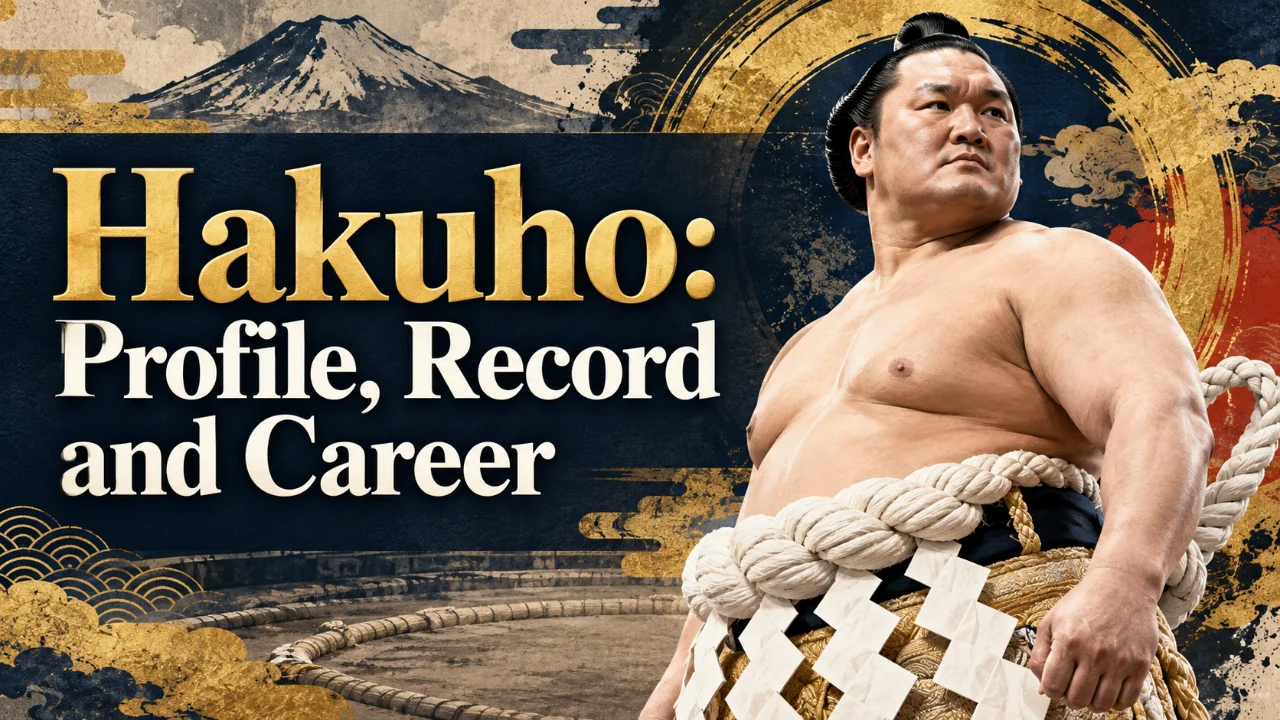
Hakuho is the 69th yokozuna, sumo’s highest rank, and the record holder for top-division championships with 45. He fought from 2001 to 2021, finished with 1,187 career wins, and left the Japan Sumo Association altogether in June 2025. This guide follows the Association’s own records on his career and how he won. It then covers what happened at his stable after he retired, and what he does now.
📖 What you’ll learn
- What the Japan Sumo Association’s records say about his profile and career
- How a 62 kg recruit from Mongolia reached yokozuna in just over six years
- The records behind his 45 championships, and how he actually won his bouts
- Why his stable closed in 2024, and what he has done since leaving the Association
Who Is Hakuho?
Hakuho is a retired sumo wrestler from Mongolia who became the 69th yokozuna and won a record 45 top-division championships.
He was born on March 11, 1985, in Ulaanbaatar, Mongolia, and fought his whole career for Miyagino stable. The Japan Sumo Association lists his highest rank as “The 69th Yokozuna” and records his retirement in September 2021. He held the rank of yokozuna from July 2007 until that retirement, a span of more than fourteen years.
In the record book, Hakuho sumo means a wrestler who almost never lost. Across his top-division career he won 1,093 bouts and lost 199. Set the absences aside and that is a winning rate of about 85 percent over 103 tournaments.
His career after the ring has been far less settled. He became a coach inside the Association and took over his old stable. He then saw it closed after a violence case involving one of his wrestlers, and resigned. Since June 2025 he has worked in sumo from outside the professional system.
For daily life as a rikishi, the formal word for a professional sumo wrestler, see our guide to what a rikishi actually is.
Q. Is Hakuho still part of professional sumo?
A. No. The Japan Sumo Association announced that the elder Miyagino, registered name Sho Hakuho, left the Association with effect from June 9, 2025. He no longer coaches any wrestler in professional sumo. He now runs events such as the Hakuho Cup, an amateur tournament, from outside the Association.
Hakuho’s Profile: Real Name, Height and Stable
The Japan Sumo Association registers him as Sho Hakuho and lists him at 192 cm (6 ft 4 in) and 155 kg (342 lb).
That registered name is why searches for yokozuna Hakuho Sho lead to the same man. When he took Japanese citizenship in September 2019, according to Nippon.com, his ring name became his legal name too. Nippon.com writes the ring name with a macron, as Hakuhō Shō in full. The Association’s English pages drop the macron.
He was born Mönkhbatyn Davaajargal, a name Nippon.com and Reuters both give. His father, Jigjidiin Mönkhbat, won a silver medal in freestyle wrestling at the 1968 Mexico City Olympics, according to Nippon.com.
The table below reproduces the fields on the Association’s profile and former-yokozuna pages, as recorded on October 3, 2026.
| Item | Official record |
|---|---|
| Ring name | Hakuho |
| Registered name | Sho Hakuho |
| Born | March 11, 1985 |
| Birthplace | Ulaanbaatar, Mongolia |
| Height | 192.0 cm (6 ft 4 in) |
| Weight | 155.0 kg (342 lb) |
| Highest rank | The 69th Yokozuna |
| Signature maneuvers | migi-yotsu, yori, uwatenage |
| Stable as a wrestler | Miyagino |
| Career record | 1,187-247-253 (122 tournaments) |
| Top-division record | 1,093-199-253 (103 tournaments) |
| Retired | September 2021 |
Two lines in that table deserve a second look, and one deserves a caution. The caution is the weight: 155 kg is the figure the Association publishes, not a measurement taken at any particular tournament. The second look goes to the absences. The Association’s career and top-division records both show 253, so none of them came before he reached the top division.
His stable, Miyagino, was a small one when it took him in. The sumo stable system explains how a stable recruits, houses and trains its wrestlers.
Q. What is Hakuho’s real name?
A. His registered name is Sho Hakuho, given name first, as the Association’s English profile prints it. The Association’s Japanese pages put the family name first, as Hakuho Sho, which is why both orders appear in search results. He was born Mönkhbatyn Davaajargal in Mongolia, according to Nippon.com and Reuters.
From a 62 kg Recruit to Yokozuna in Six Years
Hakuho debuted in March 2001 and first appeared on the ranking sheet as yokozuna in July 2007, six years and four months later.
The start was unpromising. According to Nippon.com, he arrived in Japan in October 2000 with a group of Mongolian hopefuls. He stood 175 cm (5 ft 9 in) and weighed 62 kg (137 lb). Stablemasters passed him over for bulkier prospects. He was preparing to fly home when Miyagino stable made a last-minute offer.
His stablemaster, the former Chikubayama, chose the ring name with care. Nippon.com reports that it joins characters from Kashiwado and Taiho, two yokozuna whose 1960s rivalry gave its name to an era. The Association’s record of his promotions shows how quickly he grew into it.
Two tournaments decided the last step. Hakuho won his first top-division title in May 2006, his debut tournament at ozeki, going 14-1, according to an Association report. In May 2007 he won again with a perfect 15-0 record, which Nippon.com says secured his promotion.
There is a gap worth knowing about here. Nippon.com records a promotion ceremony at the stable on May 30, 2007. The Association’s ranking record shows him at yokozuna from July 2007, the next tournament. Both dates are correct; one is the decision and the other is the ranking sheet.
Our guide to how the sumo rankings work explains each rank along the way, from the unsalaried lower divisions to the titled ranks. What a wrestler must show to be promoted to the top rank is covered in our guide to the rank of yokozuna.
Q. How old was Hakuho when he became yokozuna?
A. He was 22. Nippon.com reports that he was 22 years and 2 months old when the promotion was decided, the third-youngest wrestler to reach the rank. By the Association’s dates he debuted in March 2001, the month he turned 16, and retired at 36 in September 2021.
Hakuho’s Record: 45 Championships and 1,187 Wins
Hakuho won 45 top-division championships and 1,187 career bouts, and the Association lists both figures on his official profile.
The championship count is the headline figure on his profile. Nippon.com reports that he took sole possession of the all-time record in January 2015 with his 33rd title, passing Taiho’s 32. He then added twelve more over the next six years.
The table below sets out the awards the Association records for him, alongside two records that Nippon.com reported at the time.
| Award or record | Figure | Source |
|---|---|---|
| Top-division championships | 45 | Japan Sumo Association |
| Juryo championships | 1 | Japan Sumo Association |
| Lower-division championships | 0 | Japan Sumo Association |
| Outstanding Performance Prize | 3 | Japan Sumo Association |
| Fighting Spirit Prize | 1 | Japan Sumo Association |
| Technique Prize | 2 | Japan Sumo Association |
| Kinboshi | 1 | Japan Sumo Association |
| Career wins | 1,187 | Japan Sumo Association |
| Consecutive wins in 2010 | 63 | Nippon.com |
| Title that passed Taiho’s 32 | 33rd, January 2015 | Nippon.com |
A few rows need a word of explanation. The three prizes, the sansho, are awarded only to wrestlers ranked below ozeki, so all six came before his promotion in 2006. His one kinboshi is earlier still: only a maegashira, a rank-and-file top-division wrestler, earns one by beating a yokozuna.
The winning streak belongs to 2010. Nippon.com reports that Hakuho put together 63 consecutive wins that year. Accounts differ on the tournament in which the count reached 63, so this page gives the year only.
The lower rows are just as telling. He won the second division, juryo, once, and no lower division at all. His dominance began at the top, not on the way there. The full list of wrestlers covered on this site, past and present, is in our directory of sumo wrestlers.
Q. How many championships did Hakuho win?
A. He won 45 top-division championships, the most in sumo history. The Association’s records also show 103 top-division tournaments, so he won the title in roughly 44 percent of the tournaments he was ranked in. That count includes tournaments he missed through absence.
How Hakuho Won: Right-Hand Grip and Belt Sumo
Hakuho won mostly by taking a right-hand inside grip on the belt, then forcing or throwing his opponent out of the ring.
The Association lists his signature maneuvers as migi-yotsu, yori and uwatenage. Migi-yotsu means both wrestlers hold the belt with the right arm inside. Yori means driving forward while gripping the belt. Uwatenage is an overarm throw, made with the hand on the outside of the opponent’s arm.
His profile also publishes a breakdown of his most-used winning techniques over a set of bouts it counts: 17 wins from 18 bouts. The page does not say which period those bouts cover, so this article does not date them. The percentages below are shares of those 17 wins.
Read with the Association’s classification of the 82 kimarite, its named winning techniques, the pattern is clear. Two of his top three are basic techniques that begin with a belt grip and a forward drive. The third is a throw. Nearly half his wins in the sample came by other techniques, which is what a complete wrestler looks like on paper.
In practice, a migi-yotsu bout starts with both wrestlers reaching for the belt with the right arm inside. His listed maneuvers follow from that position: the forward drive, yori, and the overarm throw, uwatenage. That breadth is the point. In the Association’s sample, almost half his wins came by techniques outside his top three. The full set of techniques and how bouts are decided is covered in our guide to the rules of sumo.
Not every tactic was popular. Nippon.com reports that he used kachiage, an upward forearm strike, and harite, a slap to the face, at the opening charge. He stopped using them later in his career after criticism that they were unbecoming of a yokozuna.
Q. Was Hakuho’s face slap against the rules?
A. No. Open-hand slaps are allowed in sumo; striking with a closed fist is one of the fouls. Our guide to the sumo rules lists the eight fouls. The objection to Hakuho’s harite and kachiage was about what suited a yokozuna, not about legality, according to Nippon.com.
Retirement, Miyagino Stable and the 2024 Scandal
The Association’s board approved Hakuho’s retirement on September 30, 2021, and he stayed on as a coach until June 2025.
Staying on required two things. The first was Japanese citizenship, which a stablemaster must hold; he had taken it in September 2019, according to Nippon.com. The second was one of the Association’s limited elder names. The board approved his succession to the name Magaki on the same day as his retirement. He held it only until he took the Miyagino name in 2022. The Association’s notice of June 1, 2023 records that the former Ishiura, a wrestler from the same stable, then succeeded to Magaki.
Nippon.com also reports an unusual condition. Before approving his elder name, the Association had him sign a pledge to uphold the traditions of sumo and the Association’s rules “in words and actions.” The table below sets out what followed, using the Association’s notices and contemporary reporting.
| Date | Event | Source |
|---|---|---|
| September 30, 2021 | Board approves his retirement and his succession to the elder name Magaki | Japan Sumo Association |
| July 2022 | Becomes master of Miyagino stable as Miyagino | Jiji Press via Nippon.com |
| February 2024 | Demoted two ranks and given a 20% pay cut for three months over violence by his wrestler Hokuseiho | Jiji Press via Nippon.com |
| March 2024 | Miyagino stable shut down; he and its wrestlers move to Isegahama stable | Nippon.com |
| June 9, 2025 | Leaves the Japan Sumo Association | Japan Sumo Association |
| June 9, 2025 | Elder name Miyagino passes to the former yokozuna Asahifuji | Japan Sumo Association |
The February 2024 case is the turning point. Jiji Press reported that Hokuseiho, a top-division wrestler at the stable, had repeatedly assaulted junior stablemates. Hakuho said he had not noticed the abuse, but accepted that he had failed to protect his wrestlers. The penalty dropped him to the lowest elder rank, and Jiji called it the third-heaviest of seven possible sanctions.
The stable closed the following month. Nippon.com’s timeline describes Miyagino stable as shut down, with the stablemaster and wrestlers transferred to Isegahama stable. It was never reopened under him. On June 9, 2025, the Association announced his departure. How the Association governs its elders, and why elder names are so tightly limited, is explained in our guide to the Japan Sumo Association.
Q. Why did Hakuho leave the Japan Sumo Association?
A. The Association announced his departure on June 9, 2025, without giving a reason. Nippon.com reported that it followed the closure of Miyagino stable in 2024, after one of his wrestlers abused junior stablemates. Jiji Press reported that Hakuho said he had no regrets and would be involved in sumo from outside the Association.
Hakuho Today: The Hakuho Cup and Sumo Outside the Association
Hakuho now runs the Hakuho Cup, an international amateur tournament, and promotes sumo from outside the professional Association.
The tournament predates his departure. It began as a competition for children while he was still wrestling, and the 2026 edition, the 16th, shows how far it has grown. According to the tournament’s official site, the Hakuho Cup 2026 was held on February 7 and 8, 2026, at Toyota Arena Tokyo, with free admission.
The program has widened too. The official site lists boys’ divisions from preschool to junior high on the first day. The second day opened with girls’ divisions for elementary and junior high students. Selected high school, university and adult wrestlers, men and women, followed in four weight classes. Its stated theme is “uniting the world through sumo.”
The organizers are the Hakuho Cup Executive Committee and Hakuho Dayan Sumo & Sports Co., Ltd., according to the same site. When he left the Association, Jiji Press reported his plan to spread sumo worldwide. He framed it as a “world sumo grand slam.” No professional league has been announced.
His old stable lives on in a different form. The elder name Miyagino passed to the former yokozuna Asahifuji on the day Hakuho left. On the same day, the former yokozuna Terunofuji took over Isegahama stable, where the former Miyagino wrestlers had moved. His story is told in our profile of Terunofuji.
Q. Can you watch the Hakuho Cup in person?
A. Yes. The official site listed the 2026 edition at Toyota Arena Tokyo as free admission with unreserved seating. It asked visitors who need wheelchair seating or other support to contact the organizers in advance, because those seats are limited.
Summary
Hakuho is the 69th yokozuna, the record holder with 45 top-division championships, and since June 2025 a figure outside professional sumo.
The Association’s records give the shape of his career. He debuted in 2001 as an overlooked 62 kg recruit and reached yokozuna by 2007. He then held the rank until 2021, winning 1,093 top-division bouts and losing 199. He won on the belt, with a right-hand grip, a forward drive and throws from either side.
The years since have been harder to summarize. He became a coach in 2021 and a stablemaster in 2022. He was penalized in 2024 when one of his wrestlers abused junior stablemates, and lost the stable the following month. A year later he left the Association. He now runs the Hakuho Cup and promotes amateur sumo internationally.
For other wrestlers covered the same way, see our full directory of sumo wrestlers. The guide to what the rank of yokozuna demands and the explanation of how the rankings are built cover the ranks he climbed.
The record book will carry his numbers for a long time: 45 championships, 1,187 wins, 63 in a row. What it does not record is that the wrestler who set them now works outside the institution that kept the score.