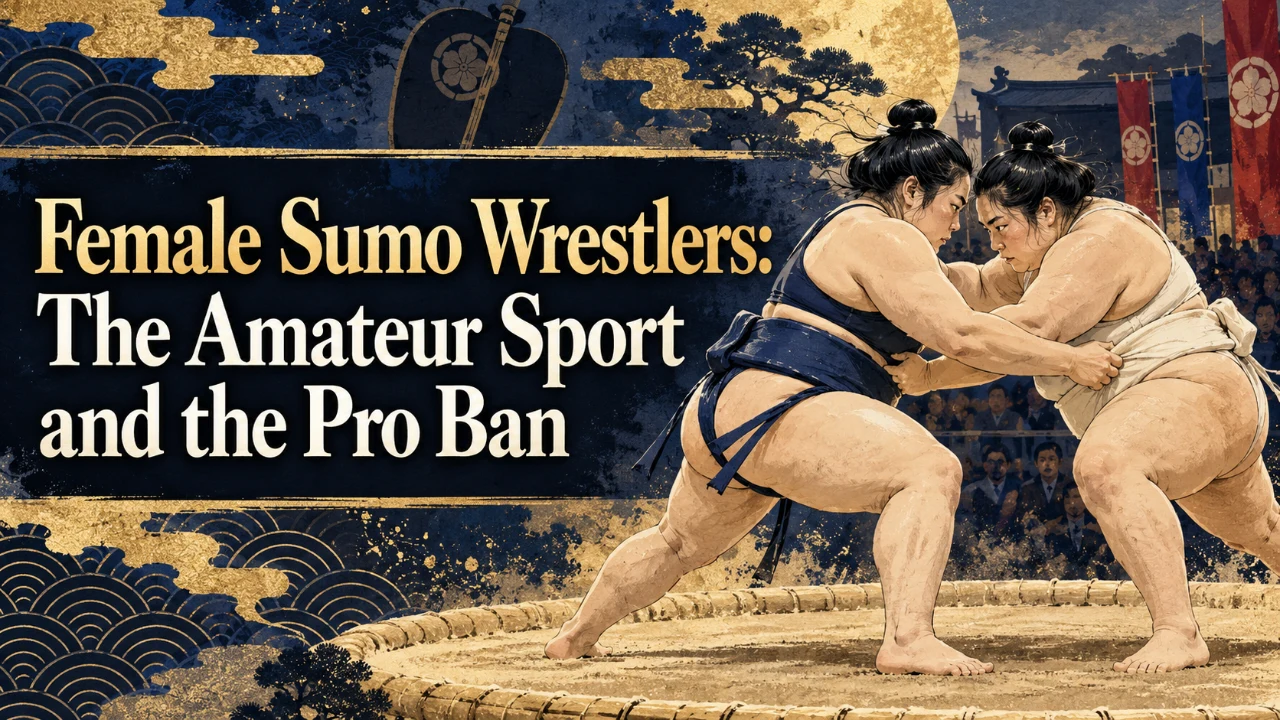
Female sumo wrestlers exist, more than 600 in Japan alone by an Associated Press count in 2025, but none of them can fight in professional sumo. Female sumo is an amateur sport with its own national championships in Japan, its own weight classes and a world championship that reached its 17th edition in 2025. Professional sumo, the six tournaments a year run by the Japan Sumo Association, admits only men as wrestlers and does not allow women onto its ring. This guide explains both sides: the rule that keeps women out of the professional game and the reasons the Association has given for it, the 2018 incident that brought the question to the front pages, the women’s sumo of the Edo period, and how female sumo works today, from the rulebook to the wrestlers who win medals in it.
📖 What you’ll learn
- Why a woman cannot become a professional sumo wrestler, in the Association’s own words
- What happened in Maizuru in April 2018, and what the Association said afterwards
- How female sumo is run: the kit, the three-minute bout and the five weight classes
- Where female sumo wrestlers compete, and the names that keep appearing on the podium
Are There Female Sumo Wrestlers? Yes, but Not in Pro Sumo
Yes, women wrestle in amateur sumo in Japan and abroad, but the professional sport run by the Japan Sumo Association accepts men only.
The word “sumo” covers two separate worlds, and every answer in this guide depends on which one is meant. Professional sumo, also called ozumo or grand sumo, is the one on television: six tournaments a year, ranked wrestlers living in stables, topknots and the ring ceremonies. Amateur sumo is a competitive sport organised by federations, with school, university, company and national teams. The rules of the bout are close, but who may enter is not.
If you are new to the sport as a whole, start with our guide to what sumo is. The table below sets the two side by side as they stand in 2026.
| Point | Professional sumo | Female amateur sumo |
|---|---|---|
| Run by | Japan Sumo Association | Japan Sumo Federation and Japan Women’s Sumo Federation; International Sumo Federation abroad |
| Who may enter | Healthy males who have completed compulsory education | Women and girls, by weight class |
| What is worn | Mawashi only | Leotard with a mawashi over it |
| Weight classes | None; everyone meets everyone | Yes, plus an open-weight class |
The practical result is simple. A girl who is good at sumo can win national titles, travel to world championships and wrestle into her twenties for a company team. She cannot take the new-recruit examination, join a stable, or appear on the banzuke.
Q. Is there a women’s version of professional sumo?
A. No. There is no women’s division, women’s banzuke or paid women’s tournament in Japan. The top level for a female sumo wrestler is amateur: the All Japan Women’s Sumo Championships at home and the Sumo World Championships abroad.
Why Women Cannot Become Professional Sumo Wrestlers
Women cannot turn professional because the Japan Sumo Association’s entry rule names men, and the Association keeps women off its ring as a tradition.
The rule is short. The Association’s page on how to become a wrestler states that the basic qualification for the new-recruit examination is to be a healthy male who has completed compulsory education. Candidates must also meet height and weight minimums, 167 centimetres and 67 kilograms as of September 2024, and be under 23, or under 25 with certain amateur results. Every professional wrestler enters through that examination, so the word “male” closes the door on its own. Our guide to a rikishi’s life covers what happens to those who pass.
Why the rule exists is a separate question, and the Association answered it in writing on 28 April 2018. Its chairman’s statement said the question had been debated before, and that past chairmen and directors had broadly given three reasons for keeping women off the ring.
- First, sumo has its origins in Shinto ritual.
- Second, the Association wants to preserve the traditional culture of professional sumo.
- Third, the ring is a sacred place of combat and training for the wrestlers, who are men.
The same statement took up an explanation repeated widely abroad and in Japan: that women are kept off because they are regarded as impure. The chairman called that interpretation a misunderstanding. The statement also said that the Association, as a public-interest foundation, has a responsibility to explain its reasons again. How the Association is organised is covered in our guide to the Japan Sumo Association.
Q. Has the Japan Sumo Association changed the rule since 2018?
A. Not on the evidence of its own pages. The 2018 statement said the Association owed the public an explanation but announced no change, and its page on becoming a wrestler, with standards dated September 2024, still limits the new-recruit examination to males.
The 2018 Maizuru Incident and the Association’s Statement
In April 2018 a referee repeatedly told women giving first aid to a collapsed mayor to leave the ring, and the Association apologised.
The incident took place on 4 April 2018 at a regional tour event in Maizuru, Kyoto prefecture. The city’s mayor, Ryozo Tatami, collapsed while giving a speech on the ring. Women from the audience, among them a nurse, climbed up to give him emergency treatment. During that treatment, a young referee repeatedly announced over the public address system that women should leave the ring. News of the announcements spread quickly, first in Japan and then abroad, with The Japan Times and CNN both reporting it the next day. The mayor was taken to hospital.
The chairman’s statement of 28 April opened with this case. It described the announcements as seriously inappropriate and apologised again to the women who had come forward to save a life. It then set out the position that still applies: professional sumo’s tradition is not to allow women onto the ring, but emergencies are an exception, and a situation where a life is at stake is “the exception of exceptions”. The statement put the failure down to the Association’s own leadership, which had not trained its staff to respond correctly. The referees who work the ring, and what their job normally involves, are covered in our guide to sumo’s officials.
A second case from the same month is also in the statement. At a tour stop in Takarazuka, Hyogo prefecture, the city’s mayor, Tomoko Nakagawa, was asked to give her greeting from a platform set up beside the ring rather than on it. The chairman apologised for the discomfort caused. He then asked the question the Association itself had to answer: why ceremonies such as speeches and prize-giving should not be an exception too. His answer was the three reasons in the previous section. The statement did not announce any change to the rule for ceremonies.
For how the ring itself is built and blessed, and why it is treated as a special space, see our guide to the dohyo.
Q. Can a woman give a speech or present a prize on the sumo ring?
A. Not under current practice. In April 2018 the mayor of Takarazuka was asked to speak from a platform beside the ring instead. The Association’s statement accepted that it had to explain why ceremonies are not an exception, but did not make them one. Only emergencies are.
Onna-zumo: Women’s Sumo Before the Modern Era
Women’s sumo, onna-zumo, was staged as paid entertainment in Edo from the mid-1700s and was banned by the Meiji government in 1872.
The history is thin in official sources, and the best short account is in Japanese reference works. The encyclopedia Sekai Dai Hyakka Jiten says women’s sumo is said to have begun with a show in Ryogoku, Edo, in 1745. The Nihon Dai Hyakka Zensho encyclopedia, both as quoted on the Kotobank dictionary site, fills in what followed.
In the Meiwa era, 1764 to 1772, bouts between female wrestlers and blind men became a popular attraction. They were then prohibited on the grounds that they demeaned blind people. In the Kaei era, 1848 to 1854, women’s sumo was organised again in Nagoya and toured the whole country. Men from the audience were allowed to jump in and challenge the women, which drew crowds. In 1872, the fifth year of Meiji, it was banned as bad for public morals. The same encyclopedia says that, today, women’s sumo survives only at festivals and similar events in Kyushu.
Two points are worth keeping straight. Onna-zumo was a separate commercial show, described by the encyclopedias as touring entertainment rather than ranked competition. And the modern amateur sport has its own starting point: the Japan Women’s Sumo Federation dates its first national championship to January 1997 and describes the sport as contested in weight classes.
Q. Were there female sumo wrestlers in old Japan?
A. Yes, as paid performers rather than ranked athletes. One Japanese encyclopedia says women’s sumo is said to have begun with a show in Edo in 1745; another records touring troupes in the mid-1800s and gives 1872 as the year it was banned on grounds of public morals.
How Female Sumo Works Today: Rules, Kit and Weight Classes
Female sumo follows men’s amateur rules with two differences: women wear a leotard under the mawashi, and bouts are capped at three minutes.
The modern sport in Japan dates its first national tournament to January 1997. The Japan Women’s Sumo Federation records that the first championship, then called the All Japan Shin-Sumo Championships, “new sumo”, was held that month at the Twin 21 gallery in Osaka. It describes women’s sumo as a new sport contested in weight classes, which is the key difference from the professional game, where there are no weight classes at all.
The Federation spells out the only two rule differences from men’s amateur sumo, citing the Japan Sumo Federation’s regulations.
- Kit. Men may wear nothing but the mawashi and underwear. Women wear a leotard with the mawashi tied over it; primary and junior high school girls may wear a plain swimsuit instead. That is Article 39 of the competition regulations. For how the belt itself is tied, see our guide to the mawashi.
- Time. In men’s amateur sumo, a bout still undecided after five minutes is stopped and fought again. For women the limit is three minutes. That is Article 17 of the refereeing regulations.
Everything else, from how a bout is won to the fouls, is the same. Our guide to sumo rules explains those.
Internationally, the International Sumo Federation sets five weight classes for women. The table below gives its categories.
| Class | Women | In pounds (approx.) |
|---|---|---|
| Lightweight | Under 65 kg | Under 143 lb |
| Middleweight | 65–73 kg | 143–161 lb |
| Light heavyweight | 73–80 kg | 161–176 lb |
| Heavyweight | 80 kg and over | 176 lb and over |
| Open weight | No limit | — |
The open-weight class is the closest thing female sumo has to the professional game, which has no weight classes: anyone may meet anyone.
Q. Do female sumo wrestlers have to be heavy?
A. No. Because the sport runs in weight classes, a lightweight under 65 kg (143 lb) only meets others of her size. Weight matters only in the open-weight class, where there is no limit and, in principle, a 60 kg wrestler can be drawn against a 100 kg one.
Where Female Sumo Wrestlers Compete
Female sumo wrestlers compete in school, university and company teams, the All Japan Women’s Championships and the Sumo World Championships.
The national championship. The All Japan Women’s Sumo Championships are organised by the Japan Sumo Federation and the Japan Women’s Sumo Federation. The 31st edition is scheduled for Sunday 4 October 2026 at the Kyoto City Budo Center, with the opening ceremony at 9:00. Recent editions have all been held in Kyoto prefecture.
Girls. Children’s sumo is where the gap with professional sumo first shows. Number Web reported in 2019 that the national final of the Wanpaku children’s tournament, held at the Ryogoku Kokugikan, was closed to girls because girls are not allowed on that ring. A girl who won her local qualifier did not go through; the runner-up boy did. A separate national girls’ tournament was set up in response. The first was held on 25 August 2019 at the Okudo General Sports Center in Katsushika, Tokyo, with about 180 girls from fourth to sixth grade. At high school level, the Associated Press reported in September 2025 that girls from across Japan had been attending spring and summer camps at Tottori Johoku High School since 2016, home to what the agency called the nation’s largest girls’ sumo club.
The world championships. The International Sumo Federation’s results list the 2025 championships in Bangkok as the 17th women’s individual tournament. The table below shows the last three editions.
| Edition | Open-weight champion | Heavyweight champion | Japanese winners |
|---|---|---|---|
| 17th, 2025 Bangkok, Thailand | Iryna Pasichnyk (Ukraine) | Ivanna Berezovska (Ukraine) | Hana Kishimoto, lightweight |
| 16th, 2024 Krotoszyn, Poland | Iryna Pasichnyk (Ukraine) | Ivanna Berezovska (Ukraine) | Nene Yamashita, lightweight; Rio Hasegawa, middleweight; Sakura Ishii, light heavyweight |
| 15th, 2023 Tokyo, Japan | Airi Hisano (Japan) | Ivanna Berezovska (Ukraine) | Airi Hisano, open weight |
Two patterns stand out in these three editions. Japan’s titles came mostly in the lighter classes, and Ukraine held the heavy end: the same heavyweight champion three years running, and the open-weight title in both 2024 and 2025.
Q. Can I watch female sumo in Japan?
A. Yes, at amateur events rather than the professional tournaments. The next All Japan Women’s Sumo Championships are scheduled for 4 October 2026 at the Kyoto City Budo Center. Check the Japan Women’s Sumo Federation’s page for the latest details before you go.
Notable Female Sumo Wrestlers
The best-known female sumo wrestlers include Hiyori Kon, Airi Hisano and Rio Hasegawa from Japan, and Ukraine’s Ivanna Berezovska and Iryna Pasichnyk.
Hiyori Kon became known outside Japan through film. She is from Ajigasawa in Aomori prefecture and was the subject of Little Miss Sumo, a short Netflix documentary directed by Matt Kay that followed her through the 2018 season and her call for women to be allowed to compete professionally. The BBC included her in its 100 Women list in 2019. On the mat she has stayed near the top: the International Sumo Federation’s results list her as the heavyweight runner-up at the 2023 world championships in Tokyo.
Airi Hisano won the open-weight world title in Tokyo in 2023, the one class with no weight limit. The Associated Press described her in September 2025 as having a reputation as the strongest female sumo wrestler in Japan, and gave her height and weight as 1.72 metres and 115 kilograms. She wrestles alongside a job at Tachihi Holdings. Her aim, as she told the agency, is for sumo to become an Olympic sport with no distinction between men and women.
Rio Hasegawa won the middleweight world title in 2024 and took silver in 2025. The same AP report says she was the first woman to join the Keio University sumo club since its founding in 1919.
Ivanna Berezovska of Ukraine won the women’s heavyweight world title in 2023, 2024 and 2025, and Iryna Pasichnyk, also of Ukraine, won the open weight in 2024 and 2025. Earlier, the Federation’s results list Russia’s Anna Zhigalova as the open-weight world champion at the 10th edition, held in Kaohsiung in 2014.
Behind these names is a wider base. The AP put the number of women wrestling amateur sumo in Japan at more than 600 in 2025.
Q. Who is the most famous female sumo wrestler?
A. There is no official ranking. Hiyori Kon is known outside Japan through the Netflix short Little Miss Sumo and the BBC’s 100 Women list. By results, Airi Hisano, the 2023 open-weight world champion, and Ukraine’s Ivanna Berezovska, heavyweight world champion in 2023, 2024 and 2025, have the stronger records.
Summary
Female sumo is a real, organised sport, but it lives entirely in the amateur world while professional sumo stays male. The points to take away:
- Professional sumo is men only. The Japan Sumo Association’s new-recruit examination is open to healthy males, and there is no women’s division.
- The Association’s reasons are on record. Its 28 April 2018 statement cited Shinto origins, traditional culture and the ring as a sacred place, and called the “impurity” explanation a misunderstanding.
- Emergencies are the exception. After Maizuru in April 2018, the Association said a life at stake overrides the tradition.
- Onna-zumo came first. Women’s sumo shows ran in Edo from 1745 and were banned in 1872.
- The first national championship was in 1997. Today’s rules: leotard under the mawashi, three-minute bouts, five weight classes internationally.
- It is international. The 2025 world championships were the 17th for women; the 31st All Japan Women’s Championships are on 4 October 2026.
Related guides: What is sumo? · The dohyo · Sumo rules · A rikishi’s life · How to buy sumo tickets
Sources
- Japan Sumo Association — how to become a rikishi (qualifications for the new-recruit examination), read September 29, 2026
- Japan Sumo Association — chairman’s statement of April 28, 2018
- Japan Women’s Sumo Federation — what women’s sumo is and All Japan Women’s Sumo Championships
- International Sumo Federation — weight classes, women’s results 2019–2025 and women’s results to 2014
- Kotobank — onna-zumo (Sekai Dai Hyakka Jiten; Nihon Dai Hyakka Zensho)
- The Japan Times — report of April 5, 2018
- Associated Press, via Taipei Times — women and girls in Japanese sumo, September 12, 2025
- Number Web — the first national girls’ Wanpaku tournament, 2019
- Netflix — Little Miss Sumo