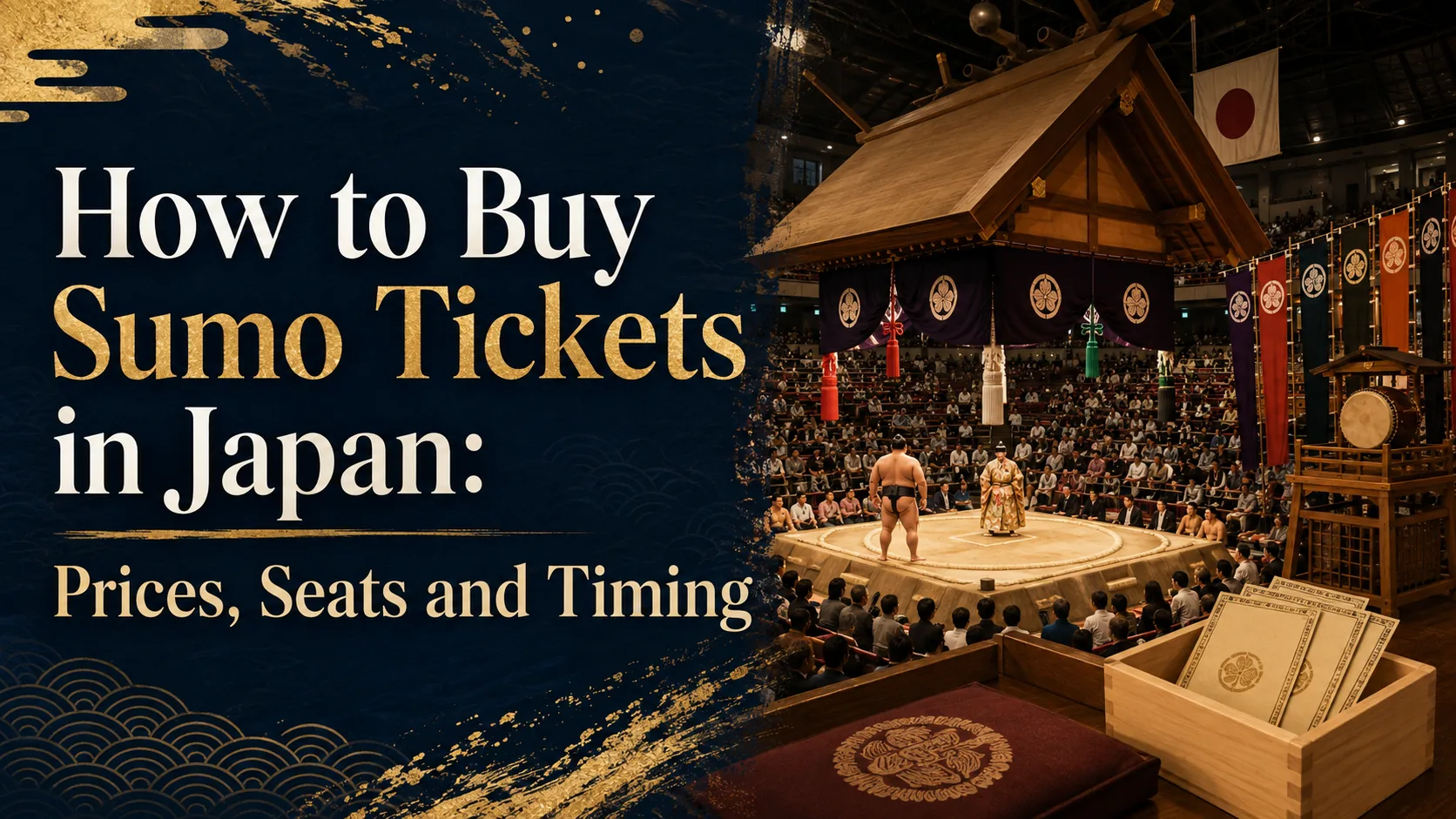
The general sale of sumo tickets for the November 2026 tournament in Fukuoka runs from 10 a.m. Japan time on September 19, 2026, until 5 p.m. on each day of the tournament. One website sells them in English: Ticket Oosumo English, which takes credit cards only, adds ¥2,000 (approx. US$13) per ticket and issues tickets only at Seven-Eleven stores in Japan. September in Tokyo is sold out on every day, with no tickets at the door. The next Tokyo sale, for January 2027, opens on December 5, 2026.
📖 What you’ll learn
- Why November in Fukuoka is the tournament to buy now, and where the next Tokyo sale falls
- The five sales rounds, and why the English site only takes part in the last one
- Every seat price in Fukuoka and at Ryogoku Kokugikan, and which seats the English site does not sell
- The fee, payment and pickup rules on the English site that catch visitors out
- What still works when your day is sold out, and what the Association says about resale sites and Buy Sumo Tickets
Where to Buy Sumo Tickets, and Why They Sell Out So Fast
Buy sumo tickets on Ticket Oosumo English, the one English-language site the Japan Sumo Association lists, and expect the best seats to go early.
Tickets are sold by the day. The ticket site lists a price for each of the 15 days of a basho, the Grand Sumo Tournaments held six times a year, and one ticket covers that day from the first bout in the morning to the last at around 6 p.m.
The Japan Sumo Association’s English ticket page names a single place to buy: Ticket Oosumo English, run by the ticket agency Ticket Pia. Resale marketplaces, buying services and tour packages all sit outside that route.
Demand is high. The Japan Times reported that the May 2026 tournament sold out on all 15 days, and later tied the boom more to inbound tourism than to star wrestlers. The queue matters too: each tournament is sold in five rounds, and the English site takes part only in the last.
| Round | Entry period (2026) | Who can enter | Run in English? |
|---|---|---|---|
| 1. Fan club first lottery | August 14–17 | Top tiers of the paid official fan club | No |
| 2. Fan club second lottery | August 21–24 | A wider range of fan club tiers | No |
| 3. Ticket Oosumo lottery | August 28–31 | Registered users of the Japanese Ticket Oosumo site | No |
| 4. Ticket Pia lottery | September 4–7 | Registered users of Ticket Pia | No |
| 5. General sale | From September 19, 10 a.m. | Anyone, first come first served | Yes, and only this round |
The Association states that seat types that sell out in the four lottery rounds are not offered in the general sale at all. For November, the English site also does not sell ringside or Box S seats; both are sold only on the Japanese site.
Q. Can overseas visitors buy sumo tickets?
A. Yes. Ticket Oosumo English sells to anyone during the general sale and takes payment by credit card, so you can buy from abroad. The limit is collection, not purchase. The English site issues tickets only as printouts from a Seven-Eleven store inside Japan, so you cannot hold the ticket before you land.
When Sumo Tickets Go on Sale: Dates Through 2027
Sumo tickets go on sale on a Saturday four to eight weeks before each tournament, on dates the Japan Sumo Association publishes years ahead.
The Association publishes these dates years ahead, so you can work backwards from your trip. For day-by-day tournament dates, see our sumo tournament schedule.
| Tournament | Venue | Tickets on sale | Banzuke published | First day | Final day |
|---|---|---|---|---|---|
| September 2026 | Ryogoku Kokugikan, Tokyo | August 8, 2026 (sold out) | August 31, 2026 | September 13, 2026 | September 27, 2026 |
| November 2026 | Fukuoka Kokusai Center | September 19, 2026 | October 26, 2026 | November 8, 2026 | November 22, 2026 |
| January 2027 | Ryogoku Kokugikan, Tokyo | December 5, 2026 | December 21, 2026 | January 10, 2027 | January 24, 2027 |
| March 2027 | EDION Arena Osaka | February 6, 2027 | March 1, 2027 | March 14, 2027 | March 28, 2027 |
| May 2027 | Ryogoku Kokugikan, Tokyo | April 10, 2027 | April 26, 2027 | May 9, 2027 | May 23, 2027 |
| July 2027 | IG Arena, Nagoya | May 15, 2027 | June 28, 2027 | July 11, 2027 | July 25, 2027 |
| September 2027 | Ryogoku Kokugikan, Tokyo | August 7, 2027 | August 30, 2027 | September 12, 2027 | September 26, 2027 |
| November 2027 | Fukuoka Kokusai Center | September 18, 2027 | November 1, 2027 | November 14, 2027 | November 28, 2027 |
| January 2028 | Ryogoku Kokugikan, Tokyo | December 4, 2027 | December 24, 2027 | January 9, 2028 | January 23, 2028 |
One date needs a warning. For March 2027, the English ticket site lists the sale as Saturday, February 8, but February 8, 2027 is a Monday. This guide follows the Association’s schedule, which gives Saturday, February 6.
You also buy before you know who you will see. The banzuke, the official ranking sheet, comes out about two weeks before the first day: October 26 for November 2026, five weeks after the sale opens.
The final day, senshuraku, decides the championship, and it falls on a Sunday in every tournament on the Association’s schedule. Weekend prices are above weekday prices for most seat types.
Q. How far in advance do sumo tickets sell out?
A. Popular days can go as soon as the general sale opens, and some seat types never reach it. The Japan Times reported that the September 2026 tournament in Tokyo sold out almost as soon as it went on sale, and every day is now listed as sold out. Be online when the sale opens, and have a second-choice day ready.
November 2026 in Fukuoka: Seats and Prices
In Fukuoka a chair seat costs ¥2,000 to ¥6,000 per person and a four-person box ¥32,000 to ¥56,000, before any booking fee.
Fukuoka Kokusai Center has its own price list, not a copy of Tokyo’s. Dollar figures here are approximate, using the Bank of Japan’s central rate of ¥157.10 on September 18, 2026.
| Seat | Weekend | Weekday | Where / how many | On the English site? |
|---|---|---|---|---|
| Ringside (tamari) | ¥20,000 | ¥20,000 | Floor, 1 person, ages 16 and over | No |
| Box S | ¥56,000 | ¥52,000 | Box rows 1–4, 4 people | No |
| Box A | ¥52,000 | ¥44,000 | Box rows 5–8, 4 people | Yes |
| Box B | ¥40,000 | ¥38,000 | Box rows 9–10, 4 people | Yes |
| Box C | ¥34,000 | ¥32,000 | Box row 11, 4 people | Yes |
| Two-person boxes (S / A / B) | ¥28,000 / ¥26,000 / ¥20,000 | ¥26,000 / ¥22,000 / ¥19,000 | 1 box, 2 people | No |
| Three-person boxes (A / C) | ¥39,000 / ¥25,500 | ¥33,000 / ¥24,000 | 1 box, 3 people | No |
| Themed boxes (baby photo Box A / Orion beer Box B) | – | ¥44,000 / ¥38,000 (Days 2–6 only) | 1 box, 4 people | No |
| Special C Box | ¥19,000 | ¥19,000 | Box rows 12–13, a four-person box for 2 | Yes |
| Pair Seats with table | ¥19,000 | ¥19,000 | Row 14, 2 chairs | Yes |
| Kids / Senior Box voucher (B / C) | ¥24,000 / ¥20,000 | ¥24,000 / ¥20,000 | 4 people, general sale only | No |
| Chair S | ¥6,000 | ¥5,500 | Upper level, front side | Yes |
| Chair A | ¥5,000 | ¥4,500 | Upper level, opposite side | Yes |
| Chair B | ¥3,000 | ¥2,500 | Upper level, east and west | Yes |
| Chair C | ¥2,500 | ¥2,000 | Upper level, east and west | Yes |
| Wheelchair space | ¥10,000 | ¥10,000 | User plus 1 companion | No (phone, in Japanese) |
The cheapest ticket is a weekday Chair C at ¥2,000 (approx. US$13), and it is sold in English. Ringside costs ¥20,000 (approx. US$127) on every day but is sold only on the Japanese site.
Pairs get two seat types of their own on the English site. The Special C Box gives two people a four-person box, and Pair Seats put two chairs at a table. Both cost ¥19,000 (approx. US$121), well below a whole Box C.
There is no Chair D, no child fare and, the Association states, no unreserved seating this November. Anyone aged four or over needs a ticket. On the Japanese site, Kids / Senior Box vouchers cover a four-person box for groups with a child aged 15 or under or someone over 60.
Wheelchair spaces cost ¥10,000 (approx. US$64) for the user and one companion, booked by phone in Japanese from 10 a.m. on October 22, 2026, according to the Association’s wheelchair page.
The official November availability page (in Japanese) showed no status for any day when we checked at 7:30 a.m. Japan time on September 19, before the sale opened. It updates at 11 a.m. and 5 p.m. on weekdays; check it before you buy.
Q. How much do sumo tickets cost?
A. In Fukuoka in November 2026, chairs cost ¥2,000 to ¥6,000 (approx. US$13 to US$38) per person, a four-person box ¥32,000 to ¥56,000 (approx. US$204 to US$356), and ringside ¥20,000. At Ryogoku Kokugikan in September 2026, chairs cost ¥2,500 to ¥9,500 and boxes ¥34,000 to ¥60,000. The English site adds ¥2,000 per ticket.
Ryogoku Kokugikan Prices for the Tokyo Tournaments
At Ryogoku Kokugikan a chair cost ¥2,500 to ¥9,500 and a four-person box ¥34,000 to ¥60,000 in September 2026.
Tokyo hosts the January, May and September tournaments at Ryogoku Kokugikan. January 2027 prices have not been announced, so treat the September figures below as a guide to the December 5 sale, not a quote.
| Seat | Weekend / holiday | Weekday | Where it is | On the English site? |
|---|---|---|---|---|
| Ringside | ¥20,000 (1 person) | ¥20,000 | Floor, ringside | No |
| Box S | ¥60,000 (4 people) | ¥56,000 | 1F, rows 1-4 | No |
| Box A | ¥52,000 (4 people) | ¥48,000 | 1F, rows 5-8 | Yes |
| Box B | ¥42,000 (4 people) | ¥40,000 | 1F, rows 9-12 | Yes |
| Box C | ¥38,000 (4 people) | ¥34,000 | 1F, rows 13-15 | Yes |
| Chair S | ¥9,500 | ¥9,000 | 2F, rows 1-3 | Yes |
| Chair A | ¥8,500 | ¥8,000 | 2F, rows 4-6 | Yes |
| Chair B | ¥5,500 | ¥5,000 | 2F, rows 7-11 | Yes |
| Chair C | ¥4,000 | ¥3,500 | 2F, rows 12-13 | Yes |
| Chair D | ¥2,500 (child ¥500) | ¥2,500 | 2F, row 14 | No |
Chair D, the back row of the upper tier, costs ¥2,500 (approx. US$16), with a ¥500 child fare for ages 4 to 15. It is the cheapest seat in the building and does not appear on the English page, where the cheapest Tokyo seat is Chair C.
The Association prices boxes per box, not per person, so two people in a four-person box pay for four. A box is also not a booth with armchairs: you take off your shoes and sit on flat cushions on the floor, with no back rest. If you want a chair, book a chair.
Ringside, in Tokyo and Fukuoka alike, is for ages 16 and over, with no eating, drinking, photos or phone use. Other venues set their own seats: in 2026, Osaka sold an English-site Chair D at ¥3,500, and Nagoya sold single-person boxes from ¥7,000.
Q. Is a box seat worth it for just two people?
A. In Tokyo, it costs more than two chairs. The box is sold whole, so two people pay for four, and you sit on flat cushions for hours with no back rest. Two Chair S seats cost ¥19,000 on a weekend, against ¥34,000 for the cheapest box. In Fukuoka the answer changes: the Special C Box gives two people a first-floor box for ¥19,000, less than any four-person box.
How to Buy Sumo Tickets Online on the Official English Site
To buy sumo tickets online in English, use Ticket Oosumo English during the general sale, pay by credit card and collect in Japan.
The process takes minutes. The conditions are what catch people out.
- Open Ticket Oosumo English and choose the tournament. Only a tournament on general sale has an active purchase link: in late September 2026, November in Fukuoka.
- Choose the day, then the seat category. Weekend prices are higher.
- Pay by credit card, the only method accepted.
- Add ¥2,000 per ticket. A four-person box counts as four tickets, or ¥8,000 in fees. On a ¥2,000 weekday Chair C in Fukuoka, the fee doubles the cost.
- Print the ticket at a Seven-Eleven in Japan. Your seat number appears only when it prints.
The Japanese Ticket Oosumo site charges ¥220 per ticket in the general sale plus an issuing fee, according to the Association’s fee table (in Japanese). On a four-person box, that saves more than ¥6,000. The Japanese site also offers postal delivery, cash payment at Seven-Eleven counters, and a Japanese-only booking line, 0570-02-9310.
Tickets cannot be changed or cancelled once bought, and a lost ticket will not get you in. All times on the site are Japan time. Online sales run until 5 p.m. on each day while seats remain, and tickets bought through an advance lottery carry a further ¥550 each.
Q. Can I collect my ticket before I arrive in Japan?
A. No. The English site lists one collection method only: printing the ticket at a Seven-Eleven store inside Japan. There is no postal delivery and no e-ticket on the English site. Plan a stop at a convenience store after you land, and keep the printout safe, because a lost ticket will not get you in.
Sold Out? What Still Works
When your day is sold out, switch to a weekday, a cheaper upper seat or another venue, and check the official face-value resale.
Move to a weekday. Weekday prices are lower, and a sold-out Saturday does not mean a sold-out Tuesday; the availability page lists each day separately.
Look upstairs. Upper-tier chairs are the cheapest seats, and in Tokyo the cheapest, Chair D, is sold only on the Japanese site.
Change venue. Osaka in March, Nagoya in July and Fukuoka in November are the alternatives to Tokyo, and Fukuoka’s prices sit below Tokyo’s in most categories.
Try the official resale. The Japanese Ticket Oosumo site runs a face-value resale service (in Japanese): tickets sell at face value, the seller pays a 10% fee, buyers pay by card on a first-come basis, and the buyer’s registered name is printed on the ticket. The page does not say whether English-site tickets qualify.
Consider a jungyo, one of the regional exhibition tours between tournaments. They are separate events with their own tickets, and the wrestlers are the same.
Or watch from home: our guide to watching sumo live covers free English coverage.
Turning up at the door works only if the day has not sold out. The Kokugikan box office sells no advance tickets. The Fukuoka box office sells advance tickets from September 20 to 27, 2026, 10 a.m. to 4 p.m. For November, same-day sales are still undecided.
Q. Can you buy sumo tickets on the day?
A. Only if the day has not sold out. For November 2026 the Association says same-day sales are undecided, and there will be none if the day sells out in advance. Older guides describe a cheap unreserved ticket sold at the door each morning. No unreserved seats are sold in Fukuoka this November, and none appear in Tokyo’s 2026 seat list.
Resale Sites, Buy Sumo Tickets and Tours: What the Association Says
The Japan Sumo Association treats tickets bought through unauthorized resale as grounds to refuse entry, and it names specific resale sites.
In a notice on resale (in Japanese), the Association names resale intermediaries including Ticket Ryutsu Center, Tiketjam, Buy Sumo Tickets, viagogo and StubHub, and says it is refusing entry on tickets traded through them, even completed deals. Buy Sumo Tickets describes itself on its own site as a buying service, and shows no partnership with the Association.
The notice lists typical problems: no ticket arrives, the date is wrong, the seller claims the purchase screen gets you in, or only one ticket arrives for a four-person box.
For the six tournaments of 2025, the Association reported a combined 138 actions: suspended Ticket Oosumo accounts, suspended fan club memberships, and cancelled tickets with entry refused. No breakdown is published; Nikkei reported the figure on April 3, 2026.
The basis is contractual. Article 4 of the Association’s spectator terms (in Japanese) bars passing a ticket to a third party without the organizer’s permission, except to family, friends or business contacts with no profit and not as a business. Articles 3 and 6 let the Association refuse sale or entry. Its Fukuoka visitor guide warns that tickets from resale sites or social media may not get you in.
Japan’s Ticket Resale Act (in Japanese), in force since June 14, 2019, bans reselling qualifying event tickets as a business above face value without the organizer’s consent. The penalty is up to one year of imprisonment, a fine of up to ¥1 million (approx. US$6,400), or both. A ticket qualifies only if it meets three conditions set out in the law. We found no Association or Agency for Cultural Affairs page saying whether sumo tickets do, so this guide does not call a resold sumo ticket illegal. What the Association’s terms do allow is refusal at the gate.
Tour packages with tickets exist; ask the operator whether it buys with the organizer’s permission. For how the Association works, see the Japan Sumo Association.
Q. Is Buy Sumo Tickets official?
A. No. The Association’s English ticket page lists Ticket Oosumo English as the place to buy, and an Association notice names Buy Sumo Tickets among the resale intermediaries whose tickets it is refusing at the gate. The company describes itself as a buying service. Whatever you decide, the risk of being turned away sits with the ticket holder.
Match Day in Fukuoka and Tokyo: Doors, Top Division and Re-entry
Doors open at 8:45 a.m. on most days in Fukuoka and Tokyo, the top wrestlers start around 2 p.m., and bouts end near 6 p.m.
The day runs from the lowest ranks upward. The ticket site puts the top wrestlers’ start at around 2 p.m., and the top-division bouts fill roughly the last two hours. One ticket covers it all.
Doors open later near the end: in Fukuoka, 10:30 a.m. on November 20 and 21 and 10 a.m. on November 22. Tokyo followed the same pattern in September 2026.
Re-entry differs by venue. The November page allows unlimited re-entry at Fukuoka Kokusai Center; the September page allowed one at Ryogoku Kokugikan. Both require you back by 5 p.m.
Fukuoka Kokusai Center is a 12-minute walk from Gofukumachi subway station or 15 minutes from Nakasu-Kawabata, per the venue’s access page (in Japanese), with Nishitetsu buses from Hakata Station and Tenjin. There is no parking. You may eat at your seat except at ringside.
Q. What time should I arrive at the venue?
A. For the atmosphere, arrive in the early afternoon and settle in before the top wrestlers appear around 2 p.m. To see the whole ranking system at work, from the newest wrestlers upward, come when the doors open. In Fukuoka you can step out and come back as often as you like before 5 p.m.; in Tokyo, only once.
Summary
Buy sumo tickets on Ticket Oosumo English when the general sale opens, and plan around the ¥2,000 fee, card-only payment and pickup in Japan.
- The November 2026 tournament in Fukuoka is on general sale from 10 a.m. Japan time on September 19, 2026. The next Tokyo sale is December 5, 2026, for January 2027.
- Four lottery rounds run before the English site opens, and seat types that sell out in them never reach the general sale.
- In Fukuoka a chair costs ¥2,000 to ¥6,000 and a four-person box ¥32,000 to ¥56,000. In Tokyo in September 2026, chairs ran from ¥2,500 to ¥9,500 and boxes from ¥34,000 to ¥60,000.
- The English site adds ¥2,000 per ticket, takes credit cards only, refunds nothing and issues tickets only at Seven-Eleven stores in Japan.
- If your day is sold out, try a weekday, an upper seat, another venue or the official face-value resale. The Association says it is refusing entry on tickets traded through the resale sites it names, Buy Sumo Tickets among them.
Read next: Grand sumo tournament schedule · Ryogoku Kokugikan · How to watch sumo live · What is sumo? · The Japan Sumo Association
Buying a ticket to a basho is a slower business than buying a ticket to a match. The dates were fixed years ago, the ranking sheet arrives after the sale, and the price depends on which of the fifteen days you pick. None of that is an obstacle placed in front of visitors. It is the shape of a sport that runs on a calendar older than the buildings it fills. Work backwards from the date, and the rest falls into place.