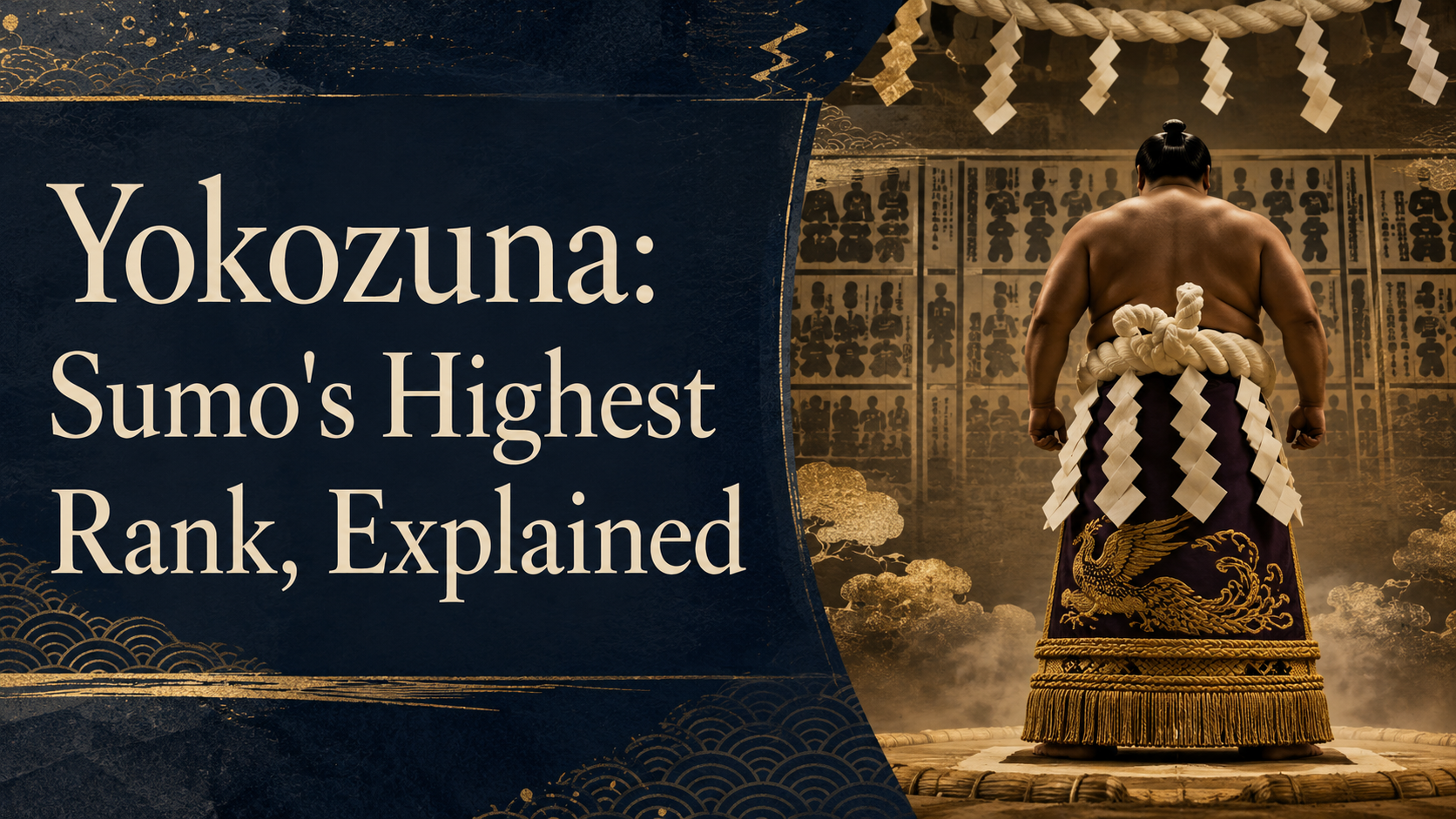
Yokozuna is the highest rank in professional sumo, and the word is a rank rather than a prize. Nobody wins it on a single afternoon. A wrestler is promoted into it by the Japan Sumo Association, he keeps it until he retires, and more than one man can hold it at the same time. In roughly 240 years of records only 75 men have held it. This guide explains what the rank means, how it is earned, what the rope weighs, and who holds it today.
📖 What you’ll learn
- Why yokozuna is a rank on the ranking sheet, not a championship belt
- What the Japan Sumo Association asks for before it will promote anyone
- What the braided rope weighs, and what the ring-entering ceremony is doing
- Who the two current yokozuna are, and who holds the records
What Is a Yokozuna?
Yokozuna is the top rank in professional sumo. A wrestler is promoted to it by the Japan Sumo Association after sustained results at the rank below, and he holds it for the rest of his career. It is not a championship, it is not awarded for a single tournament, and several wrestlers can hold it at once.
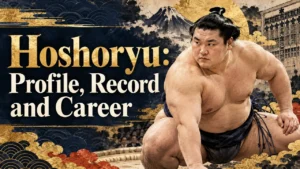
Two men hold the rank now. Hoshoryu was promoted as the 74th yokozuna in history in January 2025, and Onosato as the 75th in May 2025. Hoshoryu fights out of the Tatsunami stable, stands 188 cm (6 ft 2 in) and weighs 150 kg (331 lb). Onosato, of the Nishonoseki stable, is 192 cm (6 ft 4 in) and 189 kg (417 lb). The rank sits at the head of the banzuke, the ranking sheet the Association redraws before every tournament.
That is the whole of it, and most of the confusion in English comes from expecting the word to behave like a belt. It does not. A yokozuna can go a full year without winning a tournament and remain a yokozuna. A wrestler ranked far below him can take the Emperor’s Cup and stay exactly where he was. If you are new to the sport, our beginner’s guide to sumo covers how a bout is won before you go further here.
Q. Is yokozuna a title you win, or a rank?
A. It is a rank. The Japan Sumo Association promotes a wrestler to yokozuna on the strength of his results over several tournaments, and the rank then appears against his name on every banzuke until he retires. The prize for winning a tournament is the Emperor’s Cup, which is a separate thing and can go to a wrestler of any rank.
Q. How many yokozuna are there right now?
A. Two: Hoshoryu, the 74th, and Onosato, the 75th. The number changes only when someone is promoted or retires, so it can sit at one, two or three for years, and the sport has also gone stretches with none at all. Seventy-five men in total have held the rank.
The Only Rank That Cannot Be Demoted
Every other rank in sumo moves both ways. After each 15-day tournament the Association redraws the banzuke, and a winning record pushes a wrestler up while a losing one drags him down. Yokozuna is the single exception. According to the Association, the yokozuna alone can never be demoted, however badly a tournament goes for him.
The pressure does not disappear, it changes shape. A yokozuna who keeps posting poor records is expected to retire, and that expectation is the mechanism the sport uses in place of relegation. Compare the rank directly below. An ozeki who puts together two losing tournaments in a row drops to sekiwake, and he is given one immediate chance to win his way back. A yokozuna has no such ladder underneath him, in either direction.
Being at the top also makes a wrestler a target in a formal, accounted sense. One of the three special prizes handed out at the end of a tournament, the shukunsho, goes to the wrestler who beat the most yokozuna and ozeki. A rank-and-file maegashira who beats a yokozuna is credited with a kinboshi, a gold star. The gold star is not only a note in the record: it is reported to raise the wrestler’s tournament bonus for the remainder of his salaried career, so one win on one afternoon keeps paying for years.
Q. Can a yokozuna be demoted?
A. No. The Japan Sumo Association states that the yokozuna, alone among the ranks, can never be demoted, even after a poor tournament. A yokozuna whose results keep slipping is expected to retire rather than drop down the banzuke. That is why yokozuna careers tend to end abruptly instead of tailing off down the ranking sheet.
How a Rikishi Becomes a Yokozuna
The bar is written down. Before a wrestler can even be considered, he must have won two consecutive tournaments as an ozeki, or produced results the Association judges equivalent. He must have shown he can perform at that level consistently, and the Association must hold him to be a man of the character the rank demands.
That last clause is not decoration. Promotion is not automatic on results, and a separate advisory body, the Yokozuna Deliberation Council, weighs candidates and passes a recommendation to the Association. The council is made up of people from outside the sport rather than former wrestlers, which is the point of it: sumo does not grade its own top rank alone.
The route is short in theory and long in practice. Onosato reached the rank in May 2025 after only 13 professional tournaments, reported as the fastest ascent of the modern era, and he did it by winning the March and May tournaments back to back. Most careers never come near it. There are about 700 wrestlers in professional sumo at any time, spread over six divisions, and 75 of them have ever ended up at the top of the sheet.
The Rope: What a Yokozuna Wears
The rank takes its name from what the holder wears. Yokozuna means “horizontal rope”, and only a yokozuna wears one. It is braided from hemp, worn over the ceremonial apron, tied in a bow at the back, and hung at the front with folded paper strips in a zigzag. The Association puts its weight at 11 to 15 kg (24 to 33 lb).
The rope is a Shinto marker before it is a sporting one. The same shape hangs at shrine gates and above the household god-shelf at home, so the man wearing it marks sacred ground rather than carrying a trophy. It is worn for the ceremony, not for the fight.
That ceremony is the dohyo-iri, the ring-entering ritual performed before the top-division bouts. A yokozuna comes down the aisle with a senior referee and two top-division wrestlers, one of them carrying a sword. In the ring he claps his hands to draw the attention of the gods, spreads his arms and turns his palms up to show he is hiding no weapon, then raises one leg high to the side and stamps it down, and repeats it with the other, driving out anything unwelcome. When there is more than one yokozuna, each performs it in turn.
One more detail is visible from any seat. Only a tate-gyoji, one of the two most senior referees, may officiate a bout involving a yokozuna, and you can identify him by the tassel on his fan: purple, or purple and white. If you see that colour, the bout in front of you involves the top rank.
Q. How much does the yokozuna rope weigh?
A. The Japan Sumo Association gives 11 to 15 kg (24 to 33 lb) for the braided hemp rope worn over the ceremonial apron. It is worn only for the ring-entering ceremony, never for a bout. The men who wear it are heavier again: the two current yokozuna weigh 150 kg (331 lb) and 189 kg (417 lb).
The First Yokozuna — and Why the Count Is Off
The count says Onosato is the 75th. The list it comes from is not a clean record from the start, and knowing why explains a discrepancy you will run into everywhere else.
The rank as an institution begins in 1789, when the Yoshida house, which claimed authority over sumo custom, issued licences to two wrestlers, Tanikaze and Onogawa. That ceremony is where the rope and the ring-entering display first appear together. Those two are the first men known to have held the rank while alive.
The numbering, though, starts earlier and on thinner ground. Akashi Shiganosuke is listed first, on the strength of a story that he wore a sacred rope before the Emperor in 1630; he was named to the rank long after his death, and historians are not certain he existed. Two more names sit between him and Tanikaze on the same footing. That is why the first living yokozuna is counted as the fourth.
Q. Who was the first yokozuna?
A. It depends which question you are asking. The official list starts with Akashi Shiganosuke, named to the rank posthumously and hard to verify. The first wrestlers licensed as yokozuna in their own lifetimes were Tanikaze and Onogawa, in 1789, and Tanikaze is counted as the fourth. The gap between the two answers is a numbering convention, not a dispute about the record.
The Greatest Yokozuna, by the Numbers
Nothing settles an argument about the best yokozuna, but one column comes close: top-division championships. Three men have passed 30, and one of them is far clear of the rest.
| Yokozuna | Top-division championships | Years at the top |
|---|---|---|
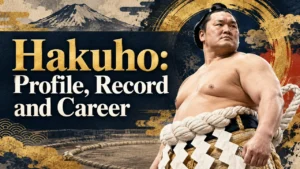
| Hakuho | 45 | 2007–2021 |
| Taiho | 32 | 1961–1971 |
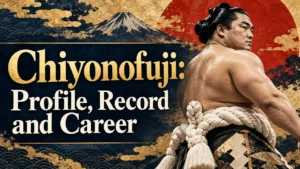
| Chiyonofuji | 31 | 1981–1991 |
Read the table with one caution. Six tournaments a year is a modern arrangement, and wrestlers before the 1950s had fewer chances to add to the column, so the totals compare eras unevenly. Longevity is the other half of the answer. The rank has no floor to fall back on, so a yokozuna who cannot win is a yokozuna on his way out, and careers at the top are usually counted in a handful of years.
Q. Who is the greatest yokozuna of all time?
A. By the championship column it is Hakuho, with 45 top-division titles against 32 for Taiho and 31 for Chiyonofuji. The measure has limits: the calendar has not always run to six tournaments a year, so older wrestlers had fewer chances to win one. Most other arguments turn on how long a man stayed at the rank.
The Other Yokozuna: the Wrestler from WWE
A large share of English searches for the word arrive from professional wrestling. Yokozuna was the ring name of an American performer who worked in WWE in the 1990s, presented as a sumo wrestler, and much of the promotional footage still circulating dates from then.
He never held the sumo rank, and the two things are unrelated. The confusion does real damage in one direction: because that character was billed as Japanese, English-speaking fans often assume the rank is closed to anyone born elsewhere. It is not. Of the two men holding it today, one was born in Mongolia, and so was Hakuho, who holds the championship record.
Summary
- Yokozuna is the top rank on the banzuke, not a prize won at a tournament, and several men can hold it at once.
- It is the only rank that is never demoted. A yokozuna in decline is expected to retire.
- Promotion asks for two consecutive tournament wins as an ozeki, or equivalent results, plus a judgment on character.
- The rope is braided hemp weighing 11 to 15 kg, worn for the ring-entering ceremony only.
- Only the two most senior referees may officiate a yokozuna’s bout; look for the purple tassel.
- Hoshoryu and Onosato hold the rank now, the 74th and 75th men to do so.
The rank is best understood as a one-way door. Everything below it moves up and down with each tournament, which makes the banzuke a living document; the top line of it does not move at all. That is why beating a yokozuna is worth a gold star that pays for years, and why a yokozuna’s bad run is a story about retirement rather than relegation. For the rest of the ladder, and how a bout is actually decided, start with what sumo is.