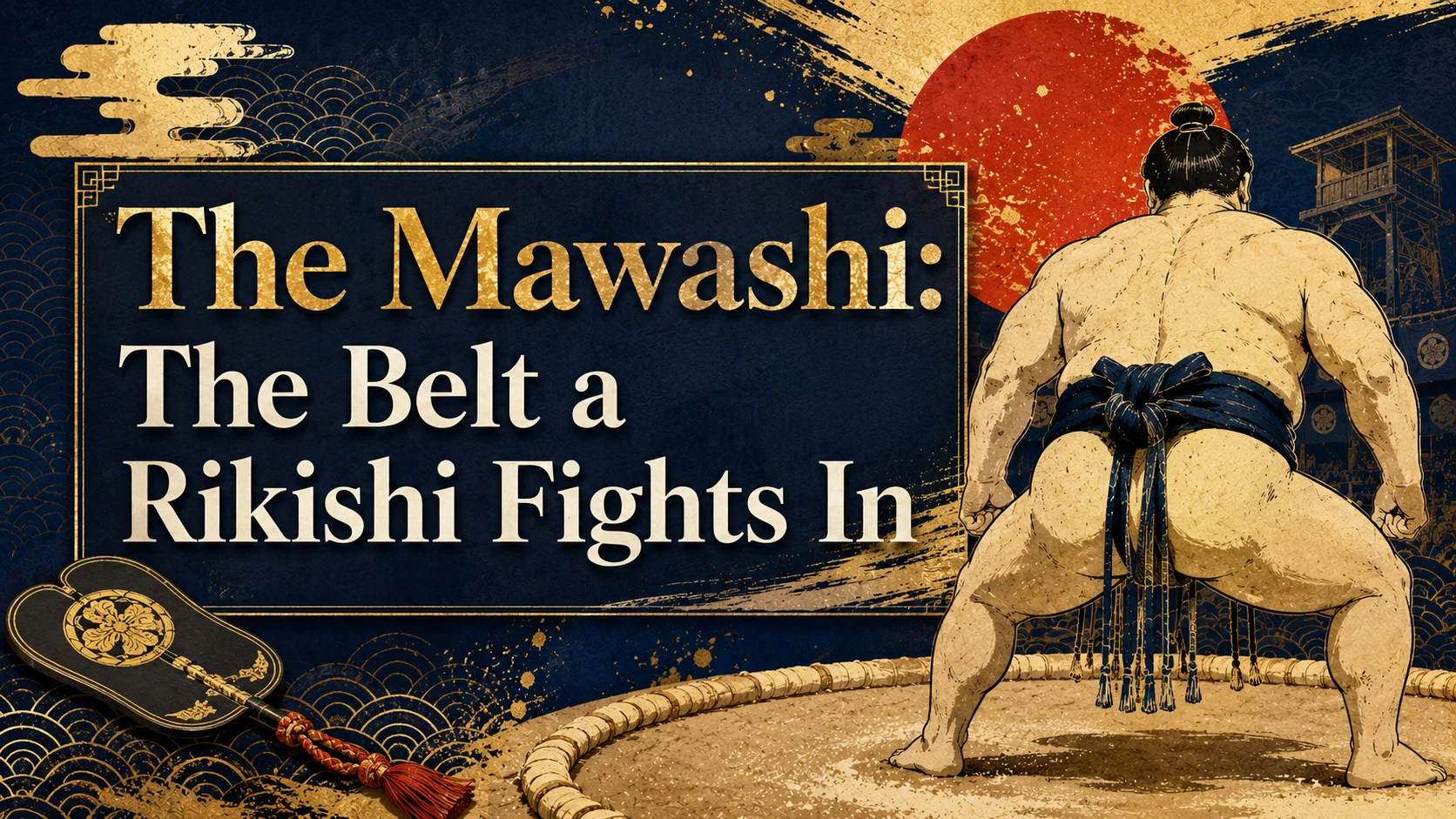
A mawashi is the belt a sumo wrestler fights in, and in professional sumo it is the only thing he wears in the ring. It is a single length of heavy cloth — silk for the two salaried divisions, cotton for everyone below them — folded lengthwise, wound round the waist several times and knotted at the back. It is not underwear and it is not a costume. It is the equipment: most of sumo’s 82 winning techniques begin with a grip on it. This guide covers the three kinds of mawashi, how one is wrapped, why the published lengths disagree with each other, what the fringe at the front is for, and what happens when a belt comes loose in a bout.
📖 What you’ll learn
- The three kinds of mawashi, and which wrestlers are allowed which
- Why the published lengths — 9 m, 10 m, 7.5 m — all disagree, and what the difference means
- What the sagari fringe is, and why the count is always odd
- The one part of the belt nobody may grab, and the loss that follows if it falls away
- How a competition belt is woven, who pays for it, and whether you can buy one
What Is a Mawashi?
A mawashi is the belt worn for sumo bouts: one length of heavy cloth, folded lengthwise, wound round the waist and tied in a large knot at the back. In professional sumo nothing at all is worn underneath it.
That last point is the single most common question English-speaking viewers ask, and the answer is short. The mawashi is the whole of a professional wrestler’s competition kit. Amateur sumo is different: the public rulebook of the International Sumo Federation refers to competitors wearing garments such as underpants or leotards under the belt, which is why amateur and student bouts look slightly different from the ones broadcast from the Kokugikan.
It is also the reason sumo is a grappling sport rather than a pushing contest. The belt is the handle. Wrestlers speak of taking a migi-yotsu or hidari-yotsu grip — right hand or left hand inside — and the throws that follow are named for which side of the belt is held. Two parts of it have their own names and their own rules: the maebukuro, the front pouch, and the maetatemitsu, the vertical section that covers the groin.
Q. Do sumo wrestlers wear anything under the mawashi?
A. In professional sumo, no. The mawashi is worn against the skin and is the only garment a rikishi wears for a bout. Amateur sumo is governed separately, and the International Sumo Federation’s rules refer to competitors wearing items such as underpants or leotards beneath the belt.
Three Types of Mawashi You Will See in Sumo
There are three, and they are not interchangeable: the shimekomi worn in tournaments by the top two divisions, the keiko-mawashi worn in training, and the kesho-mawashi, the embroidered ceremonial apron worn only for the ring-entering ceremony.
| Type | Worn for | Material | Who may wear it |
|---|---|---|---|
| Shimekomi (competition belt) | Tournament and tour bouts | Silk, in colour | Sekitori only — juryo and makuuchi |
| Keiko-mawashi (training belt) | Daily practice in the stable | Heavy cotton — white for sekitori, black below | Everyone |
| Black cotton mawashi | Both practice and official bouts | Cotton, black | Makushita and below |
| Kesho-mawashi (ceremonial apron) | The ring-entering ceremony only | Hakata-ori or Nishijin tsuzure silk, embroidered | Sekitori only |
The distinction that trips up new viewers most is the last row. A kesho-mawashi is not an apron clipped onto the fighting belt: it is a separate garment, and wrestlers change out of it before they fight. The Japan Sumo Association gives its dimensions as roughly 7 metres long and 6 to 8 kilograms in weight, with a fringe at the bottom of the front panel called the baren. Purple baren are reserved for yokozuna and ozeki; wrestlers ranked sekiwake and below may not use the colour. The aprons are almost always gifts, paid for by a wrestler’s support association or a sponsor, which is why they carry company names, regional motifs and, in the case of some foreign-born wrestlers, national flags.
Colour also marks the boundary between paid and unpaid sumo. Below juryo there is no silk and no choice: black cotton, in practice and in tournaments alike. If you can see a colour on the clay, you are watching a salaried wrestler.
Q. Is a mawashi ever washed?
A. Traditionally it is not. The Japanese government’s own English-language magazine explains that mawashi are generally hung out to dry rather than washed, for two reasons: washing is thought to wash away a wrestler’s luck, and it weakens the fabric — and a belt that gives way in a bout costs the wrestler the match.
How a Mawashi Is Wrapped — and Why Its Size Varies
It stays on because of how it is folded and how many times it goes round. The cloth is folded lengthwise into a narrow band, wound round the body four to seven times depending on the wrestler’s girth, and finished with a knot at the back that a stablemate pulls tight — one person cannot do it alone.
Now the awkward part. Ask how long a mawashi is and you get three different answers, and all three are defensible.
| Source | What it is describing | Length | Width |
|---|---|---|---|
| Japan Sumo Association | The silk shimekomi, described in general | About 10 m | — |
| The weaver who makes them (2019 interview) | Belts he actually wove, by wrestler | 7.5–7.6 m standard; Ura about 5.36 m; Akebono about 14 m | About 76 cm |
| English reference works | “A mawashi”, generically | About 9 m (30 ft) | About 60 cm |
They disagree because there is no standard length to disagree about. A competition belt is made to order for one body. The man who wove them put the ordinary case at 20 shaku — an old Japanese unit, about 7.5 metres — and then gave the two extremes he had handled: the small, quick Ura at 14.5 shaku, roughly 5.36 metres, and Akebono, the first foreign-born yokozuna, at 38 shaku, close to 14 metres. Nearly three times as much silk for one man as for the other. Any single figure you see quoted, including the Association’s own round “about 10 m”, is a convenient average rather than a specification.
Q. Why doesn’t a sumo wrestler’s mawashi fall off?
A. Because it is not fastened by a buckle or a tie but by friction and bulk. Several metres of heavy cloth, folded into a narrow band and wound four to seven times round the body, are pulled tight by a second person and finished with a large knot at the back. A belt working loose is rare enough that when it happens the referee stops the bout.
Sagari: The Fringe Hanging From the Front
Those stiff strands hanging from the front of the belt are the sagari, and they mark the part of the mawashi that nobody is allowed to grab. Their number is always odd — usually somewhere between 13 and 25.
The reason for the odd number is not decoration. The Japan Sumo Association explains it as a matter of superstition: an even number can be divided, and to divide, in sumo’s vocabulary, is what you do to the ring when you step out of it and lose. So the count is kept odd.
The Association also records something the English-language accounts leave out. Until the closing years of the Edo period the sagari and the belt were a single piece. They were separated because fingers were catching in them during bouts, and that was dangerous. What looks like a piece of costume is in fact a safety modification roughly 150 years old.
Sekitori wear silk sagari stiffened with glue so that they hang straight and match the belt; wrestlers in the lower divisions wear unstiffened cotton ones. Nobody wears them in training. They come out fairly often during bouts, and when they do the referee clears them off the clay.
Q. What are the strings hanging from a sumo wrestler’s belt?
A. They are called sagari. They hang from the front of the mawashi and mark the vertical section covering the groin, which is the one part of the belt a wrestler may not grip. The count is always an odd number, because an even number suggests division — and to “divide the ring” means to lose.
Colour: What the Rule Says and What You Actually See
The written rule and the televised reality do not match, and the Association says so itself. Its regulations describe the competition belt as being in the navy and purple range; in practice, sekitori appear in almost any colour they like.
The Association’s own explanatory pages illustrate the point with a photograph of Ura in a pink shimekomi. Nobody pretends pink is navy. The written colour rule survives as a description of what belts once were, not a restriction anybody enforces.
Colour changes mid-career are common, and they usually mean the same thing: a wrestler trying to change his luck. Onosho switched from crimson to dark grey partway through the July 2020 tournament after a run of losses — the kind of change fans notice immediately, because a sekitori’s colour becomes part of how he is recognised.
Below juryo, none of this applies. Black cotton is the rule and there is nothing to choose. Colour on the clay is a rank marker before it is a style choice.
Q. Why do sumo wrestlers change the colour of their mawashi?
A. Usually for luck. A losing streak is a common trigger, and the change can come between tournaments or in the middle of one — Onosho went from crimson to dark grey during the July 2020 tournament. Only sekitori have the option; wrestlers in the lower divisions wear black cotton.
The Rules That Involve the Belt
Two rules attach to the mawashi itself: one part of it may not be gripped, and if it comes away the bout is over.
Professional sumo does not publish its full rulebook in English, but the International Sumo Federation, which governs the amateur international game, does. Under those rules, taking hold of the maebukuro or the maetatemitsu — the front pouch and the vertical front section — or working fingers in from the side and pulling, is a prohibited move. A separate article states that if the front pouch comes undone and falls away during a bout, the judges may rule the wrestler to have lost. A third makes the opposite point clear: if the front fold of the belt merely touches the clay, nothing happens. The belt has to actually come away.
In professional sumo that verdict is called fujo-make, and it is close to extinct. The case everyone cites happened on 13 May 2000, the seventh day of the summer tournament, when the sandanme wrestler Asanokiri lost his belt against Chiyohakuho. It was reported at the time as the first such loss in 83 years.
Far more common, and still rare, is the belt working loose. On day eight of the July 2022 tournament in Nagoya, in the last bout of the day, Wakamotoharu’s back knot came undone against the yokozuna Terunofuji. The head referee, Shikimori Inosuke, ran in from the far side of the ring calling mawashi-matta — a stoppage to retie the belt. Terunofuji heard the call and relaxed; Wakamotoharu did not, and pushed the yokozuna out. The judges conferred, decided the stoppage stood, had both men restored to the positions they had been in when it was called, and restarted the bout from there. Terunofuji won it. A wrestler had beaten a yokozuna and been given nothing for it, because of a knot.
Q. What happens if a sumo wrestler’s mawashi comes off?
A. He loses. Exposure ends the bout immediately, a verdict known as fujo-make, and it is extraordinarily rare — the case usually cited is Asanokiri’s in May 2000, reported as the first in 83 years. A belt that is merely working loose is different: the referee calls a halt, the belt is retied, and the bout continues.
How a Mawashi Is Made — and Can You Buy One?
A silk competition belt is hand-woven to order, and it takes about ten days of work to produce one. It is not a retail product in any ordinary sense.
In a 2019 interview, a veteran weaver at the Kyoto obi maker Obihiro — then described as the only person in Japan still weaving competition belts by hand — set out what the work involves. The loom carries 15,000 warp threads, doubled in the habutae manner so that the true count is 30,000. The weft is five different threads twisted together, nineteen or twenty strands at a time, each doing a different job: one for the base, one for hardness, one for strength, one thin, and one to bind the rest. The weave is warp-faced satin, chosen because that is what gives the cloth its strength. Dressing the loom alone takes four days. The weaving takes another five or six.
The physical demand is the part that does not appear in any English account. The beater the weaver pulls towards himself to compact each pass weighs 30 to 40 kilograms, and it has to be pulled twice for every row. Twenty to thirty minutes is as long as anyone can keep it up. It is work normally done by two people.
The timing is dictated by the calendar. Tournaments fall in the odd-numbered months, so the belts are woven in the even ones — orders arrive around the ninth or tenth of the month, once promotions to juryo are settled, and a good stretch produces two belts, four at the very most. Orders come through the broker attached to a stable or through a wrestler’s support association, which means the weaver generally does not know whose belt he is making. He identifies his own work on television by a single gold thread, 3.7 centimetres of it, woven in at the end as a maker’s mark.
So can you buy one? A cotton training belt, yes: they are made and sold for amateur, student and school sumo, and that is what almost everyone who wants a mawashi actually ends up with. A silk shimekomi is a different proposition — a commissioned piece made for one wrestler’s measurements, ordered through a stable or a support group rather than bought off a shelf, and usually a gift rather than a purchase. The same is true of the kesho-mawashi, which is why the aprons carry the names of the people who paid for them.
Q. Can you buy a sumo mawashi?
A. You can buy a cotton one. Training belts are manufactured for amateur, student and school sumo and are sold openly. The silk shimekomi worn in professional tournaments is custom-made for an individual wrestler and ordered through his stable or support association, rather than sold as ordinary merchandise.
Summary
- Three kinds. Silk shimekomi for tournaments, cotton keiko-mawashi for training, and the embroidered kesho-mawashi worn only for the ring-entering ceremony and changed out of before bouts.
- Silk means salary. Only juryo and makuuchi wrestlers wear silk and colour. Below them it is black cotton, in practice and in competition alike.
- There is no standard length. The Association says about 10 m; the man who wove them put the ordinary case at 7.5 m and gave real examples from 5.36 m to 14 m. Each belt is made for one body.
- The sagari are a safety feature. Odd in number because an even number implies division, and separated from the belt in the late Edo period because fingers were catching in them.
- The front is untouchable. Gripping the front pouch is a foul; a belt that actually comes away ends the bout. The last well-known case was in 2000, reported as the first in 83 years.
Related guides: What is sumo? · Rikishi: a sumo wrestler’s life · Sumo rankings and the banzuke · Yokozuna, explained
There is something worth noticing in the numbers. A sport that fixes its calendar two years ahead, publishes its rankings to the day and counts its winning techniques to eighty-two does not standardise the one piece of equipment anybody wears. The belt is measured against the man. Ura and Akebono were doing the same job under the same rules, and one of them needed nearly three times as much silk to do it.