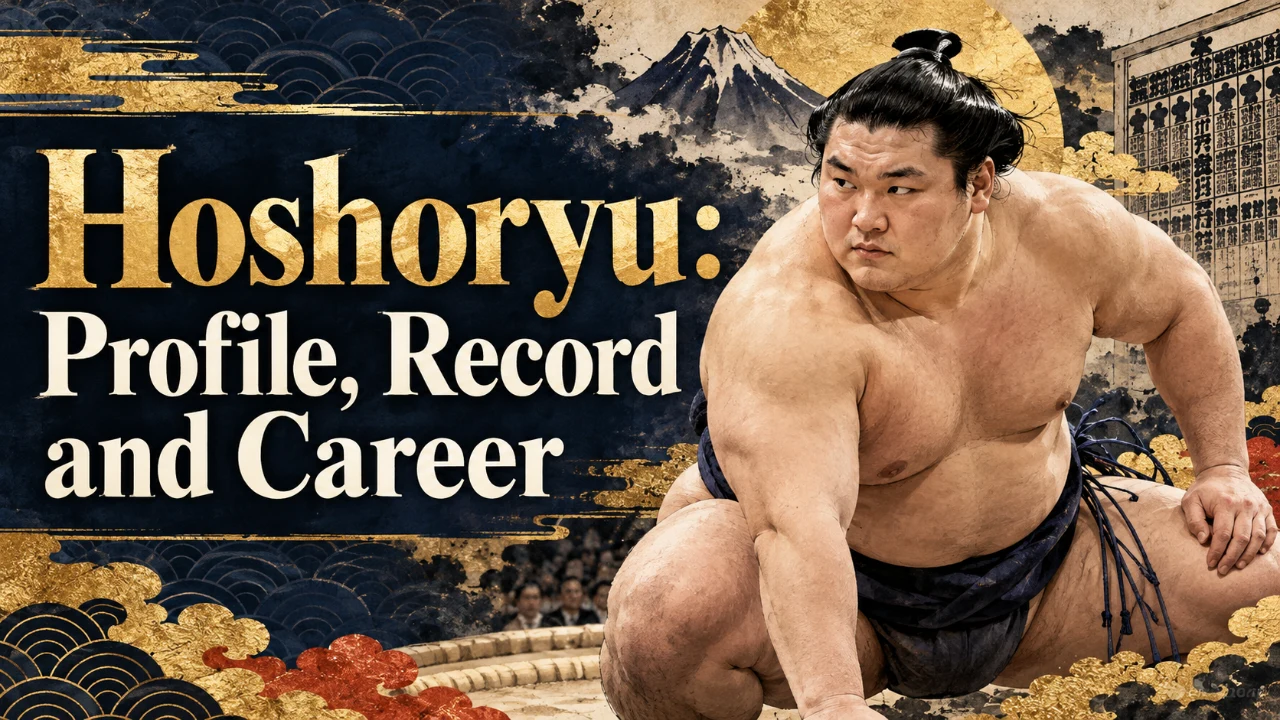
Hoshoryu is the 74th yokozuna, sumo’s highest rank, and one of the two wrestlers who held that rank in 2026. He has won two top-division championships, the second of which earned his promotion in January 2025. A right knee injury then forced him to withdraw from the July 2026 tournament and miss all of September. This guide follows the Japan Sumo Association’s own records on his career, how he wins, and where he stands now.
📖 What you’ll learn
- What the Japan Sumo Association’s records say about his profile, stable and real name
- How a high school wrestler from Mongolia reached yokozuna seven years after his debut
- The records behind his two championships, and the techniques he wins with
- His results in ten tournaments as yokozuna, and the 2026 knee injury
Who Is Hoshoryu?
Hoshoryu is an active sumo wrestler from Mongolia who became the 74th yokozuna in January 2025 after his second top-division championship.
The Association records that he was born on May 22, 1999, in Ulaanbaatar, Mongolia, and wrestles for Tatsunami stable. The Japan Sumo Association lists his current rank as yokozuna. On the ranking sheet for the September 2026 tournament he held the West side, with Onosato on the East.
In the record book, Hoshoryu sumo means a fast, belt-based style built on a right-hand grip and throws. The Association lists his signature maneuvers as a right-hand inside grip, a forward drive and throws. Those three words are covered in detail further down this page.
He debuted in January 2018 and reached the top rank seven years and two months later. His results since then have been mixed, and injuries have shaped his time at the top.
For daily life as a rikishi, the formal word for a professional sumo wrestler, see our guide to what a rikishi actually is.
Q. Is Hoshoryu related to Asashoryu?
A. Yes. AFP reports that Hoshoryu is the nephew of Asashoryu, the 68th yokozuna and the first born in Mongolia. Asashoryu won 25 championships before he left the sport in 2010. On his own promotion in 2025, Hoshoryu vowed that he would not “tarnish the title,” according to AFP.
Hoshoryu’s Profile: Real Name, Height and Stable
The Japan Sumo Association registers his real name as Sugarragchaa Byambasuren and lists him at 188 cm and 148 kg.
His full ring name is Hoshoryu Tomokatsu, the form the Association uses on its profile page. Hoshoryu is the part printed on the ranking sheet and announced in the arena. Tomokatsu is the given-name part of the same ring name.
In imperial units, that is 6 ft 2 in and 326 lb. The table below reproduces the fields on the Association’s English and Japanese profile pages, as recorded on October 7, 2026. The records are counted up to the final day of the September 2026 tournament.
| Item | Official record |
|---|---|
| Ring name | Hoshoryu Tomokatsu |
| Real name | Sugarragchaa Byambasuren |
| Born | May 22, 1999 |
| Birthplace | Ulaanbaatar, Mongolia |
| Height | 188.0 cm (6 ft 2 in) |
| Weight | 148.0 kg (326 lb) |
| Stable | Tatsunami |
| Current rank | Yokozuna (West, September 2026) |
| Signature maneuvers | migi-yotsu, yori, nage |
| Career record | 401-235-49 (52 tournaments) |
| Top-division record | 319-187-49 (37 tournaments) |
Two rows deserve a closer look. The first is the weight: 148 kg is the figure the Association publishes, not a reading from any one tournament. The second is the absences. His career and top-division records both show 49, so every absence came after he reached the top division.
His stable, Tatsunami, is where he has trained since his debut. The sumo stable system explains how a stable recruits, houses and trains its wrestlers.
The Association also publishes a short questionnaire on its Japanese profile page. In it he gives his age on starting sumo as 17. His chosen motto, translated here, is “training does not lie.”
Q. What does the name Hoshoryu mean?
A. The Association writes his ring name in Japanese as 豊昇龍. The three characters mean “abundant,” “rising” and “dragon.” The last character, read ryu, also ends the ring name of his uncle Asashoryu, written 朝青龍. His real name, Sugarragchaa Byambasuren, is not used in competition.
From High School Wrestler to Yokozuna in Seven Years
Hoshoryu debuted in January 2018 and first appeared on the ranking sheet as yokozuna in March 2025, seven years and two months later.
He did not start out in sumo. According to the city of Kashiwa, he came to Japan as an exchange student at Nippon Sport Science University Kashiwa High School. He was a wrestler at first. The city’s newsletter says he decided to switch to sumo in the summer of his first year there.
The city still claims him. Its mayor’s column, published when he became yokozuna, quotes him calling Kashiwa his hometown in Japan. It adds that he visits the local youth sumo club between tournaments and regional tours. Three years after the switch, he made his professional debut.
The Association’s record shows how fast the climb went once he did. The timeline below marks the tournament in which each rank first appears on his profile.
The lower divisions took him less than two years. He won the fifth division, jonidan, with a perfect 7-0 record in May 2018. Two months later he went 6-1 in the fourth division, sandanme, and moved up again.
The third division, makushita, slowed him down. He spent seven tournaments there, from September 2018 to September 2019. His record shows winning marks in six of them, but mostly by a single bout, such as 4-3. Only one tournament there ended with a losing record, a 3-4 in July 2019.
He broke through to juryo, the salaried second division, in November 2019. He needed four tournaments there before reaching the top division, makuuchi, in September 2020. His first top-division tournament ended at 8-7, from the lowest rank on the sheet, maegashira 16.
His first spell among the titled ranks, sanyaku, began in March 2022 at komusubi, the fourth-highest rank. He held it for three tournaments with winning records each time. From September 2022 he moved up to sekiwake, the third-highest rank, and stayed there for six tournaments.
Two championships decided the last two steps. In July 2023 he won his first top-division title as a sekiwake, going 12-3. That closed a run of 10, 11 and 12 wins, a total of 33 over three tournaments. The Association’s record shows him at ozeki, the second-highest rank, from the next tournament.
The Association’s record shows nine tournaments at ozeki, none of them with a losing record. His lowest marks there were 8-7, twice. In January 2025 he won again as an ozeki, also at 12-3, after going 13-2 the tournament before.
That January title came through a three-way playoff, according to AFP. AFP reports that he was formally promoted to yokozuna at a ceremony in Tokyo on January 29, 2025. The Association’s record shows his first tournament at the new rank in March 2025.
Our guide to how the sumo rankings work explains each rank along the way, including the 33-win figure quoted for ozeki promotion. What a wrestler must show to reach the top rank is covered in our guide to the rank of yokozuna.
Q. How old was Hoshoryu when he became yokozuna?
A. He was 25. AFP reports that his promotion became official on January 29, 2025, four months before his 26th birthday. By the Association’s dates he debuted in January 2018, at 18, and started sumo at 17 after switching from wrestling in high school.
Hoshoryu’s Record: Two Championships and 401 Wins
Hoshoryu has won two top-division championships and 401 career bouts, and the Association lists both figures on his official profile.
The two titles are the headline figures. Both came with a 12-3 record, one as a sekiwake in July 2023 and one as an ozeki in January 2025. The Yomiuri Shimbun reported that the 2025 title ended a gap of nine tournaments since his first.
The table below sets out the awards the Association records for him, with the tournament each one came from.
| Award or record | Figure | When |
|---|---|---|
| Top-division championships | 2 | July 2023 (12-3), January 2025 (12-3) |
| Juryo championships | 0 | — |
| Jonidan championships | 1 | May 2018 (7-0) |
| Outstanding Performance Prize | 0 | — |
| Fighting Spirit Prize | 1 | July 2023 |
| Technique Prize | 2 | July 2021, November 2022 |
| Kinboshi | 0 | — |
| Career wins | 401 | Through September 2026 |
| Top-division wins | 319 | Through September 2026 |
A few rows need a word of explanation. The three prizes, the sansho, go only to wrestlers ranked below ozeki. All three of his came before his promotion in 2023. The Technique Prize is the one he has won twice, which fits the way he wrestles.
The empty kinboshi row has a simple cause. Only a maegashira, a rank-and-file top-division wrestler, earns one by beating a yokozuna. He did not record such a win in his time at that rank.
Set the absences aside and his top-division record is 319 wins and 187 losses. That is a winning rate of about 63 percent over 37 tournaments. The full list of wrestlers covered on this site, past and present, is in our directory of sumo wrestlers.
Q. Has Hoshoryu ever won a tournament with a perfect record?
A. Only in the lower divisions. His one perfect record is the 7-0 that won the jonidan championship in May 2018. In the top division his best mark is 13-2, in November 2024 and September 2025. Both of his top-division titles came at 12-3.
How Hoshoryu Wins: Right-Hand Grip and Throws
Hoshoryu wins mostly by taking a right-hand inside grip on the belt, then forcing his opponent out or throwing him down.
The Association lists his signature maneuvers as migi-yotsu, yori and nage. Migi-yotsu means both wrestlers hold the belt with the right arm inside. Yori means driving forward while gripping the belt. Nage simply means throws, the family of techniques that bring an opponent down.
His profile also publishes a breakdown of his most-used winning techniques. The Association states that it calculates the figures from his bouts in the past six tournaments. That sample is 53 wins from 76 bouts, including one win by default.
Read with the Association’s classification of the 82 kimarite, its named winning techniques, the pattern is wide rather than narrow. His top two are basic techniques: one on the belt and one by pushing. The third is a throw made without a belt grip.
The difference between the first two matters. Yorikiri needs a hold on the opponent’s belt, so it follows a grip battle. Oshidashi is won with the hands on the opponent’s body, before any grip is taken. With both in his top two, he can finish a bout at close range or from a distance.
The largest bar is the one marked “all others.” More than half his wins in the sample came from techniques outside his top three. His two Technique Prizes, awarded for skill, sit alongside that spread.
In practice, a migi-yotsu bout starts with both wrestlers reaching for the belt with the right arm inside. From there he can drive forward for yorikiri or turn and throw. The full set of techniques and how bouts are decided is covered in our guide to the rules of sumo.
Q. What is sukuinage?
A. Sukuinage is a beltless arm throw, one of the Association’s throwing techniques. The attacker slips an arm under the opponent’s armpit and throws him without holding the belt. It made up 9 percent of Hoshoryu’s wins in the Association’s six-tournament sample.
Hoshoryu as Yokozuna: Ten Tournaments at the Top
Hoshoryu has fought ten tournaments as yokozuna, from March 2025 to September 2026, finishing three of them at 12 wins or better.
His promotion came at a delicate moment. AFP reported that it spared sumo from having no yokozuna for the first time in more than 30 years. The 73rd yokozuna, Terunofuji, had announced his retirement earlier that month.
The table below lists his ten tournaments at the rank, as the Association records them. The third figure in each record is days absent.
| Tournament | Record | Note |
|---|---|---|
| March 2025 | 5-5-5 | First tournament as yokozuna; withdrew |
| May 2025 | 12-3 | — |
| July 2025 | 1-4-10 | Withdrew |
| September 2025 | 13-2 | Same record as champion Onosato; lost the playoff |
| November 2025 | 12-3 | Same record as champion Aonishiki; lost the playoff |
| January 2026 | 10-5 | — |
| March 2026 | 11-4 | — |
| May 2026 | 0-2-13 | Withdrew |
| July 2026 | 7-7-1 | Withdrew from Day 14 |
| September 2026 | 0-0-15 | Absent for the whole tournament |
The totals tell the story. Across the ten tournaments he won 71 bouts, lost 35 and missed 44 days. Five of the ten included at least one day of absence.
The bouts he did fight went well. Set the absences aside and 71 wins against 35 losses is a winning rate of about 67 percent. That is higher than his top-division rate overall. The problem at the top has been finishing tournaments, not winning bouts once he is in them.
The best stretch came in the second half of 2025. He went 13-2 in September and 12-3 in November, and both times another wrestler finished level with him. The Association’s records name Onosato and Aonishiki as the champions, so he lost both playoffs.
He does not hold the rank alone. Onosato, of Nishonoseki stable, held the other yokozuna position on the September 2026 ranking sheet. For a sense of how long a reign can run, compare Hakuho, who held the rank from 2007 to 2021.
Q. Is Hoshoryu the only yokozuna?
A. Not in 2026. On the September 2026 ranking sheet he was the West yokozuna and Onosato the East. When he was promoted in January 2025, AFP called him sumo’s only grand master, because Terunofuji had just announced his retirement.
The 2026 Knee Injury and What Comes Next
Hoshoryu had right knee surgery in July 2026, NHK reported, and the Association had announced no return date as of October 7.
The injury followed a difficult spring. He withdrew early from the May 2026 tournament with two losses. In July, at Nagoya, he reached seven wins and seven losses, then withdrew from Day 14, according to NHK. The Association’s record shows that tournament as 7-7-1.
NHK then reported on September 11, 2026, that he would sit out the September tournament after the knee surgery in July. The Association’s record shows him absent for all 15 days. That made three tournaments in a row with at least one day missed.
What happens next depends on the rules of the rank. A yokozuna cannot be demoted, however a tournament goes. A yokozuna whose results keep slipping is expected to retire instead, as our guide to the rank of yokozuna explains.
The Association’s notices listed no return date for him as of October 7, 2026. The word to watch for is kyujo, the term for a withdrawal or absence. The next tournament runs from November 8 to 22, 2026, at Fukuoka Kokusai Center. The full calendar is in our sumo tournament schedule.
Q. Will Hoshoryu fight in the November 2026 tournament?
A. No decision had been announced as of October 7, 2026. The November tournament runs from November 8 to 22 in Fukuoka. The Association publishes each day’s bouts and any withdrawals on its official site, which is the place to check.
Summary
Hoshoryu is the 74th yokozuna, a two-time top-division champion, and in late 2026 a wrestler recovering from right knee surgery.
The Association’s records give the shape of his career. He came to Japan as a high school wrestler and switched to sumo at 17. He debuted in 2018, reached the top division in 2020 and won his first title as a sekiwake in 2023. A second title in January 2025 made him yokozuna at 25.
His time at the top has been uneven. He tied for the best record twice in 2025 and lost both playoffs. In 2026 injuries took over: he withdrew in May and July, had knee surgery, and missed September entirely.
For other wrestlers covered the same way, see our full directory of sumo wrestlers. Our guide to how a sumo tournament works explains the 15-day format behind every record in this profile.
His record so far reads 401 wins, two championships and a rank that cannot be taken away. What it does not yet record is a title won as yokozuna.