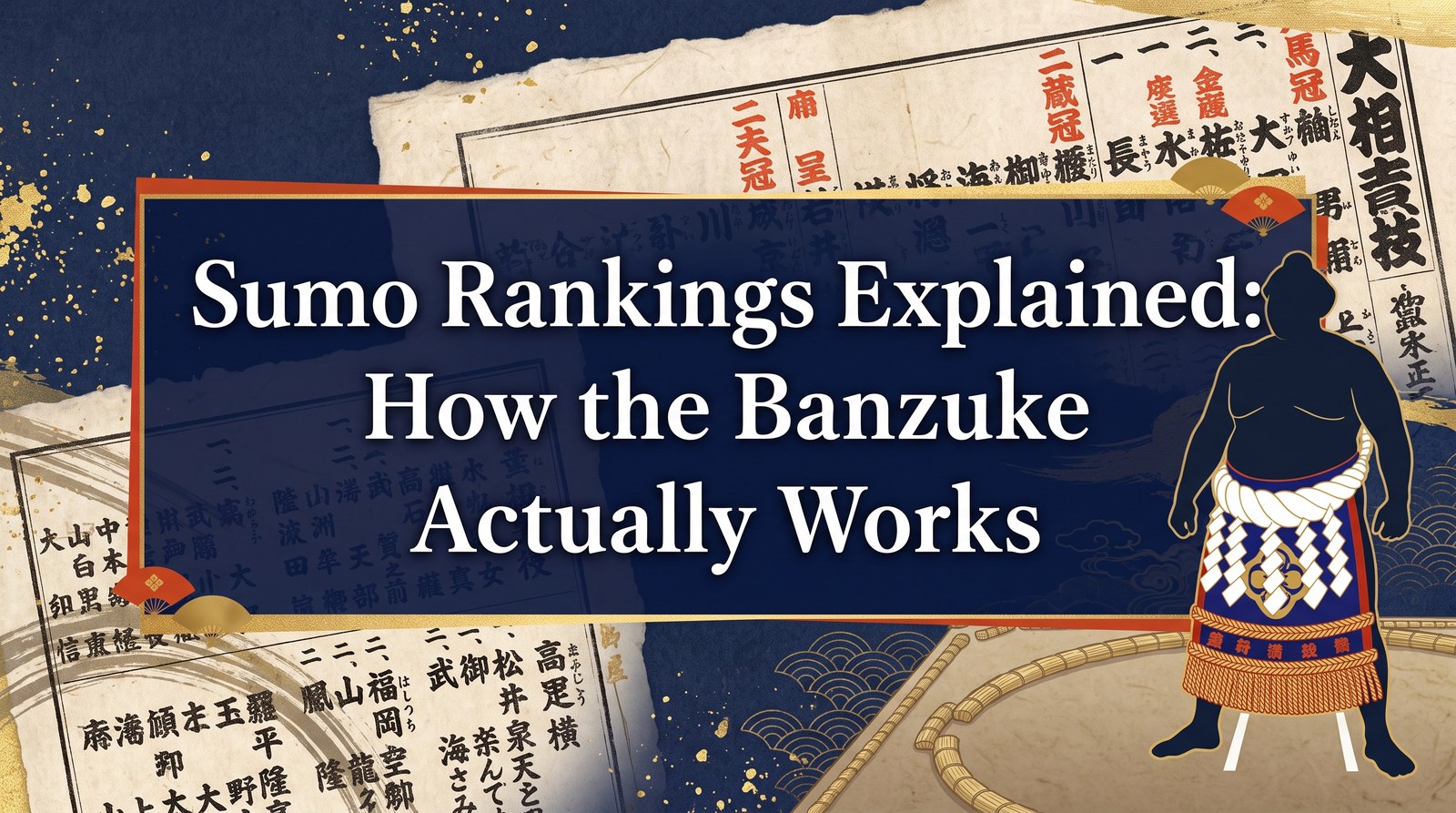
The sumo rankings are not a league table. They are a single sheet, redrawn after every tournament, that fixes where all 589 professional wrestlers stand — who is salaried, who fights whom, and who fights at all. The Japan Sumo Association calls it the banzuke, and its own English site calls it, simply, the Sumo Ranking. This guide covers what the sheet is, how to read it, when the next one appears, and what actually moves a wrestler up it.
📖 What you’ll learn
- What the banzuke is, and why no published formula decides it
- When each new ranking is released: the 13-day rule, and its exceptions
- The six divisions, their fixed quotas, and the real headcount in each
- How to read the official sheet — east, west, and what “#1” means
- What moves a wrestler up or down, and where the cut line falls
- The three official pages where you can check the rankings free
What Are the Sumo Rankings? The Banzuke Explained
Sumo rankings are set out on the banzuke, a single sheet that fixes the order of every professional wrestler for the next tournament. A closed committee of the Japan Sumo Association rebuilds it after each tournament and releases it 13 days before the opening day. No calculation formula is published.
That last point is the one most English-language explanations skip. The banzuke is not produced by feeding win totals into a table. It is assembled by the Association’s judging department at a banzuke hensei kaigi, a closed ranking committee that meets within three days of a tournament’s final day. The committee compares every wrestler against every other, and settles the order by relative judgment.
So the sheet is a construction, not an output. Two wrestlers can finish with identical records and move different distances, because the space above them is different. The results decide who deserves to rise. The committee decides how far.
Everything else follows from it. A rank sets a wrestler’s salary or the absence of one, the day he fights, and the opponents he is given. Nobody competes for points here. They compete for a position on a sheet that will be redrawn in three weeks.
Q. How often do the sumo rankings change?
A. Six times a year, once for each tournament. The order is settled within three days of a tournament ending, then held back and published 13 days before the next one starts. Nothing between those two moments changes a rank — not the regional tours, not exhibition bouts, not injuries.
When Are New Sumo Rankings Released? The 13-Day Rule
New sumo rankings are released 13 days before the first day of a tournament, on a Monday. That is not a rule of thumb. The Association publishes its schedule years ahead, and across the 18 tournaments listed for 2026, 2027 and 2028, fifteen fall exactly 13 days before day one — every one of them a Monday.
The exceptions are explainable. The January sheets come out further ahead — 20 days in 2026 and 2027, and 16 in 2028 — because the announcement has to clear the New Year holidays. The other deviation is the March 2026 sheet, released on a Tuesday, 12 days out. The Monday before it was a national holiday. The Association publishes no reason, so treat that one as an observation, not a rule.
| Tournament | Venue | Rankings released | First day |
|---|---|---|---|
| September 2026 | Ryogoku Kokugikan | August 31, 2026 | September 13, 2026 |
| November 2026 | Fukuoka Kokusai Center | October 26, 2026 | November 8, 2026 |
| January 2027 | Ryogoku Kokugikan | December 21, 2026 | January 10, 2027 |
| March 2027 | EDION Arena Osaka | March 1, 2027 | March 14, 2027 |
| May 2027 | Ryogoku Kokugikan | April 26, 2027 | May 9, 2027 |
| July 2027 | IG Arena, Nagoya | June 28, 2027 | July 11, 2027 |
| September 2027 | Ryogoku Kokugikan | August 30, 2027 | September 12, 2027 |
| November 2027 | Fukuoka Kokusai Center | November 1, 2027 | November 14, 2027 |
The practical consequence is a gap you have to live with. Advance tickets go on sale roughly two months before a tournament, and the rankings arrive about six weeks after that. You buy your seat without knowing who will be in the top division on the day. On-sale dates and how to buy are in our guide to buying sumo tickets.
On release morning the printed sheets reach the stables, and the Association posts the ranking online the same day. The contents were settled two weeks earlier. That fortnight is the time it takes to write and print the sheet. For what a stable is and how rank governs life inside one, see our guide to sumo stables.
Q. When is the next sumo ranking announced?
A. Count back 13 days from the first day of the tournament and you will land on the Monday it appears. For the September 2026 tournament, which opens on September 13, the ranking was released on August 31, 2026. The Association lists every release date on its Grand Tournament Schedule page, currently as far ahead as 2028.
The Six Sumo Divisions: Quotas, Pay and Structure
Professional sumo has six divisions, and the top four have fixed quotas. That single fact explains most of what happens on a banzuke. When a wrestler rises into a division, someone else has to leave it, because the number of places does not move.
The Association’s English site names the divisions makuuchi, juryo, makushita, sandanme, jonidan and jonokuchi, top to bottom. The figures below come from the Association’s own Find Rikishi database, counted on August 30, 2026, against the July 2026 sheet.
| Division | Fixed quota | Actual count | Bouts per tournament | Salaried |
|---|---|---|---|---|
| Makuuchi | 42 | 42 | 15 | Yes |
| Juryo | 28 (14 ranks) | 28 | 15 | Yes |
| Makushita | 120 (60 ranks) | 120 | 7 | No |
| Sandanme | 160 (80 ranks) | 161 | 7 | No |
| Jonidan | None | 198 | 7 | No |
| Jonokuchi | None | 40 | 7 | No |
| Total | — | 589 | — | 70 salaried |
Read the quota column and the pressure becomes visible. The top four divisions hold 350 places between them, and those places are full. Only the bottom two can absorb growth, which is why every promotion into makushita or above forces a demotion out of it.
Sandanme is the one line that does not match. Its quota rose to 80 ranks — 160 men — in January 2025, and the July 2026 sheet carried 161. Overruns like that are worth noticing: the quotas are targets the committee works to, not walls it cannot cross. Totals also move between counts as wrestlers retire, so treat any headcount as a snapshot with a date on it.
The 70 men in the top two divisions are the sekitori, the salaried ranks. For who those wrestlers are and where they live, see our guide to what a rikishi’s life is really like.
How to Read the Official Banzuke: East, West and #1
Read the banzuke from the centre outward, not from left to right. The highest ranks sit at the middle of the top row, and rank falls away toward both edges. The right half is East, the left half is West.
To find one wrestler on the printed sheet, start at the centre of the top row and work outward along it. If he is not in row one, drop to row two and repeat. Row two is the awkward one: it carries juryo first, then continues straight into makushita without an obvious break. The last row also lists the referees, ushers and hairdressers.
East outranks West, and the gap is worth exactly half a place. A wrestler at East Maegashira 5 stands above the man at West Maegashira 5 and below the man at West Maegashira 4. When a place opens above them, the East man is in front of the queue. The better previous record usually earns the East side in the first place. This is precedence, not team allegiance — East and West wrestlers face each other constantly. East is said to rank higher because the direction of the sunrise has traditionally been treated as the senior one.
The sheet is written by hand, by a referee, in sumo-ji, a thick brush script used for nothing else. Stroke width is graded by rank: a yokozuna’s name is drawn broad and heavy, and in the bottom division the names shrink until you have to lean in. By tradition the script is packed tight so that the seats will fill with no gaps.
Q. What does “#1” mean on the official sumo rankings?
A. It means Maegashira 1 — the senior rank in the top division below the titled ranks. The Association’s English banzuke never prints the word “Maegashira.” Below Yokozuna, Ozeki, Sekiwake and Komusubi it simply lists #1 through #16. Those wrestlers are the rank and file of makuuchi, and #1 draws the champions on the opening days.
Promotion and Demotion: How Kachikoshi and Makekoshi Work
A wrestler rises with a winning record and falls with a losing one. In the top two divisions, where everyone fights 15 times, eight wins is kachikoshi, a winning record, and eight losses is makekoshi, a losing one. Below juryo the tournament is seven bouts, so four wins does it.
What a winning record is worth is where English coverage goes wrong. You will often read that each win above eight lifts a wrestler one rank. That is a fan’s habit of thumb, not a rule, and the Association has never published anything of the kind. Because the committee ranks relatively, the same 9–6 can lift a wrestler four places in a tournament that emptied the ranks above him, and one place in a tournament that did not.
Absence is punished harder than defeat, and this is where English-speaking fans are caught out. A wrestler who withdraws injured goes kyujo, and the bouts he misses are recorded as losses. Withdraw on day four and the sheet reads 3–12, exactly as if he had been beaten twelve times.
There is no injury protection. A kosho system did once hold a wrestler’s rank for one tournament after an injury sustained in the ring; it ran from January 1972 and was abolished from the January 2004 tournament after the Association judged it was being overused. Since then a torn knee costs the same rank as a bad fortnight.
The cut line: who drops out of makuuchi
The interesting movement happens at the boundaries between divisions, because the quotas force an exchange. A wrestler at Maegashira 15 or 16 with a losing record is competing, in effect, against the men at the top of juryo who won. If more juryo wrestlers earn promotion than makuuchi wrestlers have vacated, someone has to be pushed down to balance the sheet.
The same pressure works one division lower, where the prize is far larger. Crossing into juryo means becoming a sekitori: a salary, an assistant, and a silk apron for the ring-entering ceremony. Below it, nobody is paid. The usual benchmark for that jump is a perfect 7–0 within the top 15 ranks of makushita, and even that is no guarantee: if no places open above, a spotless record can leave a wrestler where he was.
Q. Does one extra win move you up one rank?
A. Not reliably. “One win, one rank” is a fan’s shorthand, not a published rule. The ranking committee sets the order by comparing all the wrestlers at once, so the distance a record carries depends on how many places opened above. The same 9–6 can be worth four ranks one tournament and one rank the next.
Special Rank Rules: Sanyaku, Ozeki and Yokozuna
Four ranks at the top of makuuchi have rules the others do not. The Association’s English pages group ozeki, sekiwake and komusubi as sanyaku, the titled ranks, with yokozuna above them — and they use the word sanyaku in English without translating it.
Sekiwake and komusubi hold their rank only by winning. A losing record drops them straight back into the maegashira ranks. Each is normally one man on each side, but the numbers flex: the July 2026 sheet carried four sekiwake, which the Association noted was the first time since September 2024.
Ozeki is the rank with a safety net. A losing record does not demote an ozeki. It makes him kadoban — the Association uses the Japanese word in its English notes — meaning he must produce a winning record next time or fall to sekiwake. There is a way back, too. A demoted ozeki regains the rank immediately by winning 10 of 15 in the very next tournament. Aonishiki did exactly that in July 2026, and went further, taking the championship at 12–3.
Promotion to ozeki has no written rule either. The figure quoted by the Association’s judges and by the press is 33 wins across three tournaments in sanyaku, weighed alongside the quality of the sumo. Yokozuna is stricter: two consecutive championships as an ozeki, or a record judged equivalent, and a recommendation carried by two-thirds of the advisory council members present. Our guide to the yokozuna rank covers that process in full.
Q. What happens if an ozeki has a losing record?
A. Nothing immediately. He becomes kadoban and keeps the rank for one more tournament. A second losing record in a row demotes him to sekiwake. If that happens, winning 10 bouts in the following tournament restores the rank at once — the route Aonishiki took in July 2026, when he won the championship at 12–3.
Where to Check the Current Sumo Rankings
The Association publishes the current sumo rankings free, in English, on three separate pages. Most English coverage points to none of them.
Banzuke Information is the sheet itself, rendered as a table. A dropdown switches between the six divisions, so you can follow a wrestler from jonokuchi upward. This is the page that lists the top division as Yokozuna, Ozeki, Sekiwake, Komusubi and then #1 to #16.
Find Rikishi searches the same data by division, by name and by birthplace, and reports how many results it found. That counter is where the headcounts in this article came from, and it is the quickest way to see how many wrestlers a given country or prefecture currently has.
Banzuke Topics is the one worth bookmarking. After every release the Association writes up each significant move in English, using its own labels — Ozeki Kadoban, Sekiwake Return, Komusubi Debut, Makuuchi Debut, Juryo Debut — and adds the historical context. The July 2026 edition recorded that only one wrestler was promoted to juryo, the first single promotion since March 2016, and the first solo juryo debut since May 1970.
Q. Where can I see the current sumo rankings for free?
A. On the Japan Sumo Association’s own English site, on three pages: Banzuke Information for the full sheet, Find Rikishi to search it, and Banzuke Topics for the Association’s own account of who moved and why. All three are free, and all three update on release day. Printed copies of the banzuke are a separate matter and availability changes, so check the Association’s current notice before planning to buy one.
Summary
- A closed committee rebuilds the banzuke after every tournament by relative judgment. No formula is published, so no record guarantees a fixed number of places.
- The top four divisions have fixed quotas — 42, 28, 120 and 160 — so a promotion always costs somebody else a place. The July 2026 sheet held 589 wrestlers, 70 of them salaried.
- Rankings are released 13 days before the first day, on a Monday, in 15 of the 18 tournaments scheduled through 2028. The exceptions cluster around the New Year.
- The Association publishes the sheet, a search tool and a plain-English summary of every promotion, free, on release day.
Further reading on this site: what sumo is, what a rikishi’s life is really like, the yokozuna rank, and how to buy sumo tickets. The body that builds the banzuke and votes on promotions is covered in our guide to the Japan Sumo Association.
A banzuke is one sheet of paper, and it holds the whole profession at once — the two men at the centre of the top row, and the teenager at the bottom edge whose name is written small enough to miss. Half a place, east instead of west, is the difference between two mornings of training that nobody watched. The sheet records the outcome and none of the work. That is worth remembering on the Monday a new one arrives.