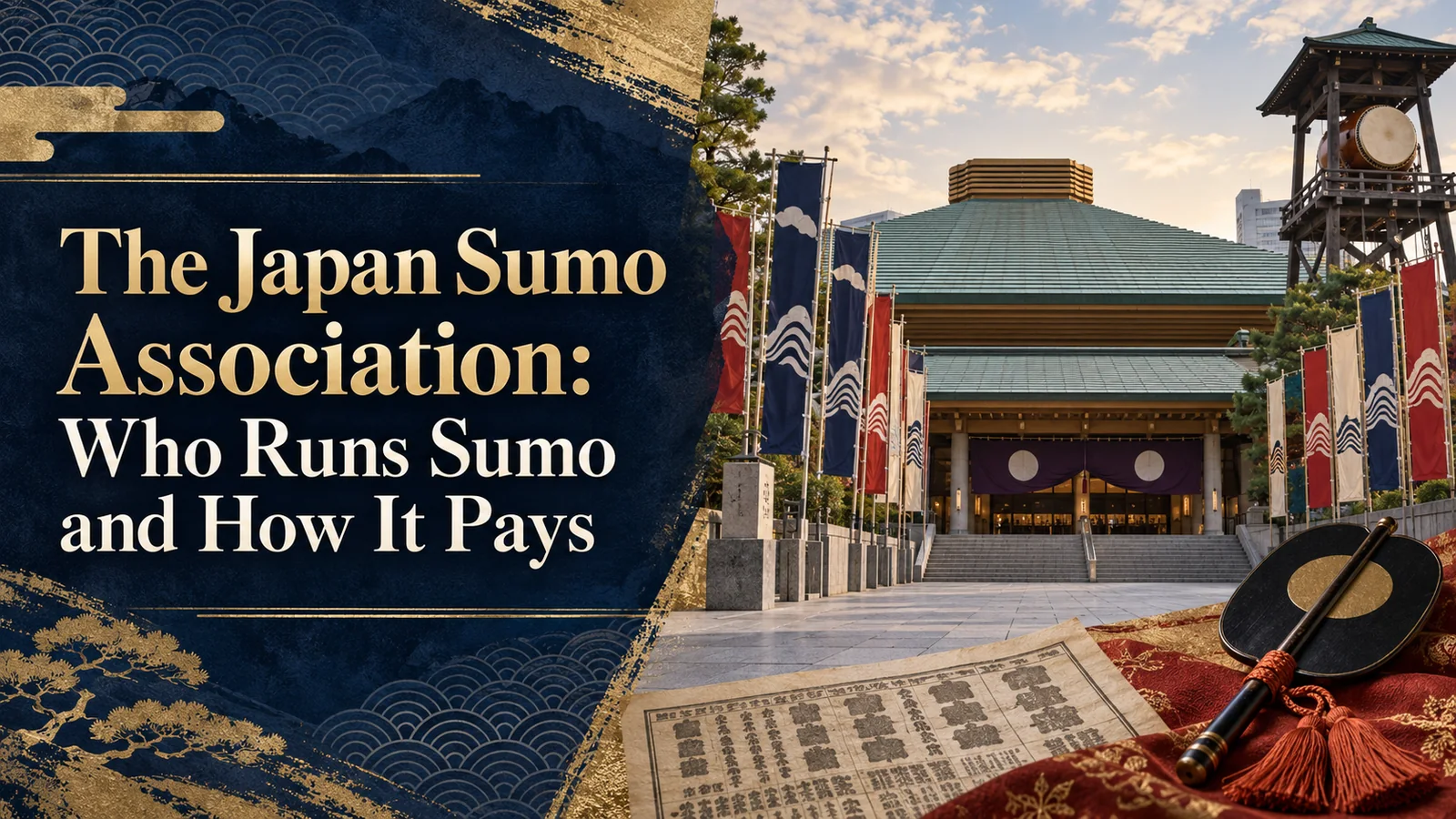
The Japan Sumo Association — Nihon Sumo Kyokai — is the organisation that runs professional sumo in Japan. It is not a government agency and not a private company. It is a public-interest incorporated foundation: a certified non-profit that stages the six annual tournaments, registers and pays the wrestlers, employs the referees, ushers and hairdressers, owns the Kokugikan, and files audited accounts every year. Those accounts are public. Almost none of them are in English. This guide sets out what the Association is, who runs it, who belongs to it, and where its ¥15.6 billion of annual income comes from — using the Association’s own filings.
📖 What you’ll learn
- What legal form the Association actually has, and why that is not the same as being run by the government
- Who decides a yokozuna promotion — and the exact order in which the decision moves
- The 850 people who make up the Association, counted by job
- Where the money comes from, what it costs to run sumo, and how close the pandemic came to breaking it
- What the official site publishes in Japanese that it does not publish in English
What Is the Japan Sumo Association?
The Japan Sumo Association is the public-interest incorporated foundation that organises professional sumo in Japan.
Its Japanese name is Nihon Sumo Kyokai, and its own English site abbreviates it to NSK. Overseas fans usually shorten it further, to “the Kyokai”.
“Public-interest incorporated foundation” is a specific legal status in Japan, not a description. A foundation that holds it must be certified by the state, must publish its articles of incorporation, budget, business plan, annual report and audited accounts, and must file annually with the supervising authority — for a body of this size, the Prime Minister’s office through the Cabinet Office rather than a sports ministry. English sources often name the education ministry as the supervisor; the Association’s own board minutes record the approval of “periodic documents for submission to the Cabinet Office”. Its accounts are audited by EY ShinNihon, an external firm.
The dates matter, because they are frequently reported wrongly.
- 28 December 1925 — the foundation is established, as the Dai-Nippon Sumo Association.
- 1 December 1957 — it is renamed the Japan Sumo Association. Not 1958.
- 30 January 2014 — it becomes a public-interest incorporated foundation, the status it holds today.
Its head office is at 1-3-28 Yokoami, Sumida City, Tokyo, in the same block as the Kokugikan. Its financial year is the calendar year, 1 January to 31 December — unusual in Japan, where most organisations run April to March, and worth knowing before you compare its figures with anyone else’s.
The purpose written into its articles is not “to promote a sport”. It is to maintain and pass on the tradition and order of sumo-do, described there as originating in Shinto rites praying for a good harvest, by holding tournaments and tours, training the people who carry them out, teaching and spreading sumo, preserving the records, conducting international goodwill, and maintaining the buildings needed to do all of that.
Q. Is the Japan Sumo Association a government body?
A. No. It is a certified non-profit foundation, not a ministry or an agency. The state certifies and supervises it, and it files annual documents with the Cabinet Office, but the government does not run it and barely funds it — direct public subsidies came to about ¥1.03 million in 2025, against ¥15.6 billion of income.
Who Runs It: the Board, the Chairman and the Departments
The Association is run by its board of directors, which elects one of its own members as chairman.
The chairman is Nobuyoshi Hoshi, known in sumo as Hakkaku — the 61st yokozuna, Hokutoumi. His listed remit is “the Association as a whole”, plus acting director of the Sumo Museum.
Below the chairman the work is split into departments, each headed by a director who is himself a former wrestler now holding an elder name. The Tournament Department runs the Tokyo tournaments; the Regional Tournament Department runs Osaka, Nagoya and Fukuoka, with a separate director for each; the Judging Department decides bout results and builds the daily match-ups; the Tour Department runs the regional tours; and there are departments for public relations, instruction and outreach, and members’ welfare and conduct, alongside a crisis-management and compliance line and an inspection committee whose job is to detect and punish deliberately uncompetitive bouts.
Not everyone on the board comes from inside sumo. The officer list for the year includes a company executive, two lawyers, two executives of other organisations and a novelist as non-executive members, and the auditor’s post is held by a lawyer.
The Yokozuna Deliberation Council sits outside all of this. It is an advisory body of people from outside the Association, and the Association’s own description of it is precise: it exists “mainly to recommend yokozuna”. The Association’s business plan sets out when it meets — the day after each tournament ends, convened on the chairman’s request, to deliberate and return an opinion on yokozuna promotions and other yokozuna matters.
Q. Who decides yokozuna promotions — the Association or the Yokozuna Deliberation Council?
A. The board of directors decides. The Judging Department starts the process after a tournament, the chairman then asks the Yokozuna Deliberation Council for its opinion, the council deliberates and returns a recommendation, and the board passes the resolution. The 2025 annual report lists those resolutions by date: Hoshoryu’s promotion to yokozuna on 29 January, Onosato’s on 28 May, Aonishiki’s promotion to ozeki on 26 November. The ordinary ranking list is built separately, by the banzuke committee.
Who Belongs to It: 850 People in Seven Jobs
The Association is not only its wrestlers. As of 31 December 2025 it had 850 members, and the wrestlers were fewer than three-quarters of them.
| Role | What they do | Number |
|---|---|---|
| Rikishi | Wrestlers, all six divisions | 598 |
| Toshiyori (elders) | Retired wrestlers who run the stables and the Association, directors included | 105 |
| Gyoji | Referees | 43 |
| Yobidashi | Ring announcers, who also build and maintain the dohyo | 44 |
| Tokoyama | Hairdressers, who tie the topknots | 44 |
| Sewanin | Attendants | 10 |
| Wakaimonogashira | Supervisors of the lower-division wrestlers | 6 |
| Members, total | — | 850 |
| Office staff | Salaried employees, not sumo members | 61 |
Two things about that table are easy to miss. The first is the referees, announcers and hairdressers: 131 people between them, roughly one member in six, in jobs that are careers rather than support roles. The second is that “105 elders” is a headcount of people, not a count of licences. Becoming an elder means succeeding to one of the association’s elder names, of which there is a fixed roster — the two numbers are related, but they are not the same thing, and English accounts routinely merge them.
Wrestlers arrive through an entrance test held at each of the six tournaments. The basic standard is a man who has finished compulsory education, is under 23 on the day of the test, and stands at least 167 cm and weighs at least 67 kg; junior-high leavers tested in March may qualify at 165 cm and 65 kg.
Both limits have a way round them. Candidates who meet the Association’s relaxed age criteria may be older than 23, and candidates who fall short on height or weight may instead sit a physical-ability test and qualify on that. Those who get in are assigned to a stable and trained there, while taking six months of instruction at the Association’s own training school. In 2025, 65 new wrestlers registered and 59 retired.
The stables themselves are where most of the Association’s people actually live, and money flows to them rather than the other way round: the Association pays each stablemaster a stable maintenance allowance and training-ground costs, plus a training allowance for the lower-division wrestlers he is raising. At the end of 2025, citing inflation, it added a one-off top-up to those two payments, scaled to the number of wrestlers in each stable. What that contract looks like from the stable’s side — and what each of the 45 stables is paid to do — is set out in our guide to sumo stables.
Q. Are all sumo wrestlers paid a salary by the Association?
A. No — only the top two divisions. The Association’s annual report is explicit: wrestlers in juryo and above receive a salary, an assistance allowance and merit money, with an extra tournament payment for the three ranks above them. Wrestlers in makushita and below receive no monthly salary at all: a per-tournament allowance six times a year and an incentive payment, and their living costs are carried by their stable.
What the Association Actually Runs
Six tournaments a year, fifteen days each, in four cities. That is the core of what the Association runs.
The phrase you will see on its English pages — grand sumo tournament — is the translation of honbasho, the official tournaments that count towards the rankings. Exhibition events, including the overseas tours, do not.
| 2026 tournament | Dates | City | Venue |
|---|---|---|---|
| January | 11–25 Jan | Tokyo | Ryogoku Kokugikan |
| March | 8–22 Mar | Osaka | EDION Arena Osaka |
| May | 10–24 May | Tokyo | Ryogoku Kokugikan |
| July | 12–26 Jul | Nagoya (Aichi) | IG Arena |
| September | 13–27 Sep | Tokyo | Ryogoku Kokugikan |
| November | 8–22 Nov | Fukuoka | Fukuoka Kokusai Center |
Between tournaments the Association takes sumo to the rest of the country. In 2025 it staged 69 regional tour dates — 23 in spring, 24 in summer and 22 in winter, with no autumn tour at all because the wrestlers were in London instead. Every one of the 90 tournament days that year sold out.
The rest of what it runs is less visible. The Sumo Training School, where every new wrestler spends six months. The Sumo Museum, attached to the Kokugikan, which opened on 190 days in 2025 and admitted 139,940 people, 36,420 of them from overseas. A clinic in the basement of the Kokugikan that treated 7,617 outpatients, roughly half of them wrestlers, and which also sees members of the public. And the Kokugikan itself, which the Association owns, rents out for other events when sumo is not there, and is now renovating in stages.
Q. What is a “Nihon Sumo Kyokai grand tournament”?
A. It is the official name for a honbasho — one of the six 15-day tournaments the Japan Sumo Association holds each year, in January, March, May, July, September and November. The phrase turns up in searches because the Association’s own English site is titled “Nihon Sumo Kyokai Official Grand Sumo Home Page”. Results from these six tournaments are what the rankings are built from.
Where the Money Comes From
In the year to 31 December 2025 the Association’s ordinary income was ¥15,624,569,688 — about ¥15.6 billion, or roughly US$100 million at the exchange rates of that year. Almost all of it was earned.
The largest line, ¥11.18 billion, is sumo itself: tournament and tour income. Then merchandise at ¥1.93 billion — up almost 45% on the previous year, the fastest-growing thing the Association does. Then advertising and sponsorship at ¥950 million, and ¥877 million from hiring out the Kokugikan when sumo is not using it. Donations of ¥644 million come mostly from the ijiin patron scheme, which sold 1,151 of its 1,155 places in 2025 at ¥4,050,000 for three years in Tokyo and ¥1,125,000 for three years in the regional cities.
Spending was ¥13.83 billion, leaving an operating surplus of ¥1.66 billion. The single biggest cost is people: ¥4.08 billion in salaries and allowances, plus ¥1.39 billion in wrestler training costs and ¥385 million in wrestler incentive payments. There is a line in the accounts for practice belts — ¥5,576,155 of them.
The Association also pays corporate tax. Its profit-making activities — venue hire, advertising, merchandise, the public clinic — are taxed like anyone else’s, and the 2025 charge was ¥329 million. What the public-interest status buys is not a subsidy but the tax treatment of the non-profit side, together with the obligations that come with it: certification, annual filings, audited accounts and public disclosure.
Then there is what the accounts show about the pandemic.
| Year | 2020 | 2021 | 2022 | 2023 | 2024 | 2025 |
|---|---|---|---|---|---|---|
| Ordinary income (¥bn) | 6.00 | 7.56 | 10.15 | 13.33 | 14.67 | 15.62 |
| Change in net assets (¥bn) | −5.03 | −3.24 | −3.23 | +0.48 | +1.45 | +1.66 |
Across 2020, 2021 and 2022, the Association’s net assets fell by about ¥11.5 billion. That is not cash burned — the figure includes depreciation and valuation changes, and the foundation was never insolvent — but it is the measure of how much of its accumulated wealth three years of empty and half-empty halls consumed. Income has since more than doubled from the 2020 low, and net assets at the end of 2025 stood at ¥29.3 billion against total assets of ¥39.8 billion, of which the land under the Kokugikan alone is carried at ¥9.4 billion.
One number is not in the accounts. The Association has a broadcasting contract with NHK, and the annual report confirms it was renewed; the fee is not disclosed.
Q. Does the Japanese government fund sumo?
A. Not in any meaningful sense. Direct public subsidies in 2025 totalled ¥1,028,036 — of which ¥150,000 came from a local authority — against ordinary income of ¥15.6 billion. That is 0.007%. The Association’s benefit from the state is its tax status on the non-profit side, not a grant, and it pays corporate tax on its commercial activities.
The Official Website: What Is in English, and What Is Not
The Association’s site is sumo.or.jp, and its English section — titled “Nihon Sumo Kyokai Official Grand Sumo Home Page” — is the official one.
It is also where a lot of English-speaking readers stop, because the English section is much smaller than the Japanese one, and the parts missing from it are exactly the parts this article is built from.
| Published in English | Japanese pages only |
|---|---|
| Rankings, results, score sheets, champions | The Association’s purpose and organisation chart |
| Tournament and regional tour schedules | The officer list, with names and portfolios |
| Wrestler search and stable guide | Articles of incorporation, budgets, business plans |
| Sumo Museum, calendar, announcements | Annual reports, audited accounts, audit reports |
| Ticket information and the ticket service | The patron scheme, statutory notices, the Association’s history page |
This is a language gap rather than a disclosure failure. The Association discloses a great deal about itself — more than most sports bodies anywhere — and files it publicly every year, going back more than a decade. Virtually all of it exists only in Japanese, which is why the English-language picture of the organisation is so much thinner than the Japanese one, and why so much of what circulates in English about how sumo is run is guesswork.
Tickets are the other place the gap shows. Sales run through the Association’s official ticket service, and there is an official resale service at face value for people who can no longer use their seats — sumo.pia.jp. Anything else is a resale site, and the Association’s position on those is not ambiguous.
Q. Is sumo.or.jp the official Japan Sumo Association website?
A. Yes. sumo.or.jp is the Association’s own site, and its English section is the official English one. Tickets are sold through the Association’s official ticket service, with an official face-value resale service for returned seats. Sites offering tournament tickets above face value are not connected to the Association, and it invalidates tickets it finds being resold.
What the Association Is Dealing With Now
Five things are live on the Association’s desk in 2026: resale enforcement, ticket prices, overseas tours, its own conduct, and the building it owns.
Resale. In April 2026 the Association published a count for the previous year: across the six tournaments of 2025, 138 cases ended in membership suspension, ticket cancellation or refusal of entry at the door. It also described its method, which is more active than fans assume — it buys listed tickets on secondary sites in order to identify the sellers, then voids them.
Prices. On 30 July 2026 the Association announced that admission prices will change from the January 2027 tournament, citing rising costs and improved pay for its members. The change is not uniform: Nagoya and Fukuoka stay as they are, and only Tokyo and Osaka are revised. A new premium box category is added for the first two rows, and for the first time the last two days of a tournament are priced separately from the rest.
Going abroad. In October 2025 the Association staged five days at the Royal Albert Hall in London, its first overseas performance in 20 years and its first in London in 34. In June 2026 it played the Accor Arena in Paris on the 13th and 14th, the third Paris run after 1986 and 1995, produced with AEG Presents France. These are exhibitions; they do not affect the rankings.
A hundred years. 2025 was the centenary of the foundation’s establishment. The Association marked it with a special one-day event at the Kokugikan in October that revived old-style ceremonial sumo, a ceremony for about 650 guests on 23 December, and a free exhibition of ceremonial aprons and yokozuna ropes that drew around 5,000 people.
Its own conduct. The 2025 annual report does not hide that the year included compliance breaches — an embezzlement case and violence cases. It describes the route they took: investigation by the compliance committee, a recommendation on penalties, a board decision, and continued monitoring of the people and stables involved afterwards.
The building. The Kokugikan opened in 1985 and is being renovated in phases, with the fourth completed at the end of 2025 and a fifth contracted. The Association’s 2026 business plan is unusually direct about why: the work is being carried out “with a future rebuild in mind”. A standing committee on the inheritance of sumo culture met six times in 2025, largely to discuss what should happen to the building.
Q. What is the Association doing about ticket scalping?
A. It buys the tickets. The Association purchases listings on secondary sites to identify who is selling them, then suspends the seller’s membership and voids the ticket, so the buyer is refused entry. In 2025 that happened 138 times across the six tournaments. It also runs an official face-value resale service, and asks fans not to buy from anywhere else.
Summary
- It is a certified non-profit foundation, not a government body. Founded 28 December 1925, renamed in 1957, and given public-interest status on 30 January 2014. It files annual reports and audited accounts with the Cabinet Office.
- The board decides; the Yokozuna Deliberation Council advises. The Judging Department starts a promotion case, the chairman asks the council for its opinion, and the board passes the resolution.
- 850 members, in seven jobs. 598 wrestlers, 105 elders, and 131 referees, announcers and hairdressers, plus 61 office staff.
- ¥15.6 billion of income, almost all of it earned. Direct public subsidies were ¥1.03 million — 0.007%. The pandemic cost about ¥11.5 billion of net assets over three years, and the recovery took three more.
- The disclosure is extensive, and it is in Japanese. Accounts, officers, articles and annual reports are all published; the English site carries the sport, not the organisation.
Related guides: What is sumo? · Sumo rankings and the banzuke · The tournament schedule · How to buy sumo tickets · Ryogoku Kokugikan · Yokozuna, explained
There is a particular shape to an organisation that publishes its own accounts to the yen and then leaves them in one language. The Japan Sumo Association files more about itself than most sports bodies are ever asked to, and the number that best explains how it works sits in a line item of a Japanese-language PDF: ¥1,028,036 of public money, against ¥15.6 billion it earned by selling out ninety days in a row.