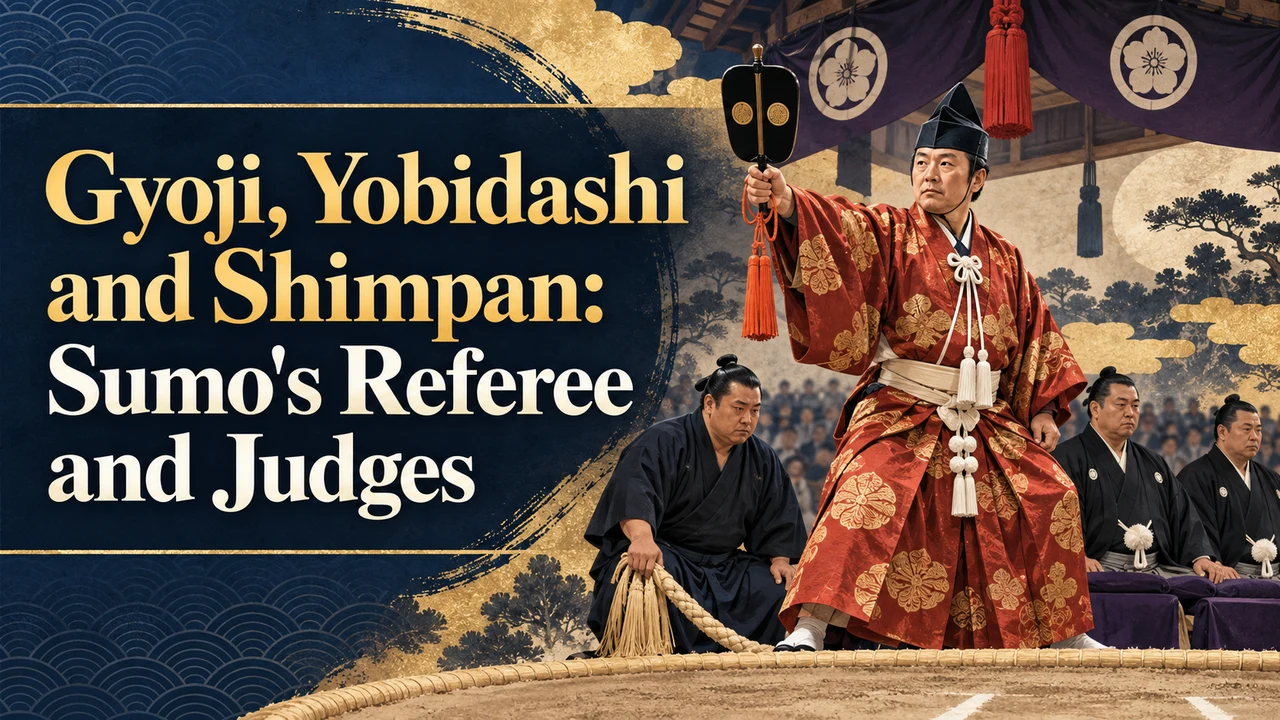
Watch a sumo bout and you will see far more than two wrestlers. A man in a silk court robe stands between them holding a fan. Five men in black kimono sit on cushions around the clay. A man in a plain cotton jacket sweeps the ring between bouts. The gyoji is the sumo referee. The yobidashi and the shimpan are the other two roles on that list. Here is what each of them does, who they are, and how many of them the Japan Sumo Association actually employs.
📖 What you’ll learn
- What a gyoji, a yobidashi and a shimpan each do, and how the three hand one bout between them
- Why every referee in professional sumo is called either Kimura or Shikimori — and why the two most senior wear a sword
- What the colour of the tassel on the referee’s fan tells you about his rank
- Who the five men in black kimono are, and what the 24 elders behind them do when the tournament is not on
Who Are the Officials of Sumo? Gyoji, Yobidashi and Shimpan
Three groups of officials run a sumo bout: the gyoji who referees it, the yobidashi who calls it, and the shimpan who judge it. A gyoji is the sumo referee who starts the bout, watches it from inside the ring, and points his fan at the winner. A yobidashi builds and maintains the ring and sings the wrestlers up onto it. A shimpan is one of the judges seated at ground level, and every one of them is a retired wrestler who now holds an elder’s share in the Association.
None of the three are wrestlers, and none of them are volunteers. All are salaried members of the Japan Sumo Association, listed by name on its own member rolls. The Association’s own description of its membership puts it plainly. Alongside the wrestlers it employs gyoji, “who judge the bouts”, and yobidashi, “who build the ring, call up the wrestlers and keep the programme moving”. Hairdressers and two further grades of staff belong to it as well.
The counts below are from the Association’s published member lists, read on September 20, 2026.
| Role | Association’s English term | What the job is | On the current list |
|---|---|---|---|
| Gyoji | Referee | Starts the bout, judges it from inside the ring, points the fan at the winner | 42 |
| Yobidashi | Ushers | Builds the ring, calls the wrestlers up, beats the drum, carries the prize banners | 45 |
| Shimpan | Judging Department | Judges the result from ground level, and builds the next day’s match-ups | 24 elders in the department |
“Ushers” is the Association’s own English rendering of yobidashi, and it undersells the job by some distance. The same organisation’s Japanese description of the role covers building the dohyo, the clay ring itself, calling the wrestlers up, and running the order of play. An usher shows you to your seat. A yobidashi digs the ring out of the ground with a hoe. If you want the structure these three roles sit inside, we have a separate guide to how the Japan Sumo Association is organised.
What a Gyoji Does: From the Shikiri to the Gunbai
A gyoji runs the bout from start to finish, from calling the wrestlers into the ring to naming the winner. He calls the wrestlers into the shikiri, the preparation ritual at the two white lines, holds them there through the salt-throwing, and judges the moment both are ready. Once they charge he stays inside the ring with them, moving to keep the contact in front of him. When it ends he raises the gunbai, the lacquered wooden fan, and points it at the winner.
That decision is announced, not merely recorded. Reference works describe the sequence: the gyoji holds the fan out over the winning side and, if no judge objects, calls out the winner’s name. The objection is the mono-ii; the judges’ conference that follows it can overturn him. We set out how a mono-ii is decided in our guide to the rules; what matters here is that the gyoji’s call stands unless a judge stops it.
The one moment a gyoji halts a bout in progress is the mawashi-matta, called when a wrestler’s belt works loose. According to the Japan Sumo Association, the referee makes that decision alone, and he will not call it while a technique is being applied. He watches for the instant the two men stop moving. Neither wrestler may change his grip; both hold the position they were in. To restart, the gyoji steps between them, calls out “ii ka, ii ka” — “ready? ready?” — and taps the front of the belt as the signal.
There is also a referee you are not watching. The Association records that whenever a bout is in progress, one gyoji must be waiting in the referees’ place. That place is at mukaishomen, the side of the hall facing the main stand, and the man there takes the next bout. He is the kae-gyoji.
Q. What is a gyoji in sumo?
A. A gyoji is the referee of a sumo bout. He wears a silk court robe, carries a wooden fan called a gunbai, and works inside the ring rather than outside it. The Japan Sumo Association lists 42 gyoji, all of them salaried members of the organisation, ranked in eight grades that mirror the wrestlers’ own divisions. He judges alone, and the judges seated below the ring are the only people who can overturn him.
Q. Why is there no draw in sumo?
A. Because the rule was changed in the 1860s. Until the Ansei era of 1854 to 1860, a bout in which the two men went down together could be called mushobu — no contest — with neither side given the win. According to the Japan Sumo Association, it was in the Keio era of 1865 to 1868 that the gyoji was required to raise his fan to one side or the other. He has had no third option since.
Gyoji Ranks and the Colour of the Gunbai Tassel
The tassel on a gyoji’s fan states his rank, and the Association lists eight ranks from jonokuchi up to tate-gyoji. The grades carry the same names as the wrestlers’ divisions, so a makuuchi-grade referee handles top-division bouts and a juryo-grade referee the division below. Promotion runs from the bottom, and the two men at the top hold named posts rather than grades.
The two top-rank colours are published by the Association itself. The tate-gyoji who takes the name Kimura Shonosuke carries an all-purple tassel; the tate-gyoji who takes the name Shikimori Inosuke carries purple and white. Below those two the colours come from published Japanese dictionaries and encyclopedias rather than from the Association, and the table marks which is which.
| Grade | Japanese | Tassel colour | On the list | Colour source |
|---|---|---|---|---|
| Tate-gyoji (Kimura Shonosuke) | 立行司 | All purple | 1 | Association |
| Tate-gyoji (Shikimori Inosuke) | 立行司 | Purple and white | 1 | Association |
| Sanyaku grade | 三役格 | Vermilion | 3 | Japanese dictionaries |
| Makuuchi grade | 幕内格 | Red and white | 8 | Japanese dictionaries |
| Juryo grade | 十両格 | Blue and white | 9 | Japanese dictionaries |
| Makushita grade | 幕下格 | Blue or black | 8 | Japanese dictionaries |
| Sandanme grade | 三段目格 | Blue or black | 7 | Japanese dictionaries |
| Jonidan grade | 序二段格 | Blue or black | 2 | Japanese dictionaries |
| Jonokuchi grade | 序ノ口格 | Blue or black | 3 | Japanese dictionaries |
The shape of that list is worth a second look. Nine referees hold juryo grade and eight hold makuuchi grade, but only five stand above them, and the two at the top are single posts that open up when a man retires. The grades track the wrestlers’ ladder, which we set out in our guide to how the banzuke ranks wrestlers, and the top grade handles the bouts involving the rank of yokozuna.
Q. What does the colour of a gyoji’s fan tassel mean?
A. It shows his rank. According to the Japan Sumo Association, the senior of the two tate-gyoji, who takes the name Kimura Shonosuke, carries an all-purple tassel, called sohmurasaki, and the second, Shikimori Inosuke, carries purple and white, called shihaku. Published Japanese dictionaries give the grades below: vermilion at sanyaku grade, red and white at makuuchi, blue and white at juryo, and blue or black for everyone further down.
Kimura and Shikimori: The Two Names and the Short Sword
Every one of the 42 gyoji on the Association’s list carries one of two surnames, Kimura or Shikimori. Counting the roll on September 20, 2026, the split is 28 Kimura to 14 Shikimori. These are professional names taken on entry, in the way a wrestler takes a ring name, and they descend from two referee houses. A gyoji’s given name changes as he is promoted; the surname stays with the house.
At the top the names become titles. The Association sets the tate-gyoji establishment at two posts, held by a Kimura Shonosuke and a Shikimori Inosuke, with Shonosuke the senior of the pair. His seniority has a visible consequence: he referees the musubi-no-ichiban, the final bout of each day. The two posts are currently held by Kimura Shonosuke, whose civil name is Yuji Horasawa, and Shikimori Inosuke, whose civil name is Yoshimitsu Morita.
Both men wear a tanto, a short sword, at the waist. The reason is stated by the Association itself, and it is not decorative. Judging a yokozuna or an ozeki is described there as a great charge. The sword is carried to show that the referee is prepared to take responsibility with his own life, should he call a bout wrongly.
The 42 referees are spread across the training stables rather than attached one to each. Counting the stable column on the Association’s list gives 29 stables holding at least one gyoji, with three apiece at Kokonoe, Kasugano and Oshima. The Association lists 45 stables in all, so on that same day’s roll 16 of them had no referee at all. Our guide covers all 45 sumo stables and how a heya works.
Q. Do sumo referees really carry a knife?
A. The two most senior do. According to the Japan Sumo Association, a tate-gyoji wears a short sword at his waist, and the Association’s own explanation is that judging yokozuna and ozeki is a great charge, so the sword marks his readiness to take responsibility with his life if he calls a bout wrongly. The senior of the two takes the name Kimura Shonosuke and referees the final bout of each day. The other 40 referees on the list do not wear one.
What a Yobidashi Does: The Ring, the Call and the Kensho Banners
A yobidashi builds the ring, calls the wrestlers up to it, beats the drum, and carries the prize banners around it. The Association lists 45 of them, in nine grades that run from jonokuchi up to a single tate-yobidashi, the post currently held by a man who works under the name Katsuyuki. The English member list titles them “Ushers”, which is the Association’s own translation.
The ring itself is their work. The clay dohyo is rebuilt for each tournament, by hand, with five tools the Association names. A hoe breaks the ground. A tako is lifted and dropped to pack the clay down, and a tataki is raised overhead and slammed onto the surface to harden it. A beer bottle beats the small straw bales into shape. A five-sun nail — about 15 cm (6 in) — is set as the point of a compass to scribe the circle. The two white starting lines are painted to the same spec every time: 6 cm (2.4 in) wide, 90 cm (35 in) long, 70 cm (28 in) apart, in white enamel.
They are also the sound of a tournament. On the eve of the first day, at the close of the ring-blessing ceremony, two drums enter from the east walkway carried by teams of four yobidashi each. One man beats the drumhead and another the body, and the pair circle the ring three times anticlockwise before going out into the streets to announce the tournament. The custom has a second name because of that second half: machi-mawari daiko, the drum that goes round the town.
| Yobidashi grade | On the list | Gyoji at the same grade |
|---|---|---|
| Chief (tate-yobidashi) | 1 | 2 (tate-gyoji) |
| Junior chief | 1 | — |
| Sanyaku grade | 2 | 3 |
| Makuuchi grade | 10 | 8 |
| Juryo grade | 12 | 9 |
| Makushita grade | 9 | 8 |
| Sandanme grade | 4 | 7 |
| Jonidan grade | 2 | 2 |
| Jonokuchi grade | 4 | 3 |
| Total | 45 | 42 |
The banners come round before the top-division bouts. Before a top-division bout, a line of yobidashi walks a circuit of the ring carrying vertical cloth flags, each 70 cm (28 in) wide and 120 cm (47 in) tall. These are kensho, sponsors’ prizes, and the Association restricts them to makuuchi bouts. The price is fixed and published, and so is the split.
| One kensho banner | Amount | What it covers |
|---|---|---|
| Price to the sponsor | ¥70,000 (approx. US$470), tax included | One banner on one bout |
| To the winning wrestler | ¥60,000 (approx. US$400) | Handed over on the ring, on the face of the fan |
| Retained by the Association | ¥10,000 (approx. US$67) | Listing on the bout sheet, and the announcement in the hall |
| A full tournament run | ¥1,050,000 (approx. US$7,000) | 15 banners across the 15 days |
| Banner size | 70 cm × 120 cm (28 in × 47 in) | Carried around the ring by yobidashi |
The flags go past, the bout is fought, and the referee hands the envelopes to the winner on the face of his fan. The men who carried the flags are already resetting the ring. If you are going to see this in person, our guide takes you inside Ryogoku Kokugikan.
Q. What is a yobidashi in sumo?
A. A yobidashi is the official who builds the clay ring, calls the two wrestlers up onto it in a sung announcement, beats the tournament drum and sweeps the surface between bouts. The Japan Sumo Association lists 45 of them and translates the title as “Ushers” on its English member roll, though its Japanese description of the role covers construction and the running order as well. A yobidashi judges nothing; the result belongs to the referee and the judges.
Q. Who carries the banners around the ring before a sumo bout?
A. The yobidashi do. Each banner is a kensho, a sponsor’s prize attached to that single bout, and the Japan Sumo Association sells them only for top-division bouts at ¥70,000 (approx. US$470) each, tax included. The winner receives ¥60,000 (approx. US$400) of that; the remaining ¥10,000 covers listing the sponsor on the bout sheet and announcing the name in the hall. A banner is attached to one bout, not to a wrestler or to a day.
The Shimpan: Five Judges at the Ring, 24 Elders Behind Them
The shimpan are elders of the Association who sit around the ring and check whether the referee’s call was right. They are not employed as officials in the way a gyoji is. Each is an oyakata, a retired wrestler holding one of the Association’s elder shares, and judging is one of the duties attached to that position. There are 103 elders on the roll, and 24 of them were attached to the Judging Department as of September 1, 2026.
The department does two things, and the second is invisible from the seats. The Association defines its remit as deciding the result of bouts at a tournament and drawing up the match-ups. Nobody in sumo plays a fixture list published months ahead. Each day’s pairings are built the day before by this department, which is why one of its three heads carries the added title of head in charge of match-making. The department also has a deputy head.
During a bout, four or five of them are on duty at ground level. Reference works record five judges for the top two divisions, sometimes four, seated in the tamari at the sides of the hall. One sits at the main stand, one east, one west, and two at mukaishomen, the side facing the main stand. Their described job is to keep the bouts moving and to watch whether the referee’s fan goes the right way.
Video is part of the process, with limits. A reference encyclopedia describes the arrangement as confined to top-division bouts. A judge sits at a monitor, replaying the footage in slow motion or frozen, and the ringside judges treat what he tells them as a reference. The same source is specific about a second point people get wrong. The two wrestlers waiting at ringside may call for a mono-ii, but they take no part in the conference and hold no vote.
That conference, and the outcomes it can reach, belong to the rules rather than to the people, and we set them out in how a mono-ii is decided. The judges themselves come from the structure described in how the Japan Sumo Association is organised, and the tournament they work is covered in what a honbasho is.
Q. Who are the five men in black kimono sitting around the sumo ring?
A. They are the shimpan, the judges. Every one is an oyakata, a retired wrestler holding an elder’s share in the Japan Sumo Association, and 24 of the 103 elders were attached to its Judging Department as of September 1, 2026. Reference works record five of them at ringside for the top two divisions, sometimes four. Their job at the ring is to watch whether the referee points his fan at the right man, and the same department draws up the following day’s match-ups.
One Bout, Three Officials: Who Does What, in Order
The three roles hand the bout to each other in a fixed order, from the call-up to the final decision. A top-division bout is over quickly; the sequence around it takes several minutes, and each step belongs to a different man. The diagram below follows one bout from the moment the names are sung out.
Two things in that sequence are worth holding onto. The first is that the gyoji’s decision is made at once and out loud, with no pause for review; the review, when it comes, is triggered by someone else. The second is that the yobidashi’s work brackets the whole thing. He prepared the surface before the names were called, and he will sweep it before the next pair step up. The rules that govern step six are set out in how a mono-ii is decided.
Summary
Three roles, 42 referees, 45 ushers and 24 judging elders keep a tournament running, and none of them wrestle. The gyoji starts the bout, stays inside the ring, stops it only when a belt comes loose, and points his fan without hesitating. The yobidashi built the clay he is standing on, sang the names, and will be back with a broom before the noise has died down. The shimpan sit at ground level in black, say nothing on most bouts, and spend the evening after each day building tomorrow’s match-ups.
Sources
- Japan Sumo Association — list of gyoji, list of yobidashi and list of elders, read September 20, 2026
- Japan Sumo Association — the Association’s mission and departments and the assignment of duties as of September 1, 2026
- Japan Sumo Association — how kensho prize banners work
- Japan Sumo Association explanatory pages — the two tate-gyoji and the short sword, mawashi-matta, the tools used to build the ring, the announcing drum, the waiting referee, the end of the no-contest verdict and the starting lines
- Reference works via Kotobank — gyoji, shimpan-iin and mono-ii
The wrestling itself is the part that gets filmed. The rest of what you are looking at is a working organisation. One man took a two-hundred-year-old surname when he joined. Another scribed the circle in the clay with a nail that morning. Five more will sit in silence unless something goes wrong. Learn which is which, and a tournament stops being a series of collisions and starts being a day at work that a few dozen people have spent their lives learning to run.