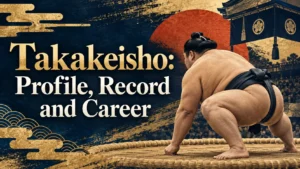
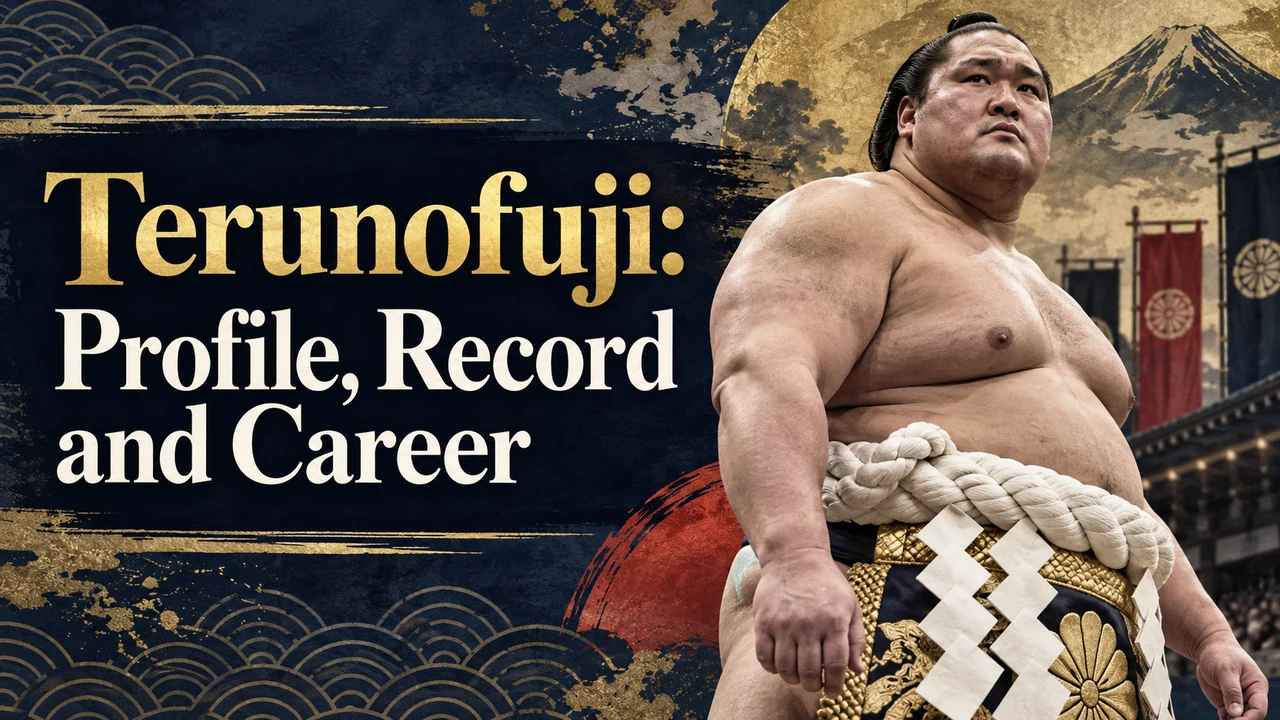
Terunofuji retired in January 2025 and now runs the Isegahama stable as an elder of the Japan Sumo Association. He was the 73rd yokozuna, the highest rank in the sport, and he reached it only after dropping from the second-highest rank all the way to the second-lowest division and climbing back. The association credits him with ten top-division championships and a career record of 523 wins, 275 losses and 231 absences. This page sets out his profile, his record as the association publishes it, the collapse and the return that made his name, and what he is doing now.
📖 What you’ll learn
- Who Terunofuji is, and what the Japan Sumo Association lists as his record
- How a wrestler falls from the second-highest rank to the second-lowest division
- What his time as yokozuna actually looked like, absences included
- What he does now, and which wrestlers he is responsible for
Who Is Terunofuji? The 73rd Yokozuna at a Glance
Terunofuji Haruo is a retired Mongolian-born sumo wrestler who held the sport’s highest rank, yokozuna, from September 2021 until January 2025. He fought for the Isegahama heya, the training stable a wrestler lives and trains in, and he is the fifth Mongolian-born man to reach the top of the ranking sheet.
Everything in the table below comes from the Japan Sumo Association’s rikishi profile page, which the association keeps up after a wrestler retires. The absences column is the one to read alongside the wins, because it is where the injuries are recorded.
| Item | Detail |
|---|---|
| Ring name | Wakamisho, then Terunofuji |
| Real name | Seizan Suginomori |
| Born | November 29, 1991, Mongolia |
| Height and weight | 192.0 cm (6 ft 4 in), 176.0 kg (388 lb) |
| Stable | Isegahama |
| Highest rank | The 73rd Yokozuna |
| Career record | 523 wins, 275 losses, 231 absences |
| Top-division record | 366 wins, 207 losses, 197 absences |
| Championships | 10 in the top division, 2 in juryo, 1 in makushita |
| Special prizes | 3 outstanding performance, 3 fighting spirit, 3 technique |
| Signature technique | migi-yotsu, yori |
| Retired | January 2025 |
Two of those rows are worth pausing on. The 231 absences mean whole days and whole tournaments sat out with injury, and they are recorded on the ranking sheet in the same ledger as the wins. The championship count of ten is split either side of a fall that took him out of the salaried divisions altogether. If the ranks themselves are new to you, our guide to the sumo ranking system explains what sits above and below yokozuna.
One more thing about the profile: it is still there. The association keeps a retired wrestler’s page on its own site with the status marked retired, and it does not archive the record away afterwards. That is why the figures above can be checked against the governing body rather than against a fan database, and it is the reason this page cites the association’s page for every number in it.
Q. Is Terunofuji still competing?
A. No, and he cannot come back. Retirement in sumo is filed with the Japan Sumo Association and the rank is given up for good, so there is no route back onto the ranking sheet for a retired wrestler. Terunofuji filed his at 33, and the elder ranks were the only way for him to stay inside the sport.
From Ulaanbaatar to the Banzuke: Terunofuji’s First Years
Terunofuji was born Seizan Suginomori in Mongolia on November 29, 1991, and made his professional debut in May 2011. He entered under the ring name Wakamisho and changed it to Terunofuji later, a normal enough step in a sport where a wrestler’s shikona, his ring name, can be revised as his career turns.
The climb that followed was quick. He reached juryo, the second division and the first salaried one, in September 2013, and the top division, makuuchi, in March 2014. Two and a half years separated his first professional bout from the division where bouts are televised nationally. For a sense of what that ladder demands of a beginner, our page on what a rikishi is covers the working life behind it.
| Milestone | When |
|---|---|
| Professional debut | May 2011 |
| Juryo debut | September 2013 |
| Makuuchi debut | March 2014 |
| Sanyaku debut | March 2015 |
| Promoted to ozeki | July 2015 |
| Promoted to yokozuna | September 2021 |
| Retirement | January 2025 |
March 2015 put him in sanyaku, the three titled ranks below yokozuna, and by July 2015 he was an ozeki, the second-highest rank of all. He was 23. On that timetable he looked like a wrestler who would spend a decade at the top, and the next four years went the other way entirely.
The 2015 leap is the part to hold on to. A wrestler reaches sanyaku by beating the ranks above him from inside the rank and file, and he reaches ozeki only after the association judges that he has done it repeatedly rather than once. Terunofuji cleared both inside four months. He was 23, he had been a professional for four years, and he was one promotion away from the top of the sheet.
The Fall: From Ozeki to the Second-Lowest Division
Terunofuji fell from ozeki, the second-highest rank, to the second-lowest of sumo’s six divisions in under four years. Both knees failed him, and he was later reported to be managing diabetes as well, which took weight and strength off a body that fought by taking hold and walking opponents backwards.
The mechanics of the drop are simple and merciless. Every rank except yokozuna moves in both directions, so a losing record pushes a wrestler down the banzuke, the ranking sheet the association redraws before each tournament. An ozeki who sits out with injury keeps losing ground, and once he is below the salaried divisions there is no floor under him at all. By 2019 he was fighting in jonidan, the second-lowest division, where wrestlers are unpaid and appear on the ranking sheet in the smallest type.
A fall that far is not a slump, it is a different job. In jonidan a wrestler fights seven bouts in a 15-day tournament instead of fifteen, earns no salary, and does his own chores in the stable. Terunofuji had been an ozeki with a championship to his name a few years earlier. The Japan Times noted in 2021 that he had been fighting in sumo’s second-lowest division just two years before returning to the second-highest rank.
There is no protection at the bottom either. A wrestler in the unpaid divisions who withdraws injured keeps his name on the sheet and earns nothing for the tournament, and the stable carries him. A former ozeki in that position is still a former ozeki in the record book, and none of it counts for anything on the day. What he had instead was the right to keep entering. The ranking sheet is redrawn six times a year, and it reads the last 15 days rather than the last 15 years.
Q. How far can an injured ozeki actually fall?
A. All the way to the bottom. Ozeki is protected for one tournament after a losing record, and below that the ranking sheet treats a former ozeki like anyone else. A wrestler who keeps sitting out with injury slides through the salaried divisions and into the unpaid ones, which is the path Terunofuji took between 2017 and 2019.
The Return: Back to Ozeki, Then Yokozuna
Terunofuji returned to ozeki in May 2021 and was promoted to yokozuna four months later, in September 2021. The Japan Times described the comeback at the time as unparalleled in the sport’s history.
The rebuilt version of him was a different wrestler from the 23-year-old ozeki. He fought lower and slower, took the belt and stayed there, and let the bout become a contest of grip and weight rather than speed. That style asked less of the knees, and it asked more of everyone else, because a wrestler who has already taken hold of your mawashi has most of the argument settled. Our guide to how a sumo bout is won sets out what that grip is allowed to do.
The association raised him to the top rank in September 2021, and he was 29. What the rank itself means, and how the association decides who gets it, is the subject of our separate page on the yokozuna rank.
The four months between the two promotions were the shortest part of a five-year climb. He had spent 2019 and 2020 working back up through divisions where the bouts are not televised nationally, and the last stretch of it happened in front of a full arena. By the time the association raised him to yokozuna he had already answered the only question anyone had left about his knees, which was whether they would hold for 15 days.
Q. Has any other wrestler come back from that far down?
A. Not to yokozuna. Wrestlers have returned to the top division after dropping out of it, and a former ozeki has won a championship after falling to the rank and file. Going from the second-lowest division to the highest rank in the sport, as Terunofuji did between 2019 and 2021, is not something the modern record shows anyone else doing.
Terunofuji’s Yokozuna Years: 21 Tournaments, 13 Missed
Terunofuji held the rank of yokozuna for 21 tournaments, from September 2021 until his retirement in January 2025. The Japan Times reported at his retirement that he missed all or part of 13 of those 21 tournaments.
That ratio is the story of the whole period. He was the only yokozuna in the sport for nearly all of it, going by the association’s own list, which meant the ceremonial weight of the rank rested on a man whose knees could not carry 15 days in a row. When he was on the dohyo, the raised clay ring, he kept winning championships. When he was not, the top of the ranking sheet was marked absent.
His last championship came in 2024, and by then he was entering tournaments knowing he might not finish them. He withdrew from the January 2025 tournament and announced his retirement during it, at 33. He is the fifth Mongolian-born yokozuna on the association’s list of yokozuna through history, after Asashoryu, Hakuho, Harumafuji and Kakuryu.
An absent yokozuna is not a quiet thing. The rank is one of the fixed points of a tournament: the ring-entering ceremony before the top-division bouts is his to perform, and the wrestlers immediately below him are matched on the assumption that he is there. When he withdraws, the schedule for the closing days is rebuilt around the gap, and the men who would have faced him lose the chance at the single win that pays them for the rest of their careers. Terunofuji spent four years being both the reason the top of the sheet held together and the reason it kept having to be redrawn.
Q. Why was a yokozuna allowed to keep missing tournaments?
A. Because the rank has no demotion. Every other rank on the banzuke moves down after a losing record, but according to the Japan Sumo Association a yokozuna cannot be demoted at all. The pressure arrives as an expectation to retire instead, which is what Terunofuji did once he judged he could no longer meet it.
How Terunofuji Won: Migi-Yotsu and Yori
Terunofuji won by taking a right-hand grip inside on the belt, migi-yotsu, and then driving forward, yori. The association lists those two as his signature, and it charts his most-used winning moves over a sample of his late-career bouts: 29 bouts, 16 of them wins.
| Winning move | Share of that sample | What it is |
|---|---|---|
| yorikiri | 63% | Holding the belt and walking the opponent out over the straw bales |
| oshidashi | 19% | Pushing him out without taking the belt |
| uwatedashinage | 6% | A pulling overarm throw that drops him forward |
| Everything else | 12% | The remainder of the 80-odd recognised kimarite |
Almost two-thirds of that sample came from one move. The figures cover the 29 bouts the association charts, not the whole career, and they still tell you what his opponents were facing: a man who intended to take the mawashi, the belt worn for competition, with his right hand on the inside and then end the bout by walking. Our page on the mawashi explains why the grip matters as much as the strength behind it.
Q. What does migi-yotsu mean?
A. It means a right-hand inside grip. Each wrestler tries to get an arm inside his opponent’s, because the inside arm reaches the belt first and controls where the body goes. Terunofuji wanted his right arm inside, and once he had that grip his preferred finish was yori, driving the opponent backwards and out of the ring.
Terunofuji Now: Isegahama Oyakata
Terunofuji is now Isegahama Oyakata, an elder of the Japan Sumo Association and the master of the Isegahama stable. His retirement and his elder name were approved by the association’s board on January 17, 2025, and on June 9, 2025 he took over the Isegahama name and the stable itself from the previous master, the former yokozuna Asahifuji.
His retirement ceremony, billed by the association as the Terunofuji Intai Isegahama Shumei Hiro Ozumo, was held on January 31, 2026 at Ryogoku Kokugikan, with doors at 10 a.m. and bouts from 11 a.m. That event is where the topknot comes off, and it is the formal end of a career rather than a farewell exhibition. The building itself is covered on our page about Ryogoku Kokugikan.
On April 9, 2026, the association disciplined him. Jiji Press reported that he was demoted from committee-grade elder to the lowest elder grade and had his pay cut by 10 percent for three months, after he struck a wrestler from his own stable, and NHK reported the same two-grade demotion and pay cut. The association kept the stable open and left him in place as its master, under the supervision of the association and of his ichimon, the group of stables his own belongs to.
As master he is responsible for a large stable. On the ranking sheet for the September 2026 tournament, the association’s banzuke lists nine salaried Isegahama wrestlers: Atamifuji at sekiwake, Hakunofuji at komusubi, Yoshinofuji at maegashira 2, Nishikifuji at maegashira 7, Takerufuji at maegashira 8, Toshinofuji at maegashira 16, and Arashifuji, Midorifuji and Enho in juryo. Our guide to the sumo stable system explains what a master is on the hook for.
What a stable master does is less visible than what a wrestler does. He recruits, he runs the daily practice, he stands as the responsible adult for teenagers who live in his building, and he answers to the association for everything that happens under his roof. He travels as well, because the regional tours between tournaments are carried by the stables as much as by the association. Terunofuji took all of that on at 33, in the year he stopped competing, with one of the larger stables in the sport.
Q. What is an oyakata, and how did Terunofuji become one?
A. An oyakata is an elder of the Japan Sumo Association, and the role is held under a named elder share rather than under the man’s own name. Terunofuji retired holding the Terunofuji elder name in January 2025, then succeeded to the Isegahama name in June 2025, which is the name attached to the stable he now runs.
Q. How do I follow his stable during a tournament?
A. Read the ranking sheet. The association publishes a fresh banzuke before each of the six tournaments and gives every salaried wrestler’s stable alongside his rank, so the Isegahama wrestlers can be picked out before the first day. Our page on the tournament calendar gives the dates those sheets come out.
Summary
Terunofuji is the 73rd yokozuna, a ten-time top-division champion, and now the master of the Isegahama stable. The short version of his career is below.
- Born Seizan Suginomori in Mongolia on November 29, 1991. Professional debut May 2011, ozeki July 2015
- Fell to the second-lowest division by 2019 with both knees gone, then returned to ozeki in May 2021
- Promoted to yokozuna in September 2021, the fifth Mongolian-born man to hold the rank
- Held the rank for 21 tournaments and missed all or part of 13 of them, retiring in January 2025
- Career record 523-275-231, with ten top-division championships and nine special prizes
- Now Isegahama Oyakata, running a stable with nine salaried wrestlers as of the September 2026 tournament
If you want the wider context, our directory of current and former sumo wrestlers is the place to start, the yokozuna rank explains the position he held, and how a tournament works covers the 15 days he kept trying to finish.
A career is measured on the ranking sheet, and his sheet shows the same name at the top and near the bottom within the space of six years. That is the part worth holding on to. The sport keeps an exact ledger of absences and losses alongside the championships, it does not tidy the record afterwards, and a wrestler who comes back has to climb through every line of it in public.