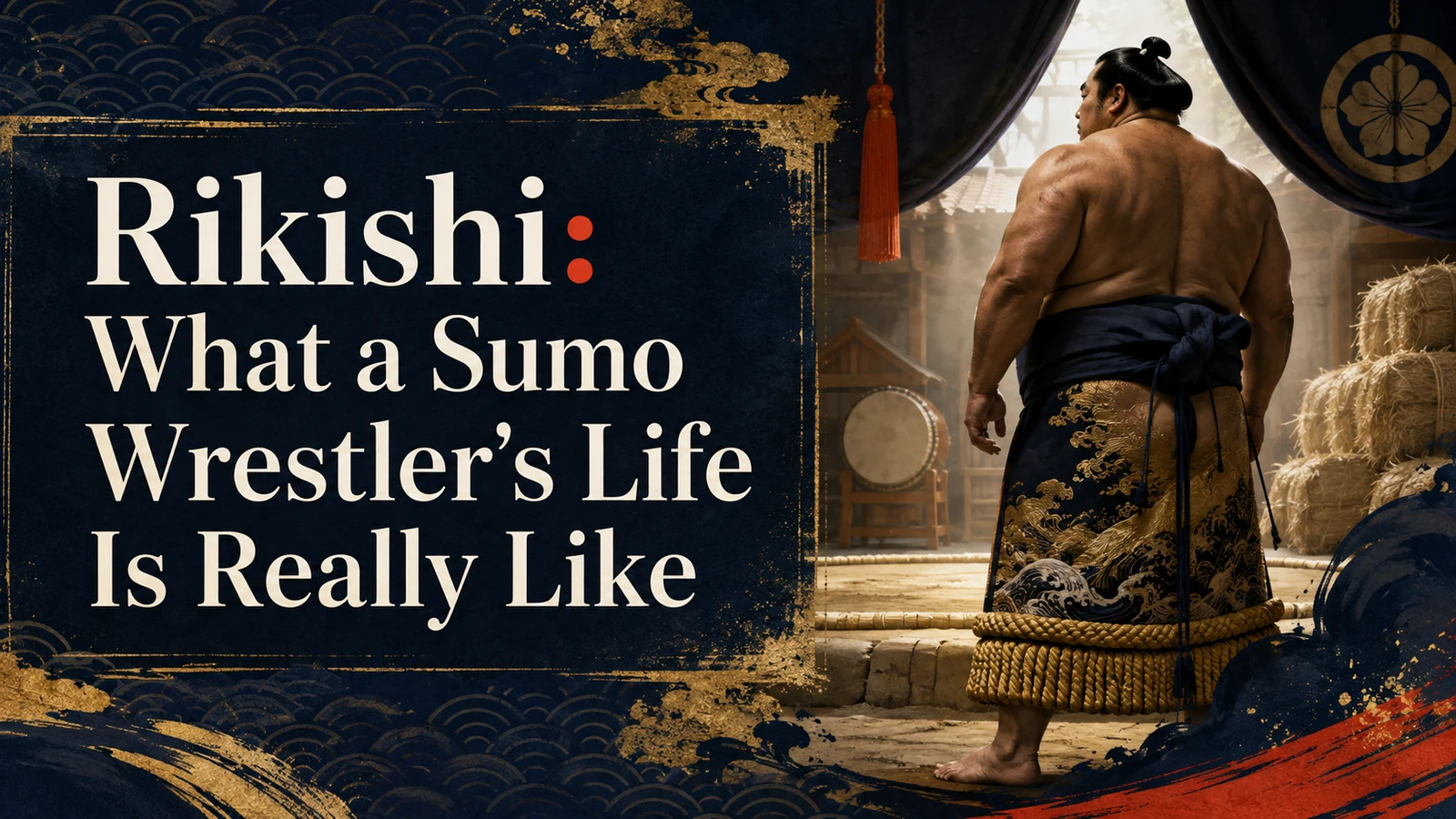
A rikishi is a professional sumo wrestler, and there are fewer of them than most people assume. The July 2026 ranking sheet lists 590 men across six divisions, from the top-division wrestlers you see on television down to teenagers who fought their first bouts a few weeks earlier. Seventy of them draw a salary. The rest do not. That gap runs through everything — what a rikishi eats, where he sleeps, whose bags he carries, and how long he lasts. This guide explains what a rikishi is, how you become one, what the days look like, who gets paid, and how a career ends.
📖 What you’ll learn
- How many rikishi there are right now, division by division
- The exact height, weight and age limits for entering professional sumo
- What a day inside a sumo stable is built around
- Which ranks are paid, which are not, and what happens after retirement
What Is a Rikishi?
A rikishi is a professional sumo wrestler registered with the Japan Sumo Association. Every rikishi appears on the banzuke, the single ranking sheet that covers the entire sport, and his rank there decides his pay, his duties, and even his hairstyle. As of the July 2026 tournament, there were 590 of them.
You will meet other words for the same person. Sumotori means much the same thing and is used freely in conversation. O-sumo-san is the warm, everyday term a Japanese speaker might use in the street. Rikishi — written with the characters for “strength” and “gentleman” — is the formal term the Association itself uses, and it is the one that appears on official documents.
The name you see on the ranking sheet is usually not his own. A rikishi competes under a shikona, a ring name, and the referee calls that name rather than his family name before every bout. Many shikona are handed down inside a stable, so the same name can pass from one generation of wrestlers to the next, and a rikishi may change his partway through a career.
It also matters that sumo did not begin as a sport. Its first matches were ritual offerings performed at shrines, and the Association traces the practice back some 1,500 years. That origin is not decoration: it is the reason the profession still runs on formalities, seniority and communal living rather than on contracts and training camps, and it explains a good deal of what follows on this page.
What makes rikishi unusual among professional athletes is that rank is not a label attached to a career. It is the career. A wrestler in the top two divisions fights on all 15 days of a tournament; everyone below him fights on seven. The top two divisions wear the oichomage, a topknot fanned out in the shape of a ginkgo leaf; everyone below wears the plainer chonmage. Only the top divisions may throw salt before a bout. Cross the line into the second division and all of it changes at once, in the same week.
How Many Rikishi Are There? The Banzuke in Numbers
The banzuke is redrawn after every tournament, and it is the cleanest picture of the profession there is. Here is what the July 2026 sheet actually contained.
| Division | Rikishi | Bouts per tournament | Paid a salary? |
|---|---|---|---|
| Makuuchi (top) | 42 | 15 | Yes |
| Juryo | 28 | 15 | Yes |
| Makushita | 120 | 7 | No |
| Sandanme | 162 | 7 | No |
| Jonidan | 198 | 7 | No |
| Jonokuchi (entry) | 40 | 7 | No |
| Total | 590 | — | 70 salaried |
The 70 wrestlers in the top two divisions are called sekitori. They are 11.9 percent of the profession. Everyone else is officially a trainee, and the Association’s own term for them translates as “wrestler in training” no matter how many years they have been at it.
Read the table from the bottom and something else appears. Jonokuchi, the entry division, holds 40 men — a fifth of the division directly above it. A healthy pyramid would be widest at the base. This one narrows at the door. According to Nikkei, the March 2026 entrance examination drew 20 candidates, the fewest since 1973, when completing compulsory education became a requirement; the same paper reported the total number of rikishi falling below 600. The Association’s own English introductory booklet still puts the figure at “about 700,” which was true when it was written and is not true now.
The 590 are spread across 45 stables, and the stables are not the same size. Isegahama had 31 rikishi on that banzuke. Nishikido had one. Every one of the 45, with its master and its headcount, is listed in our guide to sumo stables.
Q. How many sumo wrestlers are there in total?
A. There were 590 rikishi on the July 2026 banzuke, spread over six divisions and 45 stables. Only 70 of them — the 42 in the top division and the 28 in the second — hold salaried rank. The figure moves after every tournament as men enter and retire, and it has been falling: Nikkei reported the total dropping below 600.
How to Become a Rikishi: the Entrance Examination
You do not apply to the Japan Sumo Association. You apply through a stable. A boy who wants to turn professional has to find a stablemaster willing to take him, and the stablemaster submits the paperwork on his behalf. Everything else follows from that relationship.
The Association publishes the standards, and they are specific. A candidate must have completed compulsory education and be in good health. He must be at least 167 cm (5 ft 6 in) tall and weigh at least 67 kg (148 lb). He must normally be under 23. That rises to under 25 for anyone who has placed in an amateur competition the Association designates, who has competed at national level in any sport from high school upward, or who has passed the Association’s athletic-ability test for new recruits. For the March tournament only, candidates who are about to graduate from junior high school are held to a lower bar: 165 cm (5 ft 5 in) and 65 kg (143 lb).
There is a way around the physical standard, and it is written into the rules rather than granted as a favour. A candidate who falls short on height or weight may sit the athletic-ability test instead, and if his movement is judged sufficient, he is allowed to take the entrance examination anyway.
The scale of the intake is easy to picture, because the Association publishes the names. Five men passed the examination held for the July 2026 tournament, joining the Kokonoe, Kise, Nishonoseki, Sakaigawa and Isegahama stables. One of them entered at the foot of the third division rather than at the very bottom of the sheet, a placement reserved for candidates with a strong amateur record.
Q. How do you become a sumo wrestler?
A. A stable has to accept you first; the stablemaster then files your papers with the Japan Sumo Association. You must have finished compulsory education, pass a medical, and meet the size and age standards — 167 cm, 67 kg and under 23, with the age limit raised to 25 for candidates with a competitive record. Undersized candidates can qualify through an athletic-ability test.
Life in a Stable: Training, Chanko and Chores
A heya, or stable, is not a gym that wrestlers commute to. It is where the unsalaried rikishi live. They sleep in a shared room, train in the practice ring downstairs, and take on the running of the house between sessions.
The day is built around one sequence, and that sequence explains the bodies better than any diet story. Practice comes first, in the morning, before anyone has eaten. It runs for hours. The main meal follows, and it is large. Rest follows the meal. Eating heavily and then resting is what converts hard training into mass, and it is deliberate rather than incidental. Stables vary in their exact hours, so treat any single timetable you read as one stable’s version rather than the rule.
That meal is chanko. In everyday English the word has come to mean the hot pot, chanko-nabe — a broth loaded with chicken, fish, tofu and vegetables — but inside sumo, chanko simply means the stable’s food, whatever is on the table. The junior rikishi cook it. They also serve it, and they eat after the sekitori have finished.
Rank sorts the household in the same way it sorts the banzuke. Unsalaried wrestlers do the cleaning and the errands, and are assigned as tsukebito, personal attendants to the sekitori: carrying bags, preparing the belt, handling the daily logistics of a ranked wrestler’s tournament. A sekitori, in turn, gets a room of his own, is permitted to live outside the stable once married, and has attendants of his own. Promotion into the second division is not a pay rise. It is a change of life inside the same building.
The line between the 70 and the other 520 is drawn in almost everything a rikishi does, including what he is allowed to wear in the street.
| Sekitori (top two divisions) | Everyone below | |
|---|---|---|
| Income | Monthly salary | Allowance per tournament only |
| Bouts per tournament | 15 | 7 |
| Topknot | Oichomage, fanned like a ginkgo leaf | Chonmage, plain, tied with paper cord |
| Everyday dress | Silk kimono; overcoat permitted | Cotton yukata in all seasons; the third and fourth divisions may add a short haori |
| Footwear | Zori, with an attendant to carry them | Wooden geta, in winter as well |
| Living | Own room; may live outside the stable once married | Shared room inside the stable |
| Attendants | Has tsukebito assigned to him | Serves as a tsukebito |
| Salt before a bout | Yes | No, apart from some third-division bouts |
The clothing rules are the part visitors notice first, because they are visible outside the arena. A junior rikishi walks to the venue in a cotton yukata and wooden geta in February, with no coat and no scarf. A sekitori arrives in silk, and someone else is carrying his sandals.
Q. What do sumo wrestlers eat?
A. Chanko — a word that means the stable’s cooking in general, not one dish. The best-known form is chanko-nabe, a large hot pot of meat or fish, tofu and vegetables, cooked by the junior wrestlers and eaten communally. What matters as much as the food is the order of the day: training on an empty stomach, then a heavy meal, then rest.
Who Gets Paid, and Who Does Not
Only sekitori receive a monthly salary. Below the second division there is no wage at all — only an allowance paid for each of the six tournaments, plus small win bonuses. The Association does not publish a public pay table, but the following monthly figures are widely and consistently reported.
| Rank | Reported pay | Basis |
|---|---|---|
| Yokozuna | ¥3,000,000 (approx. US$20,000) | Per month |
| Ozeki | ¥2,500,000 (approx. US$17,000) | Per month |
| Sekiwake and komusubi | ¥1,800,000 (approx. US$12,000) | Per month |
| Maegashira (rest of top division) | ¥1,400,000 (approx. US$9,300) | Per month |
| Juryo | ¥1,100,000 (approx. US$7,300) | Per month |
| Makushita | ¥165,000 (approx. US$1,100) | Per tournament, six a year |
| Sandanme | ¥110,000 (approx. US$730) | Per tournament, six a year |
| Jonidan | ¥88,000 (approx. US$590) | Per tournament, six a year |
| Jonokuchi | ¥77,000 (approx. US$510) | Per tournament, six a year |
Set against that, a trainee’s costs are also low: the stable houses him, feeds him and clothes him. The point of the table is not the absolute numbers but the step between the fifth row and the sixth. One promotion converts a per-tournament allowance into a monthly wage, and 520 of the 590 men on that banzuke were on the wrong side of it.
Q. How much do sumo wrestlers get paid?
A. Only the top two divisions earn a salary, widely reported at about ¥1,100,000 a month in the second division rising to ¥3,000,000 for a yokozuna. Everyone below receives a per-tournament allowance instead — around ¥77,000 to ¥165,000, six times a year — with board and lodging provided by the stable. The Association does not publish an official pay table.
Size, Weight and the Absence of Weight Classes
Professional sumo has no weight classes. A rikishi can be drawn against an opponent twice his mass on any given day, and the sport is organised on the assumption that this is normal rather than unfair. That single rule is why the Association recognises 82 distinct winning techniques: with no bracket to protect a lighter man, angle, timing and grip have to do the work that size will not.
It also explains why the entrance standard is a floor rather than a target. The minimum is 167 cm and 67 kg — the build of an ordinary athletic teenager. Mass is acquired afterwards, through the training-then-eating-then-resting cycle of stable life, and it is acquired at a cost that former wrestlers discuss openly: joint damage, and the health problems that follow years of carrying that weight.
The only competition clothing is the mawashi, the silk belt worn for bouts. It is folded lengthwise into a narrow band and wound around the body four to seven times depending on the wrestler’s girth. There is no standard length: each belt is woven to order, and recorded examples run from about 5.4 m to about 14 m. It is not underwear and it is not a costume. It is the equipment — most of the 82 techniques begin with a grip on it.
Q. Are there weight classes in sumo?
A. No. Professional sumo has no weight limits and no size divisions, so a lighter rikishi may face an opponent twice his weight. The entrance examination sets only a minimum — 167 cm and 67 kg — and nothing above it. This is a large part of why the Association counts 82 separate winning techniques rather than a handful.
Rikishi From Outside Japan
Twenty-eight of the 590 rikishi on the July 2026 banzuke were born outside Japan — 4.7 percent of the sport. Twenty-one were from Mongolia. The rest came from Ukraine (two), and one each from Russia, Kazakhstan, China, the United States and the Philippines.
The number stays small by design. Under a long-standing Association rule, a stable may have only one foreign-born rikishi at a time, and being born abroad counts for that purpose even after a wrestler takes Japanese citizenship. With 45 stables, the ceiling is structural. The influence of that small group is out of proportion to its size: Mongolian wrestlers have held the top rank for much of the past two decades.
One point of confusion is worth clearing up for English-speaking readers. Rikishi is also the ring name of an American professional wrestler who competed in WWE, which is a different sport in a different country. Nothing on this page refers to him.
Q. Can foreigners become sumo wrestlers?
A. Yes, and 28 of the 590 rikishi on the July 2026 banzuke were born abroad. Entry is limited by rule rather than by nationality: a stable may carry only one foreign-born wrestler at a time, and that status does not change if he naturalises later. The other requirements — age, height, weight, and a stable willing to take you — are the same for everyone.
How a Rikishi’s Career Ends
The July 2026 tournament is a useful measure of the turnover, because both sides of it were published. Five men passed the entrance examination for that tournament. Five rikishi announced their retirement during and just after it: one ranked in the fourth division, one in the fifth, two off the sheet entirely, and one former top-division wrestler who had fallen to the middle of the third.
That is the shape of most careers. A rikishi who never reaches salaried rank leaves in his twenties with no pension from the sport, and usually without the ceremony that marks the end of a ranked career. Sekitori get the danpatsu-shiki, a public event at which invited guests each take one snip of the topknot before the stablemaster cuts the last of it.
Staying inside the Association after retirement is harder still. It requires one of the 105 elder stocks — named licences, strictly limited in number, which alone carry the right to draw an Association salary, coach, and run a stable. Elders retire at 65. Almost everyone else leaves the sport, and the familiar second act of opening a chanko restaurant belongs to a visible minority of a much larger group who go and do something unrelated.
Q. What happens when a sumo wrestler retires?
A. Ranked wrestlers hold a danpatsu-shiki, at which invited guests cut the topknot one snip at a time. To stay on as a coach, a retiring rikishi needs one of the 105 elder stocks, which are limited in number and held until the age of 65. Most rikishi never reach salaried rank, and leave for ordinary work in their twenties.
Summary
- A rikishi is a professional wrestler registered with the Japan Sumo Association; 590 were listed on the July 2026 banzuke
- Only the top two divisions, 70 men, are salaried; everyone below receives a per-tournament allowance
- Entry requires a stable to accept you, plus 167 cm, 67 kg and an age under 23 — or under 25 with a competitive record
- The stable is a home before it is a gym, and rank decides who cooks, who serves and who is served
- Twenty-eight rikishi were born outside Japan, capped at one per stable
- Five men entered and five retired around the same tournament
A tournament shows you the 42 men at the top of the sheet, for a few seconds each. The other 548 are in the same building, fighting on seven days instead of fifteen, cooking the lunch, and carrying somebody else’s bag to the arena. A few of them will be on television in three years. Most will not, and will leave with a story rather than a pension. The ranking sheet is not a summary of the sport. It is the whole of it, and every name on it is somebody’s entire twenties.
If you are new to the sport, start with What Is Sumo? for the rules, the ring and the tournament calendar.