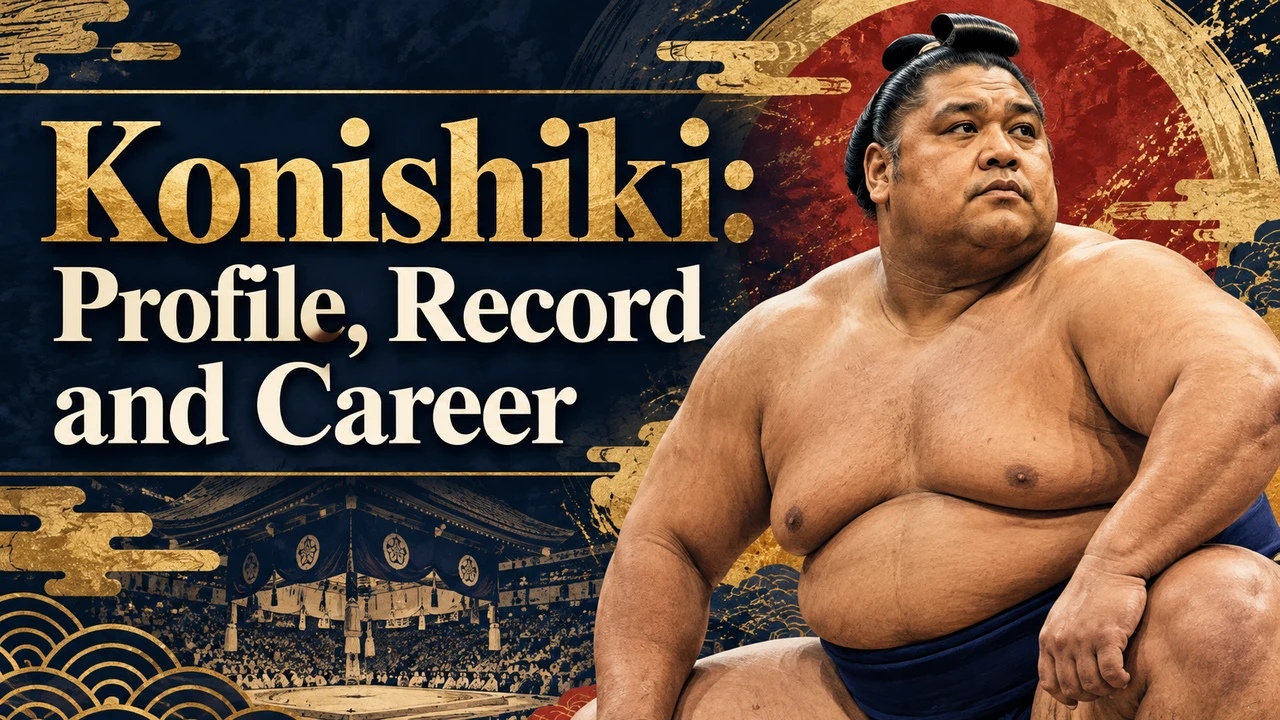
Konishiki was the first foreign wrestler to reach ozeki, sumo’s second-highest rank, in July 1987. He won three top-division championships but was never promoted to yokozuna, the highest rank. He retired in November 1997 and became a TV personality and singer in Japan. This guide follows the Japan Sumo Association’s records and contemporary news reports on his career.
📖 What you’ll learn
- What the Japan Sumo Association’s records say about his names, size and stable
- How a teenager from Oahu reached ozeki five years after his debut
- His three championships and the 1992 debate over promoting him to yokozuna
- Why he retired in 1997, and what he has done since
Who Is Konishiki?
Konishiki is a retired sumo wrestler from Hawaii who reached ozeki in 1987 and won three top-division championships for Takasago stable.
The Association lists him as retired, with ozeki as his highest rank. Its records give his birthplace as Oahu, Hawaii, and his first tournament as July 1982. His last tournament was November 1997, a career of 15 years.
For fans who search for sumo Konishiki, the first fact is his size: the Association registers him at 275 kg. That is only part of the record. He was also a pioneer, and the 1992 debate over his promotion was covered by AP, UPI and newspapers in Japan.
He was not the first foreign-born wrestler to succeed. That was Takamiyama, another Hawaiian, who won a top-division title in 1972. Konishiki went further in rank. Two more Hawaiians, Akebono and Musashimaru, later went further still. Where the Association and news reports disagree on a detail, this page says so and follows the Association.
For daily life as a rikishi, the formal word for a professional sumo wrestler, see our guide to what a rikishi actually is.
Q. Who was the first yokozuna from Hawaii?
A. Akebono. The Japan Sumo Association records him as the 64th yokozuna, born on Oahu, with the rank from March 1993 to January 2001. Musashimaru, also from Oahu, followed as the 67th in July 1999. Konishiki, the earlier Hawaiian, stopped one rank below them at ozeki.
Konishiki’s Profile: Names, Size and Stable
The Japan Sumo Association registers his Japanese name as Yasokichi Shiota, his stable as Takasago, and his size as 184 cm and 275 kg.
He was born Salevaa Atisanoe, the name that AP and Hawaii News Now use. Hawaii News Now calls him a native of Nanakuli, on Oahu’s west coast. He took Japanese citizenship in 1994, according to a Deseret News report on his retirement. The Japanese name on his Association record dates from that change.
Konishiki Yasokichi is the full ring name the Association uses. The same ring name belonged to the 17th yokozuna, a Takasago wrestler of the 1890s. The table below reproduces the fields on the Association’s English and Japanese profile pages, as recorded on October 11, 2026.
| Item | Official record |
|---|---|
| Ring name | Konishiki Yasokichi |
| Japanese name | Yasokichi Shiota |
| Born | December 30, 1963 |
| Birthplace | Oahu, Hawaii, United States |
| Height | 184.0 cm (6 ft 0 in) |
| Weight | 275.0 kg (606 lb) |
| Stable | Takasago |
| Highest rank | Ozeki (July 1987 to November 1993) |
| Signature maneuvers | tsuki, oshi |
| First tournament | July 1982 |
| Retired | November 1997 |
Two rows need a note. The first is the birthday. Several English sources give December 31, 1963, but the Association records December 30, and this page follows the Association.
The second is the weight. The figure of 275 kg is the one the Association publishes, not a reading from any one tournament. Hawaii News Now reported in 2009 that he weighed more than 620 pounds (about 281 kg) at his peak.
The Association’s profile for him has no career win-loss total, so this page does not quote one. His stable was Takasago. The sumo stable system explains how a stable recruits, houses and trains its wrestlers.
Q. Was Konishiki the heaviest sumo wrestler ever?
A. Deseret News called him the sport’s heaviest wrestler when he retired in 1997. The Japan Sumo Association does not publish an all-time weight ranking, so this page does not rank him across eras. Its profile lists his registered weight as 275.0 kg (606 lb).
From Oahu to Ozeki: The Takasago Stable Years
Konishiki was recruited at 18, Tokyo Journal reports, and first appeared on the ozeki line in July 1987, five years after his debut.
The route ran through another Hawaiian. Tokyo Journal reports that Takamiyama, born Jesse Kuhaulua, recruited him at the age of 18. Takamiyama was a Takasago wrestler himself, and in 1972 he had become the first foreign-born winner of a top-division title.
The Association’s record marks the start: his first tournament was in July 1982. The climb from there was fast. In the Association’s ranking order, ozeki sits just below yokozuna. Our guide to how the sumo rankings work shows where ozeki sits on the banzuke, the official ranking sheet.
He reached that rank in July 1987, at the age of 23. Deseret News and AP both describe him as the first foreign wrestler to reach ozeki. The Association’s own list of past ozeki agrees on the order. Of the three non-Japanese entries on it, Konishiki’s term is the earliest, ahead of Kotooshu in 2006 and Baruto in 2010.
The timeline below marks the events in his career that the Association and news reports date.
The rise also drew criticism. The Christian Science Monitor wrote in 1989 that he was faulted early on for relying on his bulk. The same report said he had since gained in skill and popularity.
The ring name itself carried weight. The Association’s page for the 17th yokozuna lists him as a Takasago wrestler from Chiba Prefecture. He first appeared as ozeki in May 1890 and held yokozuna from May 1896 to January 1901. His top-division record reads 119 wins and 24 losses over 26 tournaments. The Hawaiian Konishiki took the same name in the same stable almost a century later.
Q. Where does the name Konishiki come from?
A. It comes from the 17th yokozuna, Konishiki Yasokichi, who also wrestled for Takasago stable. The Association records that the earlier Konishiki held the top rank from 1896 to 1901. Tokyo Journal confirms that the Hawaiian wrestler was named after him.
Three Championships and Six Years at Ozeki
Konishiki won three top-division titles, which AP dates to November 1989, November 1991 and March 1992, and held ozeki from 1987 to 1993.
The Association’s list of past ozeki credits him with three titles. AP and UPI give the three dates. The first came at the Kyushu tournament in Fukuoka in November 1989. The Christian Science Monitor reported that he was 25 at the time. It called him only the second non-Japanese wrestler to win a tournament, after Takamiyama in 1972.
The second and third titles came close together. UPI reported that the March 1992 win came with a record of 13 wins and 2 losses. Over his last three tournaments he had 39 wins and 6 losses, according to the same report.
The table below sets out what each source records. It lists only results that the Association or a wire report states directly.
| Date | Event | Source |
|---|---|---|
| July 1987 | First tournament as ozeki | Japan Sumo Association |
| November 1989 | 1st championship (Fukuoka, age 25) | Christian Science Monitor; AP |
| November 1991 | 2nd championship | AP |
| March 1992 | 3rd championship, 13-2 | UPI; AP |
| November 1991 to March 1992 | 39-6 over three tournaments | UPI |
| November 1993 | Last tournament as ozeki | Japan Sumo Association |
The run did not include two titles in a row. AP noted in 1992 that Japanese wrestlers had been promoted to yokozuna after two straight championships. Konishiki had three titles, but none back to back.
He held ozeki for more than six years, from July 1987 to November 1993. After that the Association’s list shows no further ozeki tournaments, and he never returned to the rank. Each of the Association’s six annual tournaments runs for 15 days. Our guide to how a sumo tournament works explains how a championship is decided.
Q. Who was the first foreign wrestler to win a top-division title?
A. Takamiyama, born Jesse Kuhaulua in Hawaii, won in 1972, according to the Christian Science Monitor. He wrestled for Takasago stable and later recruited Konishiki, Tokyo Journal reports. Konishiki became the second foreign winner in November 1989.
The 1992 Yokozuna Debate
After his third title in March 1992, Konishiki was not promoted to yokozuna, and the decision became a public argument in Japan and abroad.
A yokozuna is chosen, not simply earned by points. Our guide to the rank of yokozuna explains the process and the expectations that come with it. In 1992, AP reported that members of the committee that advises on yokozuna promotions split in public. One member, Hideo Ueda, wrote that foreigners were not barred from the top rank. Another, Noboru Kojima, argued for more weight on the dignity of candidates.
In April 1992, the New York Times and the Nihon Keizai Shimbun quoted Konishiki as saying he was held back because he was not Japanese. UPI reported the response the same month. His stablemaster said Konishiki had given no telephone interview to the New York Times and had not said what the article reported.
The Association’s position was also on record. According to UPI, an official said promotion would be decided by performance in the ring and that race was not a consideration. The same report quoted Hanaregoma, the Association’s media relations official. He said that such a statement, if Konishiki had made it, would only count against him.
The dispute did not end there. In 1998, AP wrote that Konishiki still denied ever making the racism allegations. He did not win a fourth championship. Akebono, a younger wrestler from Oahu, was promoted to yokozuna in March 1993.
Q. Was there a rule against a foreign yokozuna?
A. No rule was cited in the 1992 reports. AP quoted council member Hideo Ueda writing that foreigners were not barred, and UPI quoted the Association saying race played no part. The Association’s records then show Akebono promoted in March 1993 and Musashimaru in July 1999.
How Konishiki Fought: Thrusting, Pushing and Sheer Mass
The Japan Sumo Association lists his signature maneuvers as tsuki and oshi, the thrusting and pushing attacks of forward sumo.
Tsuki means striking an opponent’s chest or neck with the open hand. Oshi means pushing with both hands without taking a grip on the belt. A wrestler who fights this way tries to move the opponent back and out of the ring as quickly as possible. Our guide to the rules of sumo explains how a bout is won by forcing the other wrestler out.
Professional sumo has no weight classes, so a heavier wrestler meets lighter ones every day. The Association’s figures show how far Konishiki stood from the two Hawaiians who followed him. Both also list tsuki and oshi as their signature maneuvers. None of the three is listed with a belt technique, which is the main contrast with grappling wrestlers such as Hakuho.
Konishiki was the shortest of the three and the heaviest by 40 kg. Akebono stood 19 cm taller at 203 cm. Musashimaru, at 192 cm and 235 kg, sat between them.
That build had a cost. Deseret News reported that he retired after chronic problems with his knees and lower legs. Years later he told Hawaii News Now that painkillers taken during his career had damaged his kidneys.
Retirement, Akebono, Musashimaru and the Hawaiian Line
Konishiki retired in November 1997 with chronic leg injuries, by which time Akebono had become yokozuna and Musashimaru had reached ozeki.
The Association records November 1997 as his final tournament. Deseret News reported that he ended his 15-year career on a Saturday during that tournament. It said he had been hobbled by chronic problems with his knees and lower legs, and that his retirement was not unexpected.
By then he had spent four years below ozeki. The Association’s list of past ozeki ends his term in November 1993. He kept competing until 1997, while the two younger Hawaiians reached the top rank.
The dates overlap closely. The Association records that Akebono debuted in March 1988 and first appeared as ozeki in July 1992. Musashimaru debuted in September 1989 and first appeared as ozeki in March 1994. That came two tournaments after Konishiki’s own ozeki term ended. For a few years, Hawaiians held places at or near the top of the ranking sheet.
The table below compares the three wrestlers from Oahu, using the Association’s records for each. It shows the line that Takamiyama started and Konishiki extended.
| Wrestler | Highest rank | Top-division titles | Retired |
|---|---|---|---|
| Konishiki (Takasago) | Ozeki, July 1987 to November 1993 | 3 | November 1997 |
| Akebono (Azumazeki) | 64th yokozuna, March 1993 to January 2001 | 11 | January 2001 |
| Musashimaru (Musashigawa) | 67th yokozuna, July 1999 to November 2003 | 12 | November 2003 |
Konishiki won fewer titles than either, but he came first. When he reached ozeki in 1987, AP and Deseret News record no foreign wrestler before him at that rank. Akebono became yokozuna less than six years later.
Wrestlers from Mongolia later held the top rank as well. For the longest reign at the top, compare Hakuho, who held yokozuna from 2007 to 2021.
Q. Why did Konishiki retire?
A. Deseret News reported that chronic problems with his knees and lower legs ended his career in November 1997. He withdrew during the Kyushu tournament that month. He was 33 and had wrestled for 15 years.
Life After Sumo: TV, Music and Health
After retiring, Konishiki held the elder name Sanoyama, then worked in Japanese TV and music, and later had major weight-loss and kidney surgery.
Tokyo Journal lists Sanoyama as his name as a stablemaster. Within a year of retiring he was working in Japanese TV. AP reported in 1998 that he appeared in whisky commercials and co-hosted a prime-time talk show.
The same AP report noted a project outside entertainment. He had founded the Konishiki Kids Foundation, which brought sixth graders from Hawaii to Japan. Tokyo Journal describes it as a program for children on Oahu’s Waianae Coast, the area that includes Nanakuli.
Music followed. Tokyo Journal reports that he released his first CD in March 2000. Hawaii News Now wrote in 2009 that he had recently released his 10th album.
His health has been part of the story. Hawaii News Now reported in 2009 that he had gastric bypass surgery the previous year and had lost more than 300 pounds (about 136 kg).
In January 2025, Hawaii News Now reported a kidney transplant. In June 2024, while on tour in Chicago, he was retaining water because of kidney problems. His wife, Chie, was the donor. He said the cause was the painkillers he took during his career. The same report noted that Musashimaru, another Hawaiian from the same era, had undergone the same procedure.
The same report describes him as a coach and ambassador for the sport. For the wrestlers active now, see our full directory of sumo wrestlers.
Q. What is Konishiki doing now?
A. He works in Japan as an entertainer and singer, and Hawaii News Now describes him as a sumo coach and ambassador. In January 2025 it reported that he had a kidney transplant, with his wife Chie as the donor. He lives in Tokyo, according to the same report.
Summary
Konishiki was the first foreign-born ozeki, a three-time champion, and the wrestler whose case opened the debate on a foreign yokozuna.
The Association’s records give the frame. He was born on Oahu in December 1963, joined Takasago stable in 1982 and reached ozeki in July 1987. He held the rank until November 1993 and retired in November 1997. It registers him at 184 cm and 275 kg.
The news reports fill in the rest. He won titles in 1989, 1991 and 1992, but never two in a row. The 1992 promotion debate drew reported remarks that he denied, and an Association statement that race played no part.
After sumo he became a TV personality and singer. He lost more than 300 pounds after a 2008 surgery, and in January 2025 Hawaii News Now reported a kidney transplant from his wife.
For other wrestlers covered the same way, see our full directory of sumo wrestlers. To see the rank he never reached, read our guide to the rank of yokozuna.